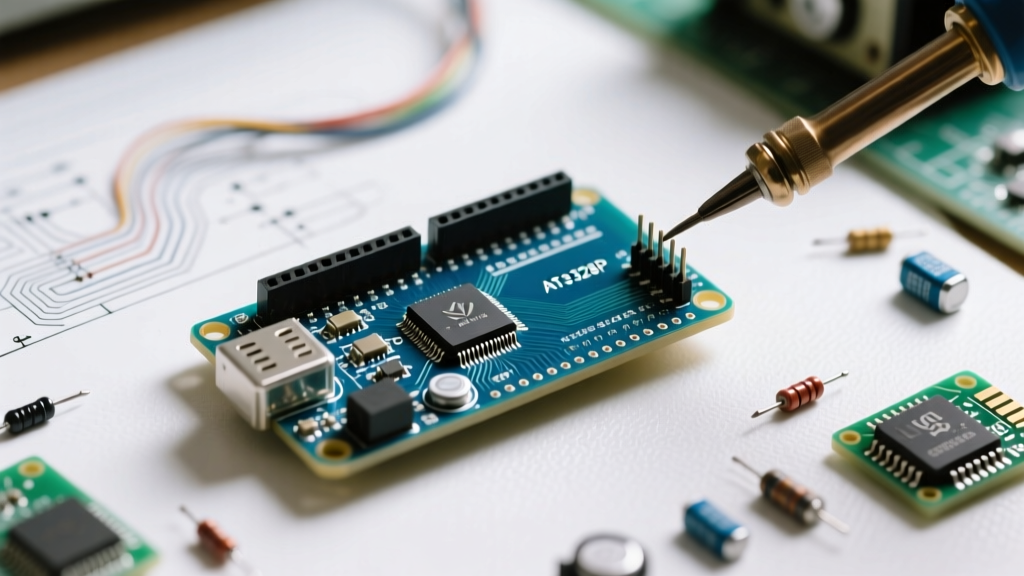

The Silicon Heart: Understanding the Microcontroller on Arduino Uno
When makers and engineers discuss the legendary Arduino Uno Rev3, the conversation often revolves around its ease of use, expansive shield compatibility, and massive community support. However, the true workhorse enabling this ecosystem is the specific microcontroller on Arduino Uno boards: the Microchip (formerly Atmel) ATmega328P. Despite the proliferation of 32-bit ARM Cortex and RISC-V alternatives in 2026, the 8-bit AVR architecture remains a cornerstone of embedded prototyping due to its predictable timing, robust electrical tolerances, and deeply entrenched toolchain.
To truly master the Uno platform, one must look past the abstraction of the Arduino IDE and understand the silicon, the bootloader ecosystem, and the broader AVR landscape that keeps this board relevant for industrial and hobbyist applications alike.
Silicon Specifications and Architecture
The ATmega328P is an 8-bit microcontroller based on the AVR enhanced RISC architecture. It executes most instructions in a single clock cycle, allowing for highly deterministic timing—crucial for bit-banging protocols or generating precise PWM signals without hardware timers.
| Feature | Specification | Practical Implication |
|---|---|---|
| Flash Memory | 32 KB (ISP) | ~31.5 KB usable (Optiboot takes 512 bytes) |
| SRAM | 2 KB | Requires careful memory management; avoid String objects |
| EEPROM | 1 KB | Ideal for storing calibration data or device states |
| Clock Speed | 16 MHz (External Crystal) | Yields 62.5 ns per instruction cycle |
| Operating Voltage | 1.8V - 5.5V | Uno board regulates to 5V; chip is 5V tolerant |
| I/O Pins | 23 (6 PWM, 6 ADC) | ADC is 10-bit (0-1023 resolution) |
According to the official Microchip ATmega328P product page, the chip features a picoPower design, allowing it to draw mere microamps in power-down mode, making it highly viable for battery-operated sensor nodes when bypassing the Uno's onboard voltage regulator.
The Bootloader Layer: Optiboot and UART Communication
The microcontroller on Arduino Uno does not natively understand USB. It relies on a secondary chip (the ATmega16U2 on genuine boards, or a CH340/CP2102 on clones) to translate USB signals into UART serial. But how does the code get from the serial buffer into the Flash memory?
The Optiboot Bootloader
Early Arduino boards used a bulky 2KB bootloader. The Uno ecosystem standardized on Optiboot, a highly optimized bootloader that consumes only 512 bytes of Flash. When the board resets, the hardware watchdog or reset pin triggers the microcontroller to jump to the bootloader's memory address (0x7E00). Optiboot listens to the UART RX pin for a specific STK500v1 handshake sequence from avrdude. If it detects the handshake within a ~500ms window, it enters programming mode; otherwise, it jumps to the user application at address 0x0000.
Expert Insight: If you are building a custom PCB using the ATmega328P and want Arduino IDE compatibility, you must burn the Optiboot bootloader via an ISP programmer. Without it, the microcontroller will not auto-reset or accept serial uploads.
Deep Dive: AVR Fuses and Clock Sources
One of the most critical, yet misunderstood, aspects of the AVR ecosystem is the fuse byte configuration. Fuses are non-volatile memory bits that dictate the microcontroller's fundamental hardware behavior. The standard Arduino Uno Rev3 fuse settings are:
- Low Fuse (0xFF): Configures the chip to use an external full-swing crystal oscillator (the 16MHz resonator on the Uno board) with a start-up time of 16K clock cycles plus 65ms.
- High Fuse (0xDE): Enables the SPI programming interface, sets the bootloader size to 512 words (1024 bytes), and configures the reset vector to point to the bootloader.
- Extended Fuse (0xFD): Sets the Brown-out Detection (BOD) threshold to 2.7V, preventing the chip from executing garbage instructions if the voltage sags.
Changing the Low Fuse to 0xE2, for instance, tells the microcontroller on Arduino Uno to ignore the external 16MHz crystal and use its internal 8MHz RC oscillator. This is a common technique for low-power breadboard projects to eliminate the quiescent current draw of the external crystal.
Ecosystem Variants: Genuine vs. Clone Silicon
While Microchip continues to manufacture the genuine ATmega328P, the open-source nature of the Arduino hardware design has spawned a massive clone ecosystem. In 2026, the most prominent silicon alternative found in 'Uno-compatible' boards is the LGT8F328P by Logic Green.
| Feature | Genuine ATmega328P | Clone LGT8F328P |
|---|---|---|
| Core Architecture | 8-bit AVR | 8-bit AVR with 32-bit ALU extensions |
| Max Clock Speed | 20 MHz | 32 MHz (Internal) |
| ADC Resolution | 10-bit | 12-bit |
| DAC (Digital to Analog) | None | 1 Channel (Hardware DAC) |
| Typical 2026 Board Price | $22.00 - $28.00 | $3.50 - $6.00 |
The LGT8F328P is largely instruction-set compatible with the ATmega328P, meaning standard Arduino sketches compile and run with minimal modifications. However, developers utilizing direct port manipulation or precise assembly-level timing must account for the LGT's altered peripheral registers and 32MHz clock domain.
Programming Beyond the Arduino IDE
The true strength of the microcontroller on Arduino Uno lies in its broader programming ecosystem. While the Arduino IDE abstracts hardware registers into simple functions like digitalWrite(), professional embedded engineers leverage the underlying toolchain for maximum efficiency.
The AVR-GCC Toolchain
Under the hood, the Arduino IDE uses avr-gcc to compile C/C++ code into machine instructions, and avrdude to flash the resulting HEX file. By using platforms like PlatformIO or bare-metal Makefiles, developers can bypass the Arduino core libraries entirely. Writing directly to the PORTB and DDRB registers reduces a pin-toggle operation from ~50 clock cycles (using digitalWrite) down to just 2 clock cycles, a necessity when generating high-frequency RF signals or driving dense LED matrices.
For comprehensive hardware mapping, engineers rely on the Arduino Uno Rev3 official documentation and the ATmega328P datasheet to map physical pins to their respective hardware interrupts (INT0 on PD2, INT1 on PD3) and timer multiplexers.
Real-World Failure Modes and Troubleshooting
Working with the AVR ecosystem requires an understanding of its specific failure modes. The most notorious error encountered by developers is the avrdude: stk500_getsync() attempt 10 of 10: not in sync timeout.
Diagnosing the 'Not in Sync' Error
- Missing or Corrupted Bootloader: If the chip was sourced raw from a distributor, it lacks Optiboot. Solution: Use a USBasp or another Arduino as an ISP to burn the bootloader via the ICSP header.
- Auto-Reset Circuit Failure: The Uno relies on a 100nF capacitor between the USB-serial DTR line and the ATmega328P reset pin. If this capacitor is damaged, the board won't reset when the serial port opens, causing the bootloader to timeout before the PC sends data. Solution: Manually press the reset button exactly when the IDE reports 'Uploading...'.
- Fused to the Wrong Clock: If a user accidentally flashes a HEX file compiled for an 8MHz internal oscillator onto a board expecting a 16MHz crystal (or vice versa), the UART baud rate will be mismatched by a factor of two. The PC and the microcontroller will be talking at different speeds, resulting in sync failures. Solution: Re-flash the fuses via ISP.
Recovering a 'Bricked' Chip
A chip is considered 'bricked' when the SPIEN (Serial Programming Enable) fuse is accidentally cleared, or the clock source is set to an external crystal that isn't physically present on the board. In these states, the microcontroller on Arduino Uno will refuse standard ISP communication. Recovery requires a High-Voltage Parallel Programmer (HVPP) or a dedicated high-voltage serial fuse fixer, which applies 12V to the RESET pin to force the chip into a factory-default programming state.
Sourcing and the 2026 Market Landscape
As of 2026, the supply chain for 8-bit AVRs has fully stabilized. A genuine Microchip ATmega328P-PU (the through-hole DIP-28 package used on the Uno) typically retails between $2.85 and $3.40 on major distributors like Mouser or DigiKey. For high-volume production or budget educational kits, TQFP-32 surface-mount variants (ATmega328P-AU) drop the cost to around $1.90 per unit.
Furthermore, the open-source bootloader ecosystem, heavily maintained by contributors on platforms like the Optiboot GitHub repository, ensures that even as IDEs evolve, the fundamental method of injecting code into the AVR's flash memory remains universally accessible. Whether you are debugging a bare-metal C application via JTAG or uploading a Python-compiled sketch via a modern CLI, the ATmega328P ecosystem remains one of the most thoroughly documented and resilient platforms in electronics history.