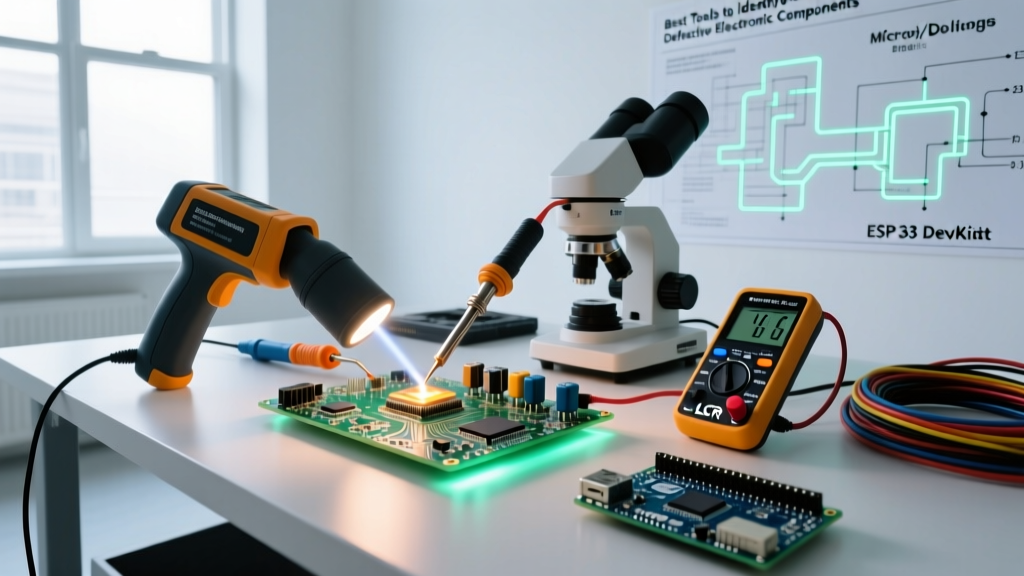

The Hidden Cost of Defective Electronic Components in 2026
Debugging a complex printed circuit board (PCB) only to discover the root cause is a dead-on-arrival (DOA) integrated circuit or a degraded ceramic capacitor is one of the most frustrating experiences in electronics. In 2026, the global secondary components market is heavily saturated with refurbished, relabeled, and out-of-spec parts. According to data from the Electronic Resellers Association International (ERAI), counterfeit and defective part reporting remains a persistent threat to both hobbyists and aerospace manufacturers alike. Identifying these faulty parts requires more than just a standard digital multimeter (DMM); it demands specialized diagnostic equipment capable of measuring parasitic properties, thermal signatures, and semiconductor junction health.
This guide reviews the most effective bench tools for isolating and verifying defective electronic components, providing specific model recommendations, real-world pricing, and technical parameters to look for when building your troubleshooting arsenal.
Precision LCR Meters: Beyond Basic Capacitance
A standard multimeter can tell you if a capacitor is shorted or completely open, but it cannot detect a degraded dielectric or a capacitor suffering from high Equivalent Series Resistance (ESR). When dealing with defective electronic components like Multi-Layer Ceramic Capacitors (MLCCs) or electrolytic capacitors, an LCR (Inductance, Capacitance, Resistance) meter is mandatory.
Top Recommendations: Keysight U1733C & DER EE DE-5000
The Keysight U1733C (approx. $450) is a benchtop powerhouse that offers test frequencies up to 100 kHz. This high-frequency testing is critical because a defective ceramic capacitor might show its nominal capacitance at 120 Hz but exhibit massive dielectric losses (low D-factor) at 100 kHz, rendering it useless for high-speed decoupling applications.
For a more budget-conscious but highly capable alternative, the DER EE DE-5000 (approx. $150) is a handheld LCR meter that punches well above its weight class. It features auto-sorting bins and a 100 kHz test frequency, making it an exceptional tool for binning and verifying bulk component purchases before soldering them to your PCB.
Pro Tip: Always test MLCCs at both 1 kHz and 100 kHz. A component that passes at 1 kHz but fails at 100 kHz is likely suffering from internal micro-cracks or moisture ingress, common failure modes in poorly stored inventory.
Thermal Imaging Cameras: Visualizing Short Circuits
When a PCB draws excessive current, the defective component will dissipate that energy as heat. Thermal imaging allows you to pinpoint shorted ICs, leaky decoupling capacitors, and overloaded traces without probing hundreds of test points.
Top Recommendations: FLIR E54 & Seek Thermal CompactPRO
The FLIR E54 (approx. $1,200) features a 320 x 240 microbolometer resolution and a thermal sensitivity (NETD) of less than 0.04°C. This extreme sensitivity allows you to detect the faint thermal gradient of a slightly leaky tantalum capacitor before it catastrophically fails.
For mobile diagnostics, the Seek Thermal CompactPRO (approx. $400) plugs directly into a smartphone or tablet. While its manual focus ring can be finicky, its 320 x 240 resolution and 12-micron pixel pitch provide enough clarity to isolate a single shorted 0402 capacitor on a densely packed BGA breakout board.
- Best for: Finding low-resistance short circuits, latch-up conditions in CMOS ICs, and thermal runaway in power MOSFETs.
- Limitation: Cannot detect open circuits or components that fail only under high-voltage transients.
Semiconductor Curve Tracers: Analyzing Junction Health
DMM diode-check functions only apply a single test current (usually 1mA to 2mA) and measure the forward voltage drop. This is entirely insufficient for identifying defective electronic components like Zener diodes with soft breakdown knees, or bipolar junction transistors (BJTs) with degraded hFE (gain) and high leakage currents.
Top Recommendation: Peak Atlas DCA75 Pro
The Peak Atlas DCA75 Pro Semiconductor Analyzer (approx. $180) is an indispensable handheld curve tracer. It automatically identifies the pinout of BJTs, MOSFETs, and JFETs, and plots the V/I (Voltage/Current) curve on its built-in display or via PC software. If you are testing a batch of power diodes, the DCA75 will instantly reveal if a diode has a high forward resistance or a premature reverse-breakdown leakage, saving you from soldering a dud into a high-power switching supply.
Milliohm Meters: Detecting Bond Wire and Trace Failures
Standard DMMs typically bottom out at 0.1 ohms of resolution. However, many defective electronic components fail due to degraded internal bond wires or high-resistance solder joints that measure in the milliohm range. A dedicated milliohm meter applies a high test current (often 1A to 10A) using a 4-wire Kelvin measurement to eliminate test lead resistance.
The Chroma 11301 or similar benchtop milliohm meters (approx. $600 - $900) are essential for testing high-current shunt resistors, verifying the integrity of thick copper PCB traces, and screening power inductors for internal winding shorts that a standard LCR meter might miss at low test voltages.
Diagnostic Tool Comparison Matrix
| Tool Category | Recommended Model (2026) | Approx. Price | Primary Failure Mode Detected | Key Specification |
|---|---|---|---|---|
| LCR Meter | Keysight U1733C | $450 | Dielectric degradation, High ESR | 100 kHz Test Freq, 0.05% Basic Accuracy |
| Thermal Camera | Seek Thermal CompactPRO | $400 | Short circuits, Thermal runaway | 320x240 Resolution, 12μm Pixel Pitch |
| Curve Tracer | Peak Atlas DCA75 Pro | $180 | Soft Zener knees, BJT leakage | Auto Pinout ID, V/I Curve Plotting |
| Milliohm Meter | Chroma 11301 | $750 | Bond wire degradation, Shunt drift | 4-Wire Kelvin, 10A Test Current |
Step-by-Step Isolation Workflow for Suspect PCBs
When troubleshooting a board suspected of harboring defective electronic components, follow this systematic isolation workflow to avoid misdiagnosing a good part or damaging the PCB:
- Visual & Optical Inspection: Use a digital microscope (e.g., Andonstar AD409 Pro) to check for physical damage. Look for MLCC flex cracks near mounting holes or signs of rework flux indicating a previously replaced (and potentially counterfeit) part.
- Power Injection & Thermal Profiling: If the board has a shorted power rail, use a bench power supply with strict current limiting (e.g., 5V at 1.0A). Inject power and use your thermal camera to find the hottest component. Note: The hottest component is not always the defective one; it could be a healthy decoupling cap reacting to a shorted IC downstream.
- In-Circuit vs. Out-of-Circuit Testing: In-circuit LCR measurements are often skewed by parallel impedances. If a component measures poorly in-circuit, desolder one leg (or remove it entirely) to verify if the component itself is defective or if the surrounding circuit is influencing the reading.
- Semiconductor Junction Verification: Use the curve tracer on removed ICs and discrete semiconductors to verify internal diode structures and transistor gain against known-good datasheets.
Edge Cases: When Components Pass Bench Tests but Fail In-Circuit
One of the most insidious issues in modern electronics is the "ghost failure," where a component tests perfectly on the bench but fails when soldered to the board. According to guidelines published by the IPC standards committee, mechanical stress during PCB assembly can induce latent defects that do not show up during standard incoming inspection.
For example, MLCC flex cracks often occur when a PCB is bent during depaneling or connector insertion. The crack may not sever the electrical connection entirely, but it compromises the moisture barrier. When the board is exposed to ambient humidity, the internal electrodes corrode, leading to a slow drift in capacitance or an eventual short circuit. Similarly, BGA pad cratering—where the mechanical stress of a heatsink mounting pulls the copper pad away from the fiberglass substrate—can cause intermittent thermal failures that a curve tracer or LCR meter will never detect at room temperature.
For high-reliability applications, engineers must refer to rigorous screening protocols. The NASA Electronic Parts and Packaging (NEPP) Program provides extensive documentation on lot acceptance testing, burn-in procedures, and acoustic microscopy (CSAM) to detect internal delamination in IC packages before they ever reach the soldering iron.
Final Recommendations for Your Workbench
Investing in the right diagnostic tools transforms component troubleshooting from a game of guesswork into a precise science. If you are operating on a strict budget, prioritize the DER EE DE-5000 LCR meter and the Peak Atlas DCA75 Pro; together, they cost less than $350 and will allow you to verify the health of 90% of passive and discrete semiconductor components. As your projects scale into high-density RF or high-power designs, upgrading to a high-resolution thermal camera and a 4-wire milliohm meter will provide the critical data needed to isolate the most stubborn defective electronic components hiding in your designs.


