
Understanding the Electronic Components Tombstone Effect
In high-density surface mount technology (SMT) assembly, few defects are as visually striking and frustrating as the electronic components tombstone effect. Often referred to as 'drawbridging' or the 'Manhattan effect,' tombstoning occurs when a passive surface-mount device (SMD)—typically a 0402, 0201, or 01005 capacitor or resistor—stands upright on one of its terminations during the reflow soldering process. According to the IPC-A-610 Rev H standards, a tombstoned component is a definitive defect for Class 2 and Class 3 assemblies, requiring immediate rework or scrap.
The physics behind this failure mode is rooted in wetting force imbalance. When the solder paste on one pad reaches its liquidus temperature (e.g., 217°C for SAC305 alloy) before the opposite pad, the molten solder's surface tension exerts a unilateral pulling force on the component's termination. If this force exceeds the component's weight and the adhesive strength of the uncured paste on the opposing pad, the component is yanked into a vertical position. As we navigate the ultra-miniaturization trends of 2026, where 01005 (0.4mm x 0.2mm) components are becoming standard in wearable tech and IoT devices, selecting the right prevention and rework kits is critical for maintaining yield.
Root Causes: Why Miniature Passives Stand Up
Before investing in rework equipment, it is vital to understand the variables that trigger tombstoning. The primary culprits include:
- Thermal Mass Discrepancies: If one pad is connected to a heavy copper ground plane via a thermal relief or direct spoke, it will act as a heat sink. The pad connected to a standard signal trace will heat faster, melt first, and cause the tombstone.
- Pad Geometry and Stencil Aperture: Asymmetrical solder paste volume deposition creates unequal wetting forces. A 10% difference in paste volume between pads is often enough to stand up a 0201 component.
- Solder Paste Particle Size: Using Type 3 paste for 0201 pads results in inconsistent brick deposition due to the low number of solder spheres across the stencil aperture width.
- Oxidation on Terminations: If one termination has a thicker oxide layer, it will resist wetting longer than the cleaner termination, creating a time-delayed wetting imbalance.
2026 Equipment Roundup: Best Kits to Prevent and Repair Tombstoning
To combat the electronic components tombstone defect, you need a combination of precision deposition tools for prevention and high-thermal-recovery rework stations for repair. Here is our curated roundup of the best SMT kits and tools available in 2026.
1. Solder Paste & Deposition Kits (Prevention)
Prevention starts with the paste. For 0402 and smaller components, transitioning from Type 4 to Type 5 or Type 6 solder paste is non-negotiable. The Indium Corporation's solder paste technical data highlights that smaller particle sizes (Type 5: 15-25µm) ensure a higher sphere count in micro-apertures, leading to uniform volume deposition and balanced wetting forces.
Top Pick: Indium 8.9 Series SAC305 Type 5 Water-Washable Paste. Priced around $145 for a 500g jar, its proprietary flux chemistry provides an extended tack time and excellent wetting on OSP and ENIG finishes, drastically reducing the risk of one pad wetting prematurely.
Stencil Kit: Pair this with a 3-mil (0.075mm) thick electroformed nickel stencil with a 1:1 aperture reduction. Electroformed stencils offer superior paste release compared to laser-cut stainless steel, ensuring the paste brick releases symmetrically on both pads.
2. Precision Soldering & Rework Stations (Repair)
When prevention fails, you need a rework station that can deliver instantaneous heat to a single pad without thermal shock to the surrounding micro-components. Traditional ceramic heater irons struggle with the thermal recovery required to reflow SAC305 on a tombstoned 0201 without dragging the iron and misaligning the part.
Top Pick: JBC CD-2BQE Precision Rework Station. Retailing at approximately $680, this station utilizes cartridge technology where the heating element is integrated directly into the tip. Using the C245-945 cartridge (a 0.3mm precision conical tip), the JBC station recovers to 350°C in under 2 seconds. This allows you to touch the tombstoned termination and the pad simultaneously, reflowing the joint in less than 1.5 seconds before the flux burns off.
Budget Alternative: Hakko FX-951. As detailed in the Hakko FX-951 specifications, this $350 station offers excellent T18 cartridge performance. While its thermal recovery is roughly 30% slower than the JBC, it remains a highly reliable workhorse for 0402 and 0603 tombstone repairs.
3. Tack Flux & Chemistry Kits
You cannot rework a tombstone with dry flux. You need a high-tack, no-clean gel flux to hold the component in place while the solder melts and to break down surface oxides.
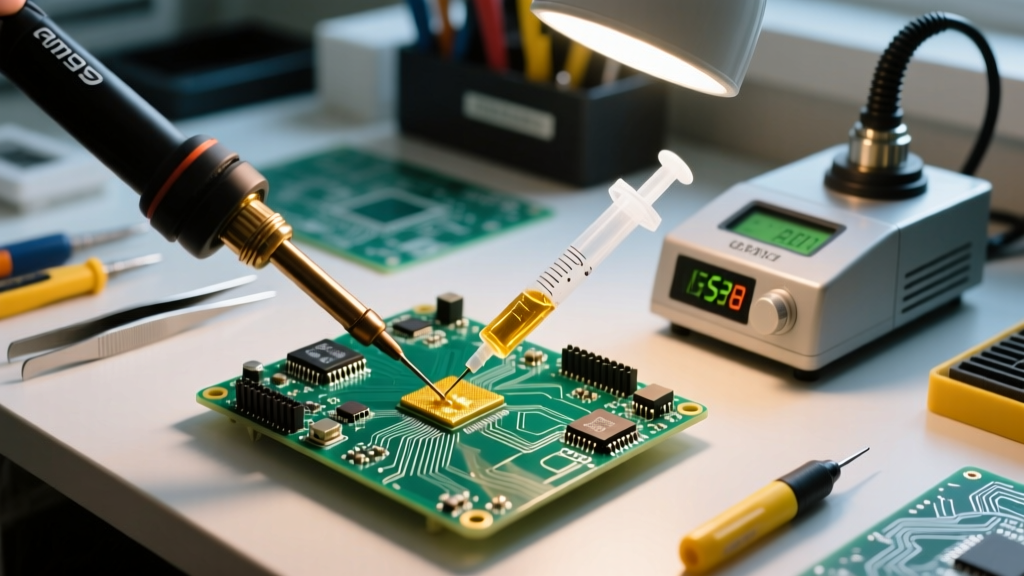
Top Pick: Chip Quik SMD291AX Tack Flux (10cc Syringe). At roughly $28, this rosin-based (RMA) gel provides exceptional adhesion. When repairing a tombstone, applying a microscopic dot of this flux to the lifted termination acts as both a chemical cleaner and a physical anchor, preventing the component from floating away during hot air rework.
Solder Paste Selection Matrix for Micro-Passives
Choosing the wrong paste type is the leading cause of the electronic components tombstone effect in automated SMT lines. Use the table below to select the correct paste and stencil combination for your specific component footprint.
| Paste Type | Particle Size (µm) | Min. Stencil Thickness | Recommended Component Size | Tombstone Risk Level |
|---|---|---|---|---|
| Type 3 | 25 - 45 | 5 mil (0.127mm) | 0805 and larger | High (for 0603) |
| Type 4 | 20 - 38 | 4 mil (0.100mm) | 0603, 0402 | Moderate (for 0402) |
| Type 5 | 15 - 25 | 3 mil (0.075mm) | 0402, 0201 | Low |
| Type 6 | 5 - 15 | 2 mil (0.050mm) | 01005, Micro-BGA | Very Low |
Step-by-Step Repair Protocol for Tombstoned Passives
Repairing a tombstoned 0201 capacitor requires a steady hand, proper magnification (minimum 10x stereo microscope), and the right sequence. Follow this exact protocol to lay the component flat without damaging the PCB pads.
- Preparation: Set your JBC or Hakko station to 320°C. If using a hot air station (like the Quick 861DW), set it to 300°C with airflow at 30% to avoid blowing away adjacent 0201 components.
- Flux Application: Dispense a 0.5mm dot of Chip Quik SMD291AX tack flux onto the pad where the component's lifted termination is currently hovering. Do not apply flux to the anchored side yet.
- Heat Application: Using a C245-945 precision tip, simultaneously touch the lifted termination and the fluxed pad. The heat will transfer through the metal termination, melting the solder on the pad in roughly 1.5 seconds.
- Seating the Component: The moment the solder flashes to a liquid state, use Vetus ESD-15 ultra-fine tweezers to gently press the component down. The surface tension of the molten solder will naturally center the part.
- Reflow the Opposite Side: Apply a microscopic amount of liquid flux to the opposite pad and touch it with the iron for 1 second to ensure a proper fillet forms on both sides, equalizing the mechanical strength.
- Cleaning: Clean the area with 99% Isopropyl Alcohol (IPA) and a lint-free swab. Inspect under the microscope to verify that the solder fillet climbs at least 25% of the termination height, per IPC Class 2 requirements.
Expert Tips for Reflow Profile Optimization
'The soak zone is your best defense against tombstoning. By holding the assembly at 150°C to 175°C for 60 to 90 seconds before the reflow spike, you allow the entire PCB, including heavy ground planes, to reach thermal equilibrium. When the temperature crosses 217°C, both pads of the 0402 component will melt simultaneously, neutralizing the wetting force imbalance.'
If you are running a prototype batch and notice a high rate of the electronic components tombstone defect, do not immediately blame the paste. Review your reflow oven's thermocouple data. If the delta-T (temperature difference) across the board exceeds 10°C at the onset of the liquidus phase, your ramp-to-spike profile is too aggressive. Switch to a soak profile to equalize the thermal mass across the PCB.
Frequently Asked Questions (FAQ)
Can I use a hot air gun to fix a tombstoned 0402 resistor?
Yes, but it is risky for dense boards. Hot air applies heat globally to the area. If you use a 2mm nozzle at 320°C, you risk reflowing adjacent components, causing them to shift or tombstone as well. A precision cartridge iron is vastly superior for localized, single-component repair.
Does the type of PCB surface finish affect tombstoning?
Absolutely. ENIG (Electroless Nickel Immersion Gold) provides a very flat, uniform surface that promotes simultaneous wetting. HASL (Hot Air Solder Leveling), however, creates uneven pad topographies. The slight doming of HASL pads can cause the stencil to gap during printing, leading to unequal paste volume and a higher tombstone risk for 0201 components.
What is the 'home plate' or 'inverted home plate' stencil aperture?
This is a geometric stencil modification designed specifically to prevent tombstoning. By reducing the aperture area near the inner edge of the pad (where the component sits) and keeping it wide on the outer edge, you shift the center of mass of the solder paste outward. This counteracts the inward pulling force of surface tension during reflow, keeping the component anchored flat to the board.