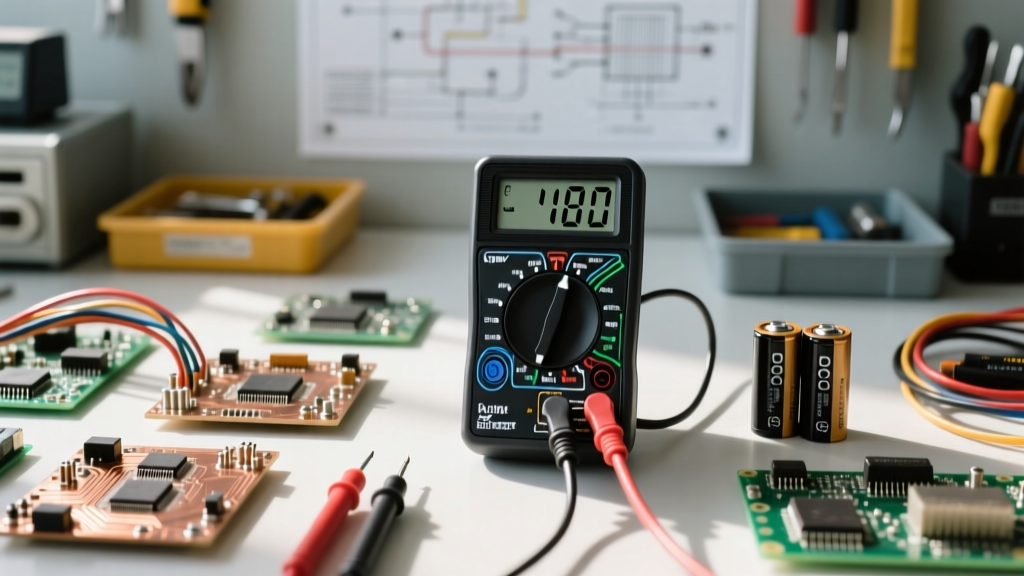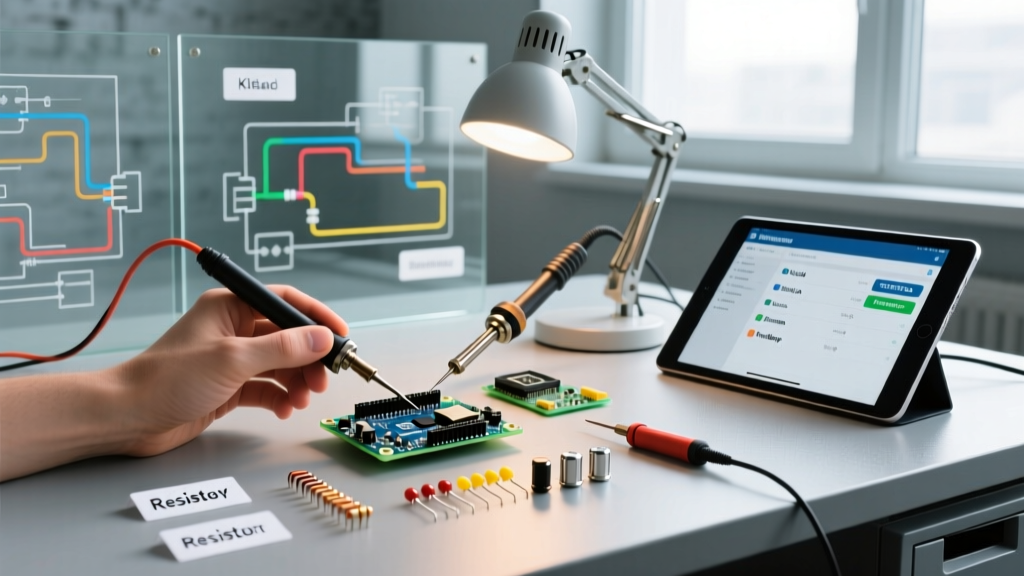

Every electronics hobbyist and professional engineer knows the sinking feeling of opening a storage drawer labeled 'Resistors' only to find a chaotic mix of 0603, 0805, and through-hole components with faded color bands. As supply chains fluctuate and component footprints shrink, maintaining an organized inventory is no longer optional. When you need to name electronic components list entries for a new lab or maker space, consistency and tooling are your primary defenses against lost time and misplaced capital.
In this guide, we review the best hardware and software tools available in 2026 for cataloging, naming, and physically labeling your electronic components. We will also break down the industry-standard naming conventions that ensure your database remains scalable from a single prototyping drawer to a full-scale SMT production floor.
Standardizing Your Nomenclature (IEEE 315 & IPC-7351)
Before purchasing barcode scanners or cloud subscriptions, you must establish a naming taxonomy. Relying on ad-hoc names like 'Big Blue Capacitor' leads to catastrophic BOM (Bill of Materials) errors. Professional labs rely on established standards to structure their databases.
According to the IEEE Standards Association, reference designators must follow strict alphabetic assignments (IEEE 315). Furthermore, surface mount footprints should align with IPC-7351 land pattern standards to ensure your inventory maps directly to your PCB design software.
Core Reference Designators
| Prefix | Component Type | Example Naming Convention |
|---|---|---|
| R | Resistor | RES_10K_0805_1% |
| C | Capacitor | CAP_100nF_0603_X7R |
| L | Inductor | IND_4.7uH_1210_FERRITE |
| D | Diode | DIODE_SCHOTTKY_SMA_BAT54 |
| Q | Transistor | TR_NPN_SOT23_2N3904 |
| U | Integrated Circuit | IC_MCU_STM32F103_LQFP48 |
Table 1: Standardized naming matrix combining reference designator, value, footprint, and critical material specs.
Top Tools to Manage and Name Electronic Components List Databases
With your taxonomy defined, you need tools to enforce it. Below are our top-tested recommendations for 2026, covering cloud databases, physical labeling, and schematic integration.
1. PartsBox (Cloud Inventory & BOM Management)
Best for: Prosumers, small consultancies, and serious DIYers managing over 1,000 unique SKUs.
Pricing: Free for up to 500 parts; Hobbyist plan at $14.99/month (billed annually).
PartsBox remains the undisputed king of component inventory management. It allows you to name electronic components list entries using strict parameterized fields rather than free-text boxes. This means you cannot accidentally log a 10k resistor as '10000 ohms' in one instance and '10k' in another; the software forces standardized SI prefixes.
- Pros: Excellent barcode generation, automatic Octopart API integration for real-time pricing and datasheet linking, and robust BOM export features.
- Cons: The mobile app UI can feel slightly cramped when editing complex IC parameters on smaller smartphone screens.
2. Brother PT-D210 (Physical Drawer & Bin Labeling)
Best for: Physical organization of Akro-Mils cabinets and Plano storage boxes.
Pricing: ~$35.00 (Hardware) + $15.00 per TZe-231 tape cartridge.
Software is useless if the physical bins don't match. The Brother PT-D210 is our top hardware pick for lab labeling. Unlike cheaper thermal printers that fade under UV exposure or heat from nearby soldering stations, the PT-D210 uses laminated TZe tapes. We recommend the 12mm (1/2-inch) TZe-231 (black on white) tape, which provides enough vertical space to print both the component value (e.g., '100nF') and the footprint ('0603') in a highly legible font.
'A well-labeled bin saves an average of 4.5 minutes per component retrieval during a complex SMT assembly run. Over a year, that equates to dozens of hours of reclaimed engineering time.' - Industrial Engineering Time-Motion Studies
3. KiCad + Octopart API (Schematic Integration)
Best for: Open-source hardware developers and PCB designers.
Pricing: Free (Open Source).
According to the KiCad Documentation, modern EDA tools allow you to map custom database libraries directly to your schematic symbols. By linking your KiCad footprint libraries to an Octopart-backed database, you ensure that the name on your schematic matches the exact manufacturer part number (MPN) in your physical bins. This eliminates the 'ghost part' phenomenon where a schematic calls for a Texas Instruments LDO, but your bin only holds the AMS1117 equivalent.
Step-by-Step: Building Your Naming Taxonomy
If you are migrating from a messy spreadsheet to a structured database, follow this exact sequence to prevent data corruption:
- Audit and Purge: Discard oxidized through-hole components and out-of-date electrolytic capacitors (anything older than 5 years).
- Define the MPN Rule: Decide if your primary key will be the Manufacturer Part Number (e.g.,
GRM188R71H104KA93D) or a generic descriptor (e.g.,CAP_100nF_0603). For generic passives, use descriptors; for ICs, always use exact MPNs. - Establish Footprint Suffixes: Always append the package type to the name. A 10uF capacitor in an 0805 package is functionally different from one in a 1206 package due to ESR and voltage derating characteristics.
- Generate and Apply Barcodes: Use your software to generate Code 128 barcodes for each bin location, linking the physical space to the digital database.
Common Naming Failure Modes & Edge Cases
Even with great tools, engineers frequently fall into specific naming traps. Watch out for these edge cases:
The Multi-Source Equivalent Trap
During the recent global silicon shortages, many engineers substituted parts. If your database lists an STM32F103C8T6, but you physically stocked the Gigadevice GD32F103C8T6 clone, your pick-and-place machine or manual assembly will face firmware compatibility issues. Solution: Use 'Approved Alternate' fields in your inventory software to link functional equivalents without overwriting the primary MPN.
Moisture Sensitivity Levels (MSL)
When naming ICs for SMT reflow, failing to note the MSL rating can result in 'popcorning' during the soldering phase. An MSL 3 component requires baking if left exposed to ambient humidity for over 48 hours. Always append _MSL3 to sensitive BGA and QFP component names in your database to trigger proper handling protocols.
Comparison Matrix: Inventory Management Approaches
| Method | Setup Cost | Scalability | Best Use Case |
|---|---|---|---|
| Spreadsheet (Excel/Sheets) | $0 | Low (Fails >500 parts) | Beginners, strict passives only |
| Dedicated Cloud (PartsBox) | $15/mo | High (100,000+ SKUs) | Consultancies, complex mixed-signal labs |
| Local Database (Snipe IT) | $0 (Self-hosted) | Medium-High | Privacy-focused labs, universities |
| Physical Labeling Only | ~$50 (Printer) | Low | Maker spaces, shared community benches |
Frequently Asked Questions
Should I sort my physical bins by value or by footprint?
Always sort by footprint first, then by value. Finding an 0402 resistor in an 0805 bin during a micro-soldering repair session can ruin a PCB pad. Group all 0603 resistors together, then sort numerically from 0 ohm to 10M ohm.
How do I handle custom cables and wire harnesses?
Wire harnesses should be treated as assemblies, not raw components. Create a 'W' or 'H' reference designator (e.g., HARNESS_PWR_MAIN) and link it to a sub-BOM containing the specific AWG wire, crimp terminals (e.g., JST-XH), and heat shrink tubing used to build it.
Final Verdict
Learning how to properly name electronic components list databases is a foundational skill that separates hobbyists from professional hardware engineers. By combining the strict parameterized fields of PartsBox with the durable physical output of the Brother PT-D210, you create a closed-loop system where digital schematics perfectly mirror physical reality. Invest the time this weekend to audit your bins, establish your IEEE-compliant taxonomy, and reclaim the hours previously lost to the component bin abyss.