
The 2026 Landscape: Selective Scarcity and the Gray Market Threat
While the broad-spectrum supply chain crises of the early 2020s have largely subsided, the electronic components shortage in 2026 has evolved into a highly selective, chronic issue. Legacy microcontrollers (specifically 90nm–130nm nodes like the STM32F1 series), automotive-grade MOSFETs, and specialized Power Management ICs (PMICs) remain heavily constrained. When authorized distributors show 40-to-52-week lead times, engineers, manufacturers, and DIYers are inevitably pushed toward independent brokers and online marketplaces.
This pivot introduces a severe, often overlooked safety hazard: counterfeit and remarked components. According to the Electronic Resellers Association International (ERAI), counterfeit incidents remain stubbornly high in the independent market, with power ICs and legacy MCUs being the most frequently faked categories. Using a counterfeit power regulator or a mislabeled microcontroller doesn't just mean your project might fail; it can lead to thermal runaway, lithium battery fires, or catastrophic high-voltage shorts.
Sourcing Channel Risk Matrix
Before purchasing scarce parts, you must understand the risk profile of your supply chain. The table below outlines the safety hierarchy for sourcing components during a shortage.
| Sourcing Channel | Counterfeit Risk | Typical Price Variance | Mandatory Verification Protocol |
|---|---|---|---|
| Authorized Distributors (e.g., DigiKey, Mouser) | Zero | MSRP (Baseline) | None |
| Franchised / Certified Brokers | Very Low | +5% to +15% | Lot Code Verification |
| ERAI-Member Independent Brokers | Medium | +20% to +60% | Visual Inspection & Electrical Testing |
| Gray Market / Direct-from-Factory (AliExpress) | Critical | -30% to +100% | Decapping, X-Ray, Full Bench Testing |
Validation Protocol 1: Visual and Microscopic Inspection
If you are forced to buy from an independent broker or marketplace, your first line of defense is physical inspection. Counterfeiters frequently use a technique called blacktopping—sanding down the original epoxy marking of a cheap, lower-spec chip and printing a new, higher-spec part number on top.
What to Look For Under a 40x Stereomicroscope:
- Surface Texture Anomalies: Genuine ICs have a uniform, slightly textured matte finish. Sanded chips will show micro-scratches or an unnaturally smooth, glossy surface where the blacktop epoxy was applied.
- Laser Etching Depth: Authentic manufacturers use high-precision YAG lasers. The etching should have sharp, consistent edges and a specific depth. Counterfeit silk-screening or low-quality laser marks will look shallow, blurred, or exhibit 'ghosting' from the original text beneath.
- Pin Oxidation and Re-tinning: Check the leads. If the date code claims the part is from 2025 but the leads show heavy oxidation, it is likely old stock that has been chemically cleaned and re-tinned. Re-tinned pins often have a slightly rounded edge and uneven solder thickness, which can cause poor wetting and cold solder joints during automated reflow.
Validation Protocol 2: Electrical and Semiconductor Testing
Visual inspection cannot catch 'clone' chips—silicon that is functionally similar but manufactured by an unauthorized fab with inferior quality control. For this, you need electrical validation.
Parasitic Diode Drop Testing
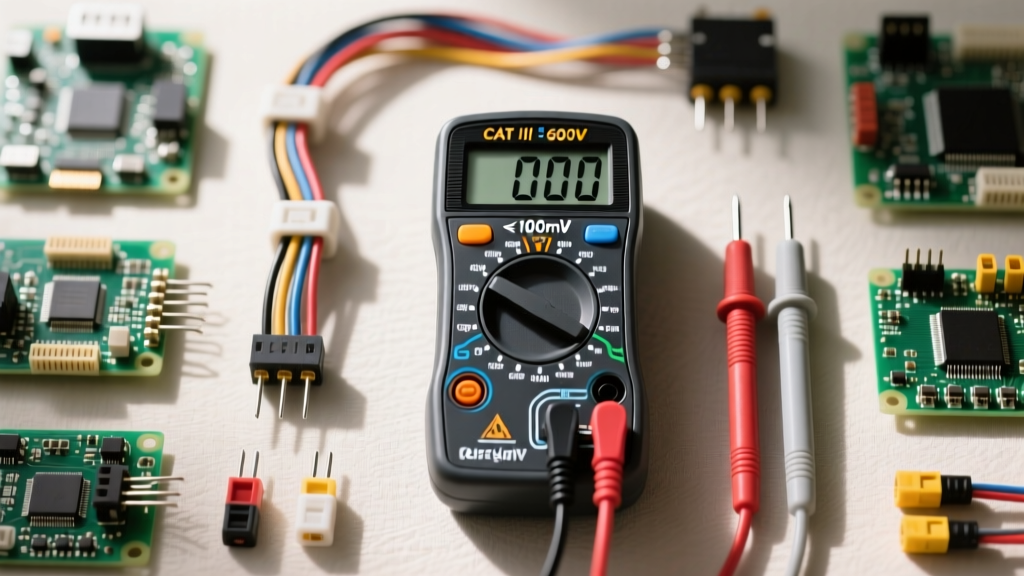
Using a high-quality multimeter like the Fluke 87V ($450) or a dedicated semiconductor analyzer like the Peak Atlas DCA75 Pro ($220), you can map the internal protection diodes of a microcontroller. Every genuine MCU has a specific parasitic diode voltage drop profile between its I/O pins and the VDD/VSS rails.
- Set your multimeter to Diode Test mode.
- Place the red probe on the VSS (Ground) pin and the black probe on an I/O pin.
- Record the forward voltage drop. For a genuine STM32F103C8T6, this typically reads around 0.55V to 0.62V.
- Compare this against a known-good golden sample. Clone chips often exhibit wildly different junction capacitances and diode drops (e.g., reading 0.4V or open-circuit) due to different silicon geometries.
Case Study: The Deadly LM2596 Counterfeit
To understand the physical danger of the gray market, consider the ubiquitous LM2596S-5.0 buck converter module, heavily used in DIY power supplies and automotive steps-downs. During peak shortage periods, genuine Texas Instruments silicon became scarce, and the market was flooded with $1.50 clone modules.
Safety Warning: A teardown of counterfeit LM2596 modules reveals a critical substitution. The genuine design requires a fast-recovery Schottky diode (like the SS34) for the flyback path. Counterfeit manufacturers frequently substitute this with a standard 1N4007 rectifier diode to save $0.02 per unit.
The Failure Mode: The 1N4007 has a reverse recovery time of roughly 30 microseconds, whereas the LM2596 switches at 150 kHz (a period of 6.6 microseconds). Because the 1N4007 cannot recover fast enough, it remains in forward conduction during the switch's 'on' cycle. This creates a massive shoot-through current, causing the inductor to saturate, the IC to overheat past 140°C, and the PCB to catch fire when pushed beyond a 500mA load. Never trust unverified power modules for critical or unattended applications.
Design-Level Mitigations for Component Scarcity
The best way to handle a shortage is to design your way out of it before you ever need to source from the gray market. The NASA Electronic Parts and Packaging (NEPP) Program heavily advocates for design-for-obsolescence and multi-source compatibility.
Footprint Flexibility
When laying out your PCB in KiCad or Altium, design overlapping footprints for critical passives and discretes. For example, if you require a specific SOIC-8 power driver that is on backorder, add a secondary MSOP-8 footprint that overlaps the pads where possible, or route 0-ohm jumper options to select between two different pinout configurations. This allows your contract manufacturer to populate whichever authorized part is currently in stock.
The Danger of 'Drop-In' Replacements
Be highly cautious of 'pin-compatible' alternatives marketed as drop-in replacements. For instance, swapping a scarce TI TPS5430 for a clone or alternative brand might seem safe, but you must verify the Enable (EN) pin threshold voltage. If the original requires 1.2V to enable, and the substitute requires 1.5V, your system's soft-start sequencing will fail, potentially causing brownouts in downstream logic circuits. Always demand the SPICE models and run a transient analysis before approving an alternate part number.
Final Best Practices for 2026
Navigating the electronic components shortage requires a shift from a purely cost-driven procurement strategy to a risk-managed approach. Always cross-reference broker stock with the Electronic Components Industry Association (ECIA) authorized distributor search to ensure you aren't accidentally buying gray-market stock at authorized prices. When forced to use independent sources, isolate the risk: test components on a dedicated evaluation board with current-limited bench supplies before committing them to your final production hardware.