
The Hidden Threat in Your Electronics Lab
When a soldering iron tips over, a lithium-ion battery enters thermal runaway, or a power supply shorts out, your first instinct is to grab the nearest fire extinguisher. However, using the wrong suppressant can be just as destructive to your workbench as the fire itself. For electrical engineers, DIY makers, and IT professionals, understanding fire suppression chemistry is just as critical as knowing how to read a schematic.
In this 2026 buying guide, we break down the chemical interactions between suppressants and printed circuit boards (PCBs), answer the critical question of which type of fire extinguisher may damage electronic components, and provide a definitive purchasing framework for protecting your expensive oscilloscopes, microcontrollers, and server racks.
Which Type of Fire Extinguisher May Damage Electronic Components?
The short answer is standard ABC Dry Chemical and Water/Foam extinguishers. While they are excellent for general facility fires, they are catastrophic for sensitive electronics. Here is the deep-dive technical breakdown of why these agents destroy hardware.
1. ABC Dry Chemical (Monoammonium Phosphate)
The standard red extinguisher found in most homes and hallways contains Monoammonium Phosphate (MAP). When MAP is exposed to the heat of an electrical fire (which easily exceeds 500°F), it undergoes a phase change. It melts at approximately 350°F (176°C) and forms a sticky, glassy slag.
- The Failure Mode: This molten slag flows directly into micro-vias, under Ball Grid Array (BGA) chips, and between the fine 0.4mm pitch pins of modern surface-mount ICs.
- Corrosive Aftermath: Once cooled, MAP residue is highly corrosive and mildly conductive. It eats through copper traces, causes galvanic corrosion on solder joints, and creates parasitic leakage paths that result in phantom shorts on your PCB.
- Cleaning Reality: It is practically impossible to remove fused MAP from under a QFN or BGA package without an ultrasonic cleaner and aggressive chemical solvents, and even then, the success rate for saving the board is below 15%.
2. Standard Water and AFFF Foam (Class A)
Water and Aqueous Film Forming Foam (AFFF) are strictly for Class A (combustibles) fires. Spraying these on an energized circuit guarantees immediate low-impedance short circuits. Furthermore, the minerals and surfactants in foam leave a conductive, corrosive residue that will permanently ruin multilayer PCBs if not immediately neutralized and baked out.
Extinguisher Comparison Matrix for Electronics Workspaces
Use this matrix to evaluate the safety and cost of various suppressants for your lab or server room.
| Extinguisher Type | UL Class Rating | Residue Left Behind | Safe for Electronics? | Avg. Cost (2026) |
|---|---|---|---|---|
| ABC Dry Chemical (MAP) | A, B, C | Heavy, corrosive, conductive slag | No (Destructive) | $65 - $85 |
| Purple-K (BC Dry Chem) | B, C | Fine powder, mildly conductive | No (High Risk) | $120 - $150 |
| Carbon Dioxide (CO2) | B, C | None (Gas) | Yes (With caveats) | $140 - $180 |
| Halotron I (Clean Agent) | B, C | None (Evaporates) | Yes (Ideal) | $250 - $320 |
| Novec 1230 / FK-5-1-12 | B, C | None (Evaporates) | Yes (Ideal) | $280 - $350 |
| Deionized Water Mist | A, C (Specific models) | None (Pure H2O) | Yes (If rated for C) | $180 - $220 |
The Safe Alternatives: What You Should Actually Buy
If you are outfitting an electronics lab, rework station, or server closet, you must purchase extinguishers that leave zero residue and are non-conductive. Here are the top choices for 2026.
Option A: Carbon Dioxide (CO2) Extinguishers
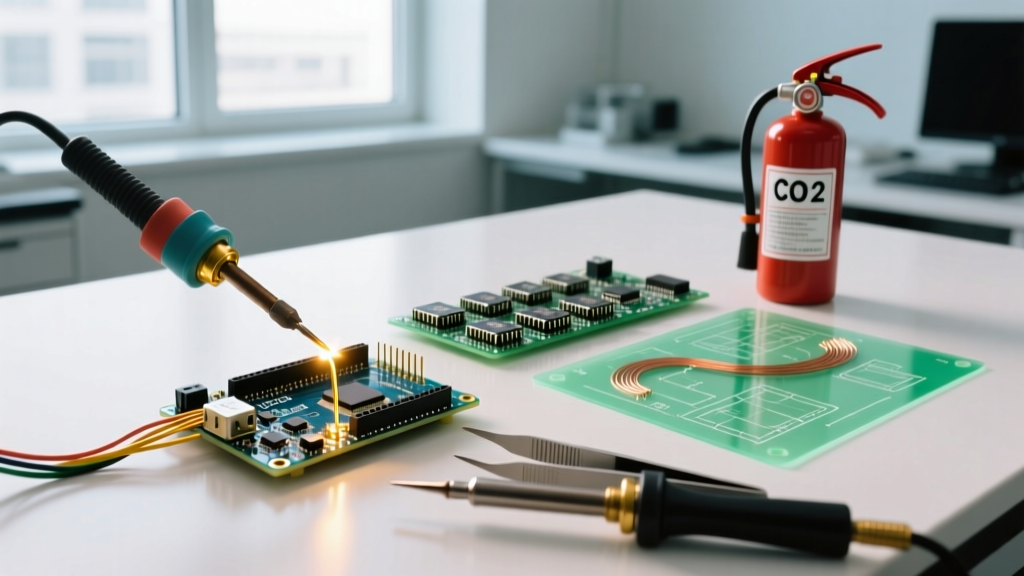
CO2 extinguishers displace oxygen and cool the fire. Because CO2 is a gas at room temperature, it leaves absolutely zero residue, making it a favorite for electrical panels and DIY labs.
- Recommended Models: Amerex B262 (5 lb CO2) or Badger C-5 (5 lb CO2).
- The Thermal Shock Caveat: CO2 discharges at an extremely cold -109°F (-78°C). If you spray this directly onto a hot power MOSFET, a ceramic capacitor (MLCC), or an energized silicon die, the rapid temperature delta can cause catastrophic mechanical cracking or package delamination. Always maintain a minimum 3-foot discharge distance when using CO2 on hot electronics.
Option B: Clean Agent (Halotron / Novec 1230)
Clean agents are the gold standard for protecting high-value electronics like Keysight Infiniium oscilloscopes, CNC controller boards, and data center racks. They interrupt the chemical chain reaction of the fire and evaporate instantly without leaving a trace.
- Recommended Models: Amerex B260 (5 lb Halotron I) or Buckeye 5 lb Novec 1230.
- Cost vs. Value: While a 5 lb Halotron unit costs around $280 (compared to $75 for dry chem), consider the cost of the equipment you are protecting. A $3,000 pick-and-place machine or a $1,500 soldering/rework station easily justifies the premium.
Expert Insight: According to the NFPA 10 Standard for Portable Fire Extinguishers, clean agent extinguishers are specifically recommended for areas where the cleanup of other extinguishing agents would cause unacceptable damage to sensitive equipment.
Strategic Placement and Sizing for DIY Workshops
Buying the right chemical is only half the battle; placement and sizing dictate your response time and effectiveness.
- Calculate the Hazard Area: For a standard home electronics lab or garage workshop (under 400 sq ft), a single 5 lb Clean Agent or CO2 extinguisher is generally sufficient. For larger commercial labs, follow OSHA guidelines which mandate a maximum travel distance of 50 feet to the nearest Class C rated extinguisher.
- Mounting Height: Mount the extinguisher on a wall bracket so the top of the handle is no more than 5 feet from the floor. This ensures quick access while keeping it out of the way of rolling workbenches.
- Proximity to High-Risk Zones: Place one unit within 10 feet of your primary AC/DC power distribution panel, and another near your lithium-ion battery charging and storage station (the most common source of modern electrical fires).
Post-Fire Recovery: Can You Save the PCB?
If a fire occurs, your post-suppression actions will determine if your hardware survives.
- If Clean Agent or CO2 was used: Simply ventilate the room. Once the ambient moisture from the CO2 discharge or the halocarbon gas dissipates (usually within 15 minutes), you can safely power the board back on to diagnose the fault.
- If Dry Chemical (MAP) was used: Do NOT apply power. The residue is hygroscopic (absorbs moisture from the air) and becomes highly conductive. You must disassemble the hardware, brush off loose powder with an ESD-safe brush, and submerge the PCB in an ultrasonic cleaner filled with 99% Isopropyl Alcohol (IPA) and a specialized saponifier. Even then, expect to replace any connectors or relays where the powder penetrated the mechanical housing.
Frequently Asked Questions
Can I use a standard ABC extinguisher if it is the only one available?
Yes, life safety always supersedes equipment safety. If a fire is growing out of control and an ABC extinguisher is your only option, use it to save your life and your building. Just accept that any electronics exposed to the MAP powder will likely be a total loss.
Are aerosol fire suppression cans safe for electronics?
Most consumer aerosol fire suppressants (like those sold for kitchen or car use) contain potassium-based aerosols that leave a fine, highly alkaline, and conductive dust. They are not safe for bare PCBs or server racks. Stick to pressurized Clean Agent or CO2 units.
Do Clean Agent extinguishers expire?
The halocarbon agent itself does not degrade or expire. However, the aluminum cylinder and the valve assembly must be inspected annually. According to Amerex Corporation, portable extinguishers require a 6-year internal maintenance check and a 12-year hydrostatic pressure test to remain compliant and safe.
Final Verdict
When evaluating which type of fire extinguisher may damage electronic components, the evidence is clear: standard dry chemical and water-based units will destroy your PCBs through corrosive slag and short-circuiting. To protect your workspace in 2026, invest in a 5 lb Halotron I or CO2 extinguisher. The $200 premium is a fractional insurance policy against the total loss of your microcontrollers, test equipment, and irreplaceable prototype data.