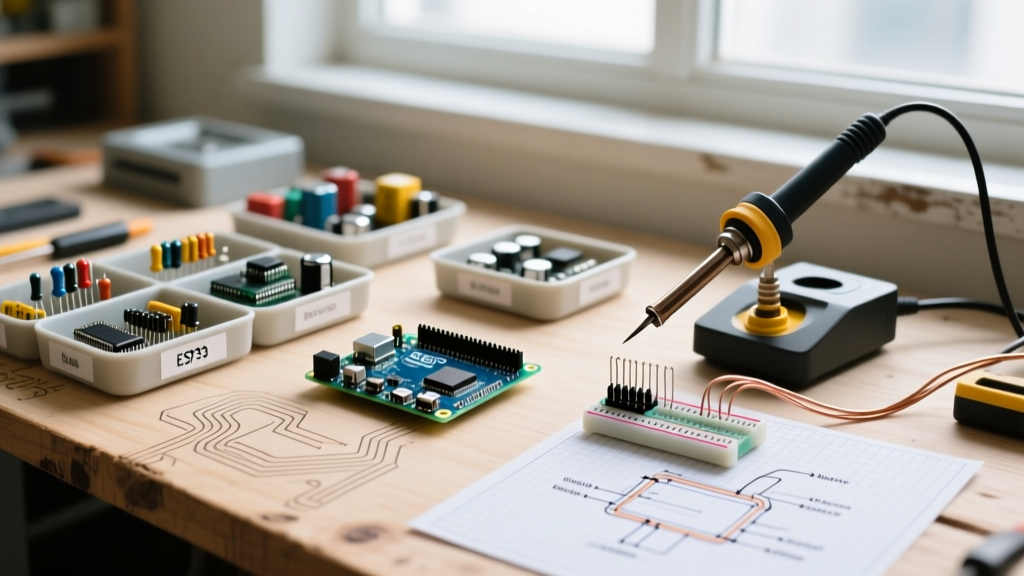

Navigating the Encyclopedia of Electronic Components
Whether you are designing a custom PCB for a high-frequency RF application or breadboarding a simple 555 timer astable oscillator, having a reliable mental index of parts is critical. This encyclopedia of electronic components serves as a quick-reference cheat sheet for makers, electrical engineering students, and professional technicians. Instead of wading through 400-page datasheets, use this guide to identify the right part numbers, package types, and failure modes for your next build.
According to industry benchmarks from the Digi-Key TechZone publication, selecting the wrong component variant—such as using a standard MOSFET instead of a logic-level one—accounts for nearly 30% of initial prototype failures in DIY microcontroller projects. Let us break down the essential categories.
Passive Components: The Foundation of Circuitry
Passives do not amplify signals, but they shape, filter, and store energy. Understanding their parasitic properties is what separates novices from experts.
Resistors: Beyond the Color Code
While the standard SparkFun Resistor Tutorial covers the basic color bands, professional design requires knowledge of tolerance and temperature coefficients (TCR).
- Carbon Film (5% tolerance): Cheap, but noisy. Avoid in audio pre-amplifier stages.
- Metal Film (1% tolerance, 50ppm/°C): The standard for general-purpose through-hole designs. Typical cost: $0.02 to $0.05 per unit.
- Current Sense Resistors: Low milliohm values (e.g., 0.01Ω) in SMD 2512 packages. Used for measuring current draw via Ohm's Law (V=IR).
Pro-Tip: When designing SMD boards in 2026, the 0603 (1.6mm x 0.8mm) package is the sweet spot for hand-soldering and automated assembly. Avoid 0402 unless you are strictly optimizing for high-density mobile form factors.
Capacitors: Dielectrics and Derating
Capacitors are defined by their dielectric material, which dictates their stability over temperature and voltage.
- C0G / NP0 (Ceramic): Ultra-stable. Zero capacitance shift with temperature. Mandatory for RF oscillators and precision analog filters.
- X7R / X5R (Ceramic): High volumetric efficiency but suffers from DC bias effect (capacitance drops as applied voltage increases). Always derate by 50%.
- Aluminum Electrolytic: High capacitance (10µF to 10,000µF) but high Equivalent Series Resistance (ESR). Use low-ESR variants (like the Panasonic FR series) for switching power supply output filtering.
Inductors: Core Materials and Saturation
Inductors store energy in a magnetic field. The critical parameter often ignored by beginners is the Saturation Current (Isat). If your circuit exceeds Isat, the inductor's core saturates, inductance plummets, and it effectively becomes a short circuit, usually destroying your switching regulator.
Active Components: Amplification and Switching
Active components require a power source to operate and are used to switch, amplify, or rectify signals. The All About Circuits DC Textbook provides deep theoretical backing, but here is the practical cheat sheet for part selection.
Diodes: Rectification and Protection
| Part Number | Type | Vf (Forward Voltage) | Primary Use Case |
|---|---|---|---|
| 1N4007 | Standard Rectifier | ~1.0V @ 1A | AC/DC bridge rectifiers, reverse polarity protection on high-voltage lines. |
| 1N5819 | Schottky | ~0.6V @ 1A | Solar panel bypass, low-voltage reverse polarity protection (minimizes heat). |
| 1N4148 | Small Signal | ~0.7V @ 200mA | High-speed logic gating, clamping circuits, and signal demodulation. |
| BZX55C5V1 | Zener (5.1V) | 5.1V (Reverse) | Crude voltage regulation, over-voltage crowbar protection circuits. |
Transistors: BJT vs. MOSFET
The most common mistake in microcontroller interfacing is driving a standard MOSFET with a 3.3V or 5V GPIO pin. Standard MOSFETs (like the IRF520 or IRFZ44N) require 10V+ at the gate to fully turn on and achieve their rated low R_DS(on). If you use them with an Arduino, they will operate in the linear region, overheat, and fail.
- Standard BJT (2N3904 NPN / 2N3906 PNP): Best for switching loads under 200mA. Requires a base resistor (typically 1kΩ) to limit base current.
- Logic-Level MOSFET (IRLZ44N / IRLB8721): Note the "L" in the part number. These are guaranteed to fully enhance (turn on) with a Gate-to-Source Voltage (V_GS) of 4.5V or even 2.5V. Use these for PWM motor control via 3.3V/5V microcontrollers.
Integrated Circuits (ICs): The Brains and Regulators
ICs package complex transistor networks into single silicon dies. Below are the workhorse ICs that belong in every laboratory inventory.
Voltage Regulators
- L7805 (Linear): The classic 5V regulator. Requires input voltage of at least 7V (2V dropout). Failure mode: Severe thermal throttling if dropping 12V to 5V at currents above 200mA without a heatsink.
- AMS1117-3.3 (LDO): Low Dropout Regulator. Can output 3.3V from a 4.5V source. Standard on most ESP8266/ESP32 development boards.
- LM2596 (Buck Converter): Switching regulator. Highly efficient (85%+) for stepping down 12V to 5V at high currents (up to 3A) without massive heatsinks.
Timers and Op-Amps
- NE555: The legendary timer IC. Available in bipolar (NE555) and low-power CMOS (TLC555) variants. Use the TLC555 for battery-operated devices to reduce quiescent current from 10mA down to 1mA.
- LM358: Dual operational amplifier designed for single-supply operation (e.g., running off a single 9V battery). Note that its inputs do not support rail-to-rail operation, meaning it cannot accurately read signals within 1.5V of the positive supply rail.
Component Selection & Sourcing Matrix (2026 Edition)
When building your inventory, balance cost, availability, and assembly method. The following matrix outlines standard procurement strategies for modern electronics labs.
| Category | Through-Hole Standard | SMD Standard | Avg. Unit Cost (2026) | Storage / Handling Notes |
|---|---|---|---|---|
| Resistors | 1/4W Metal Film | 0603 X7R Thick Film | $0.01 - $0.03 | Immune to ESD. Store in binder books. |
| Capacitors | Radial Electrolytic | 0805 MLCC (X7R) | $0.02 - $0.10 | MLCCs are brittle; avoid board flexure. |
| MOSFETs | TO-220 (IRLZ44N) | SOT-23 / DPAK | $0.30 - $1.20 | Highly ESD sensitive. Use grounded mats. |
| Microcontrollers | DIP-28 (ATmega328P) | QFN-32 (ESP32-C3) | $1.50 - $3.50 | Check MSL rating; bake if exposed to humidity. |
Sourcing, Counterfeits, and Storage Best Practices
The global electronics supply chain has stabilized post-2023, but counterfeit components remain a severe issue, particularly with high-demand parts like the STM32 microcontrollers and TI audio amplifiers.
Where to Buy
- Tier 1 (Guaranteed Authentic): Digi-Key, Mouser, Farnell, and LCSC (for Asian market equivalents). Always use these for mission-critical, medical, or automotive prototypes.
- Tier 2 (Prototyping & Hobbyist): Adafruit, SparkFun, and Arrow. Excellent for curated modules and breakout boards.
- Tier 3 (High Risk): AliExpress, Amazon third-party sellers, and eBay. Acceptable for generic passives (resistors, basic LEDs), but never buy complex ICs or high-power MOSFETs here. Counterfeit MOSFETs often contain significantly smaller silicon dies that will explode under rated loads.
Moisture Sensitivity and ESD
Surface-mount ICs are categorized by Moisture Sensitivity Level (MSL). If an MSL 3 or higher component (like a BGA microcontroller) is exposed to ambient room humidity for more than 168 hours, moisture penetrates the plastic encapsulation. When subjected to 240°C reflow soldering temperatures, the water turns to steam, causing the "popcorn effect"—micro-fractures inside the chip that lead to latent, intermittent failures. Always store sensitive ICs in sealed ESD bags with desiccant and a humidity indicator card, and bake them at 60°C for 24 hours before assembly if the seal was broken.
Summary
Mastering the encyclopedia of electronic components is not about memorizing every datasheet; it is about understanding the underlying physics, parasitic behaviors, and real-world failure modes of the parts you select. By choosing the correct dielectric for your capacitors, utilizing logic-level MOSFETs for microcontroller interfacing, and sourcing from authorized distributors, you will drastically reduce your prototype iteration cycles and build robust, commercial-grade electronics.


