
The Hidden Dangers of Misidentified Components
Mistaking a 16V tantalum capacitor for a 50V ceramic due to faded top-markings can lead to catastrophic thermal runaway, venting, and even localized fires on your workbench. When sorting through salvage boards, verifying bill of materials (BOM) substitutions, or prototyping, accurately identifying electronic components with names, logos, and alphanumeric codes is not just about circuit functionality—it is a critical safety practice.
As surface-mount devices (SMDs) continue to shrink in 2026, with 0201 and 01005 imperial packages becoming standard in high-density designs, the physical space for printing component names and safety ratings has virtually disappeared. This forces technicians to rely on partial codes, making safe handling and precise identification more crucial than ever. According to the Occupational Safety and Health Administration (OSHA), electrical incidents and bench accidents frequently stem from improper handling and misidentification of energized or volatile components during testing and rework.
ESD Protocols When Reading Component Markings
Before you even bring a magnifying loupe to a sensitive integrated circuit (IC) to read its laser-etched name, you must establish a proper Electrostatic Discharge (ESD) safe zone. The human body can generate upwards of 3,000V of static electricity just by shifting in a synthetic chair—enough to instantly punch through the gate oxide of a modern MOSFET, causing latent failures that are incredibly dangerous in high-voltage applications.
Step-by-Step ESD Inspection Flow
- Ground the Workspace: Deploy an ESD-safe mat (typically a dual-layer rubber mat costing around $45-$60) and connect it to a verified earth ground via a 1-megohm current-limiting resistor.
- Wear a Wrist Strap: Secure a conductive wrist strap snugly against your bare skin. Test it with an ESD wrist strap tester to ensure resistance falls between 750kΩ and 35MΩ, fully compliant with ANSI/ESD S20.20 standards.
- Extract Safely: Remove the component from its anti-static shielding bag or conductive foam. Never slide ICs across non-ESD surfaces just to get a better angle to read their names.
- Inspect Under Magnification: Use a stereo microscope to read faint markings without touching the delicate leads with your bare fingers or ungrounded tweezers.
Essential Tools for Safe Inspection
- AmScope SM-4TP Stereo Microscope ($180-$220): Provides 10x to 20x magnification with a boom stand, allowing you to read microscopic SMD names while keeping your hands free to manipulate ESD-safe tweezers.
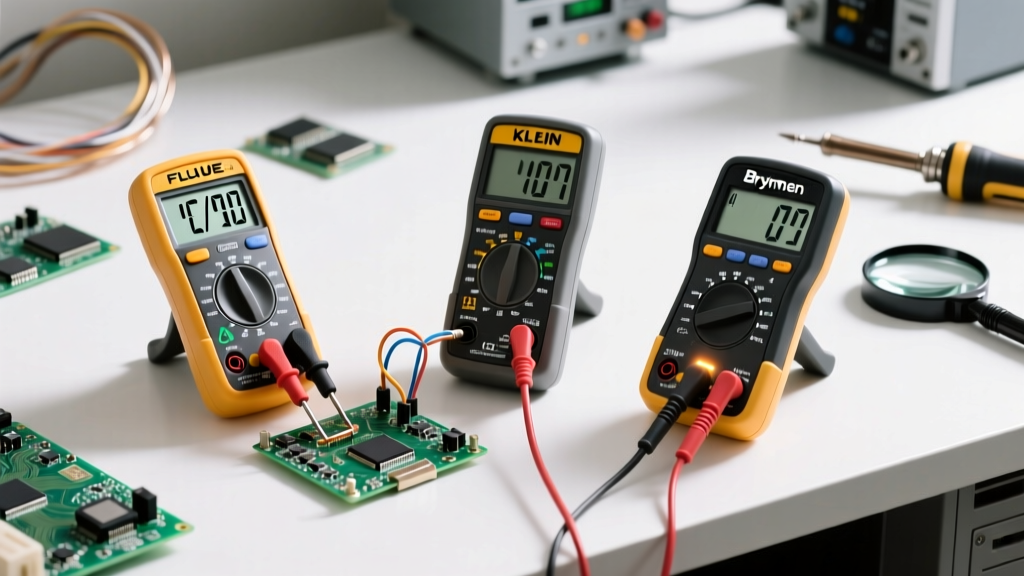
- Fluke 87V Industrial Multimeter ($350+): Essential for verifying that your ESD mat and wrist strap are properly grounded before handling sensitive, high-value parts.
- 99% Isopropyl Alcohol (IPA) & Lint-Free Swabs: Used to safely clean flux residue off component names without degrading the epoxy packaging or leaving conductive residue.
Component-Specific Safety and Identification Matrix
Different component families carry unique physical and electrical hazards. The table below outlines how to interpret the names and markings on high-risk parts and the specific safety protocols required for each.
| Component Type | Typical Name/Marking Format | Primary Safety Hazard | Safe Handling Protocol |
|---|---|---|---|
| Aluminum Electrolytic Caps | Value + Voltage + Stripe (e.g., 100µF 25V) | Reverse polarity explosion and electrolyte venting. | Verify the negative stripe aligns perfectly with the PCB silkscreen shadow. Never force bent leads into plated through-holes. |
| Tantalum Capacitors | SMD codes (e.g., Kemet T491 series) | Thermal runaway, sparking, and localized fire. | Never exceed 50% voltage derating. Always use a current-limited power supply when testing circuits containing tantalums. |
| Power MOSFETs | Alphanumeric (e.g., IRFZ44N, IRLB8721) | Gate oxide puncture via ESD; thermal burns during operation. | Keep leads shorted in anti-static foam until the exact moment of soldering. Use a grounded iron tip. |
| High-Power RF Transistors | LDMOS part numbers (e.g., MRFE6VP61K25H) | Beryllium Oxide (BeO) substrate toxicity if package is cracked. | Never machine, sand, or aggressively scrape the ceramic lid. If cracked, dispose of immediately as hazardous waste. |
Decoding Polarity and Pinout Names Safely
Many technicians suffer burns or shock hazards because they misinterpret pinout names on DIP or TO-220 packages. For instance, the pinout for a standard 7805 linear voltage regulator is Input, Ground, Output. However, if you are holding the component upside down to read the manufacturer's name, you will inadvertently reverse the input and output, potentially causing the internal pass transistor to fail short and pass full unregulated voltage to your low-voltage logic.
Expert Insight: Always read component names and pinout indicators with the part oriented exactly as it will be inserted into the circuit. If the text is upside down relative to the PCB silkscreen, you are likely holding the component backward. The IPC-A-610 standard explicitly mandates that component polarity markings must be clearly visible and aligned with the board designators after assembly to ensure safe future maintenance.
The Danger of Faded or 'Black-Topped' Markings
In the secondary market, you may encounter electronic components with names that have been intentionally sanded off and reprinted—a practice known as 'black-topping,' often used to disguise counterfeit or lower-spec parts as premium ones. Applying a high-voltage test to a black-topped 600V diode that is actually a 400V diode can result in an arc flash and severe injury.
Best Practice for Verification: Gently swab the component surface with 99% IPA. If the black residue transfers to the swab, or if the laser etching looks suspiciously uniform compared to the manufacturer's known datasheet typography, quarantine the part. Do not apply power. For high-reliability 2026 aerospace or medical builds, technicians increasingly use handheld X-ray fluorescence (XRF) analyzers to verify internal die sizes and lead-frame compositions without destroying the part.
Frequently Asked Questions (FAQ)
What should I do if a component's name is completely illegible?
Do not guess based on physical size alone. Use a component tester (like the TC1 or LCR-T7) to measure capacitance, inductance, and ESR out-of-circuit. If it is an IC, trace the PCB copper runs to identify power, ground, and data lines, then cross-reference the circuit topology with known schematics. Never apply 'test voltages' blindly to an unidentified IC.
Is it safe to use acetone to clean component markings?
No. Acetone will aggressively dissolve the epoxy resins and silicone conformal coatings used on most ICs and capacitors, potentially exposing internal die attachments and ruining the part. Stick to 99% Isopropyl Alcohol or specialized electronics cleaners like Chemtronics Electro-Wash.
How do I safely handle SMD components with no printed names?
For 0402 and 0201 resistors and capacitors, manufacturers omit names entirely due to space constraints. You must rely on the original manufacturer's reel packaging or use a high-precision LCR meter to bin and label them immediately upon removal from the tape. Never mix unmarked SMDs in a single container, as a misidentified 10uF capacitor in a timing circuit can cause unpredictable and hazardous relay switching behaviors.
Are all black plastic bags ESD safe for storing named components?
No. Standard black plastic bags are often just dyed polyethylene and offer zero static shielding. True static-shielding bags are typically silver/metallic (semi-transparent), while conductive carbon bags are black but feel distinctly different. Only store sensitive, named components in bags that meet ANSI/ESD S541 standards for packaging.