
The Hidden Bottleneck in Electronics Sourcing: Customs Classification
You have successfully negotiated a bulk purchase on 50,000 ESP32-S3 microcontrollers or secured a massive reel of Murata MLCC capacitors from a distributor in Shenzhen. The freight forwarder has booked the cargo, but three days later, your shipment is flagged and held at the port of entry. The culprit? An incorrect electronic components HS code. In the global electronics supply chain, Harmonized System (HS) classification is not just a bureaucratic formality; it is the fundamental mechanism that dictates your import duties, triggers regional tariffs, and determines whether your hardware clears customs in hours or weeks.
For electrical engineers, hardware startup founders, and procurement managers, understanding how customs authorities categorize electronic parts is a critical competency. This guide breaks down the architecture of the Harmonized System as it applies to electrical engineering, highlights the most common classification edge cases, and provides a framework for ensuring compliance in the 2026 global trade environment.
The Framework: Chapter 85 and the World Customs Organization
The Harmonized System is an internationally standardized system of names and numbers to classify traded products, maintained by the World Customs Organization (WCO). The system is updated every five years (with major revisions in 2017, 2022, and the next slated for 2027) to account for emerging technologies like advanced IoT sensors and specialized AI accelerators.
Almost all discrete electronic components, passive elements, and bare circuit boards fall under Chapter 85: Electrical machinery and equipment and parts thereof. Within Chapter 85, the first six digits of the HS code are universally recognized by over 200 member countries. However, the true complexity arises when countries append their own national digits (usually bringing the total to 8 or 10 digits) to enforce specific trade policies, anti-dumping duties, or regional free trade agreements.
Expert Insight: Never assume a supplier's commercial invoice contains the correct HS code for your destination country. Suppliers often use generic 6-digit codes or their own country's export codes, which may not align perfectly with your nation's import tariff schedule, leading to automated customs holds.
Essential Electronic Components HS Codes Matrix
Below is a reference matrix for the most frequently imported electronic components. Note that the base Most Favored Nation (MFN) duty rates listed are typical global averages; actual rates depend on your specific country's national extensions and trade agreements.
| Component Category | 6-Digit HS Code | Specific Subheading Examples (8-10 Digits) | Typical Base MFN Duty |
|---|---|---|---|
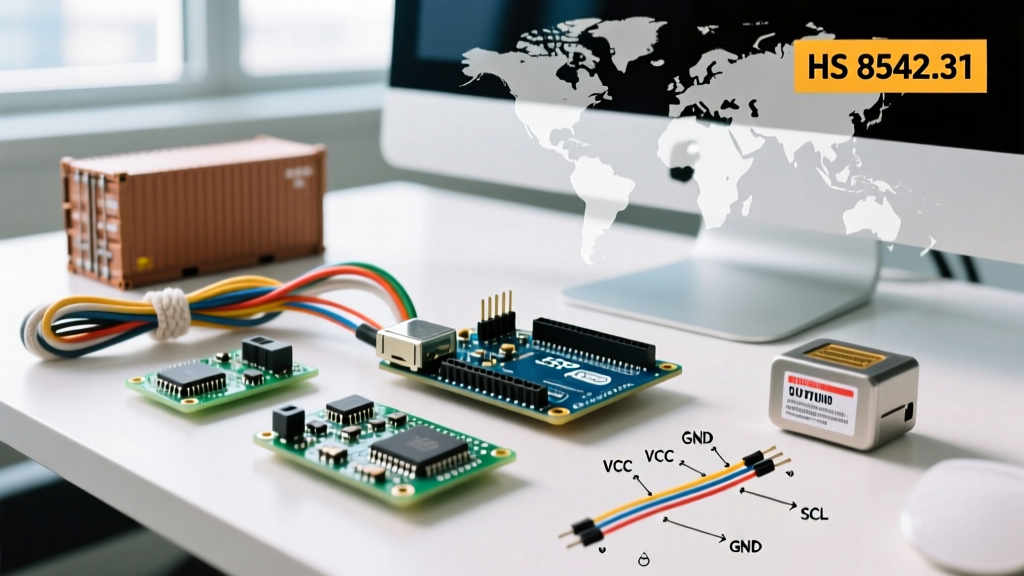
| Integrated Circuits (ICs) | 8542 | 8542.31 (Processors/MCUs), 8542.32 (Memories) | 0.0% |
| Printed Circuits (Bare PCBs) | 8534 | 8534.00 (Single/Double-sided, Multilayer) | 0.0% - 3.9% |
| Fixed Capacitors | 8532 | 8532.21 (Tantalum), 8532.24 (MLCC Ceramic) | 0.0% - 3.7% |
| Fixed Resistors | 8533 | 8533.21 (Power rating ≤ 20W) | 0.0% - 3.9% |
| Connectors & Relays | 8536 | 8536.69 (Coaxial/Circular connectors), 8536.41 (Relays ≤ 60V) | 2.5% - 5.3% |
| Semiconductor Devices | 8541 | 8541.21 (Transistors), 8541.51 (MOSFETs) | 0.0% - 2.5% |
Deep Dive: Navigating Classification Edge Cases
While discrete components like a standard 10kΩ resistor (8533.21) are straightforward, modern electronics frequently blur the lines between a 'component' and an 'assembly'. Misclassifying these edge cases is the leading cause of customs penalties.
Edge Case 1: Bare PCBs vs. Populated PCBA Boards
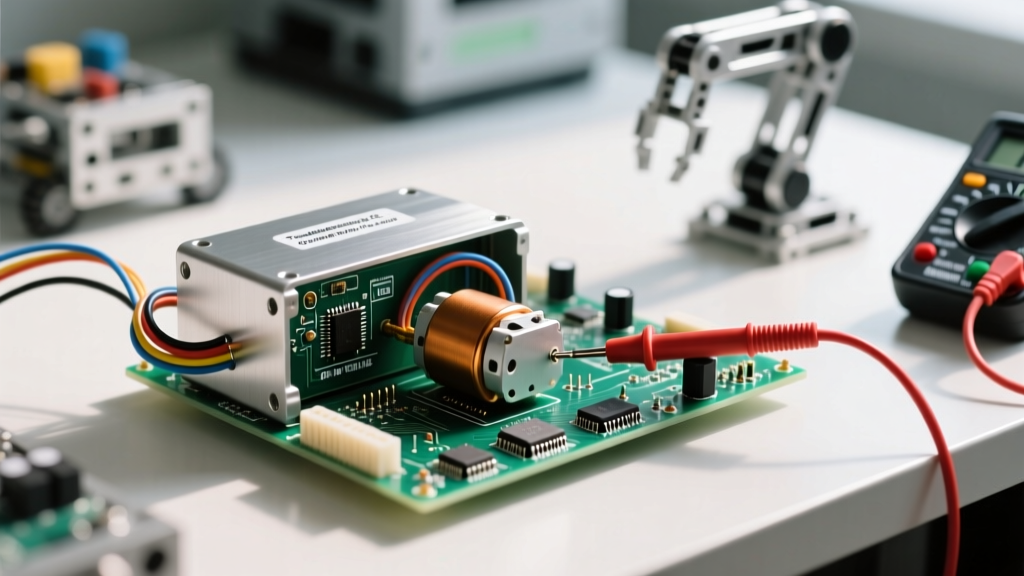
A bare, unpopulated printed circuit board is universally classified under 8534.00. However, once you populate that board with SMD components, it ceases to be a 'printed circuit' in the eyes of customs and becomes a 'Printed Circuit Board Assembly' (PCBA). How a PCBA is classified depends entirely on its function:
- Dedicated Assemblies: If the PCBA is solely designed for a specific device (e.g., a motherboard for a laptop), it is classified as a 'part' of that finished device (e.g., Chapter 84 for computers, or Chapter 87 for automotive electronics).
- General Control Boards: If the board is a general-purpose programmable logic controller or an industrial control board equipped with multiple connectors and relays, it often falls under 8537 (Boards, panels, consoles... equipped with two or more apparatus of heading 8535 or 8536).
Edge Case 2: Smart Modules and IoT Transceivers
Modules like the ESP32 or nRF52840 combine a microcontroller, flash memory, and an RF transceiver on a single shielded package. Are they processors (8542.31) or transmission apparatus (8517.62)? Under the HS 2022 revisions, smart communication modules that perform complex modulation and network routing are increasingly pushed toward 8517.62 (Machines for the reception, conversion and transmission of data), which can carry higher baseline tariffs than raw silicon ICs.
National Extensions: HTS, TARIC, and Schedule B
The 6-digit WCO code is only the beginning. To calculate actual landed costs, you must map the 6-digit code to your country's specific import or export schedule.
Importing to the United States (HTSUS)
The US uses the 10-digit Harmonized Tariff Schedule (HTS). You can verify exact classifications and duty rates using the US International Trade Commission (USITC) HTS Database. For example, while the 6-digit code for MLCC capacitors is 8532.24, the US 10-digit code might be 8532.24.0020 (Multilayer ceramic capacitors, surface mount), which dictates specific statistical reporting requirements.
Exporting from the United States (Schedule B)
If you are manufacturing in the US and exporting hardware, you must use Schedule B numbers. While often identical to HTS codes, they diverge in specific high-tech sectors. The US Census Bureau Schedule B Search is the mandatory tool for US exporters to file Electronic Export Information (EEI).
Importing to the European Union (TARIC)
The EU uses the TARIC system, which appends additional digits to track anti-dumping measures, eco-taxes (like WEEE compliance fees), and sanctions. An LED driver IC might have a 0% base rate, but TARIC will flag if the specific manufacturer is subject to regional anti-dumping duties.
The 2026 Tariff Landscape: Section 301 and Origin Rules
In 2026, the base MFN duty rate is only half the equation for North American importers. Under US Section 301 trade actions, many electronic components originating from China face punitive add-on tariffs ranging from 7.5% to 25%.
Crucial Compliance Note: HS codes do not dictate origin; they dictate the rate applied to the origin. If you source a PCBA (classified under a finished-good code) from Vietnam, but the primary ICs and PCBs were manufactured in China and merely soldered in Vietnam, US Customs and Border Protection (CBP) may rule that the 'substantial transformation' threshold was not met. The assembly will still be treated as Chinese origin, triggering the 25% Section 301 tariff. Always pair your HS code classification with a rigorous Country of Origin (COO) analysis.
Step-by-Step: How to Classify Your Electronics Shipment
- Gather Technical Datasheets: Customs brokers cannot classify a 'capacitor'. They need to know the dielectric material (ceramic, tantalum, aluminum electrolytic), capacitance range, and mounting type (SMD vs. through-hole).
- Identify the 6-Digit WCO Base: Use the general rules of interpretation (GRI) to find the correct heading and subheading in Chapter 85.
- Map to National Import Code: Use your destination country's official tariff database (e.g., USITC for the US, TARIC for the EU) to expand the 6-digit code to 8 or 10 digits.
- Check for Trade Remedies: Search the final 10-digit code against active anti-dumping, countervailing duties (CVD), or Section 301 lists based on the manufacturer's exact Country of Origin.
Frequently Asked Questions (FAQ)
Do I need a different HS code for lead-free vs. leaded components?
Generally, no. The Harmonized System classifies components based on their electrical function, physical construction, and material composition (e.g., ceramic vs. film), not their environmental compliance or RoHS status. Both leaded and lead-free solder paste typically fall under 8311.30 or 3806.90 depending on the flux core, regardless of lead content.
How are electronic component sample kits classified?
If you import a 'designer kit' containing assorted resistors, capacitors, and breadboards for educational or prototyping purposes, customs may classify it under 9023.00 (Instruments, apparatus and models, designed for demonstrational purposes) rather than breaking out every individual passive component. However, this requires the kit to be packaged strictly for demonstration/education and not for commercial resale or mass production.
What happens if my customs broker uses the wrong HS code?
As the Importer of Record (IOR), you are legally and financially liable for misclassifications, even if a licensed broker made the error. Penalties can include back-payment of duties, interest, and civil fines ranging from $1,000 to $10,000 per violation under US CBP regulations. Always audit your broker's entry summaries against your internal engineering BOMs.