
The Reality of Component End-of-Life (EOL) in 2026
For hardware engineers and DIY enthusiasts, few notifications are as dreaded as a Product Discontinuance Notice (PDN). When a critical integrated circuit transitions into an obsolete electronic component, it threatens production lines, legacy repair operations, and long-term prototyping projects. The semiconductor industry's relentless push toward smaller nodes means older, mature-process chips are routinely sunsetted to free up fab capacity.
A prime example is the legendary Zilog Z80 microprocessor. After nearly 50 years of continuous production, Zilog officially initiated the end-of-life process for the Z80 family in mid-2024. By 2026, sourcing genuine, factory-fresh Z84C0010FEC (the 10MHz CMOS 40-pin PDIP variant) from authorized distributors is virtually impossible, pushing buyers toward volatile secondary markets.
When you encounter an obsolete electronic component, you must pivot from a procurement mindset to an engineering strategy. Below, we compare the four most viable alternatives for managing component obsolescence, analyzing cost, risk, and engineering effort.
Alternative 1: The Gray Market and Broker Scavenging
The most immediate reaction to an EOL notice is to buy up remaining stock from independent brokers. While this requires zero PCB redesign, it is a tactical band-aid rather than a long-term strategy.
The Risks of the Secondary Market
As authorized inventory dries up, the gray market becomes flooded with counterfeit parts. According to data from ERAI (Electronic Resellers Association International), counterfeiters frequently use "blacktopping"—sanding the original markings off a cheaper, modern IC and re-stenciling it with the obsolete part number.
- Cost: High and volatile. A Z80 CPU that cost $4.50 in 2022 now trades for $18.00 to $35.00 on broker sites in 2026.
- Verification Overhead: Requires X-ray inspection and decapsulation (chemical removal of the epoxy package) to verify the silicon die matches the manufacturer's known good die (KGD) library.
- Longevity: Poor. You are simply delaying the inevitable.
Alternative 2: Pin-Compatible Drop-In Replacements
If you are dealing with standard logic families, linear regulators, or basic op-amps, finding a pin-compatible alternative from a different manufacturer is the gold standard. However, "pin-compatible" does not always mean "electrically identical."
Edge Case: TTL vs. CMOS Logic Level Mismatches
Suppose you are replacing an obsolete 74LS00 (Low-power Schottky TTL) NAND gate with a modern 74HC00 (High-speed CMOS). While the pinout is identical, the input voltage thresholds are drastically different.
| Parameter | 74LS00 (Obsolete/Legacy) | 74HC00 (Modern CMOS) | System Impact |
|---|---|---|---|
| V_IH (Min High Input) | 2.0V | 3.5V (at 5V VCC) | 3.3V MCU outputs will fail to register as a logical HIGH on the HC chip. |
| V_IL (Max Low Input) | 0.8V | 1.35V (at 5V VCC) | Noise margins are reduced; floating inputs cause massive shoot-through current. |
| Output Drive | Asymmetrical (Sink > Source) | Symmetrical | LEDs wired to VCC (active low) will be brighter; wired to GND (active high) will be dimmer. |
Expert Fix: If migrating from LS to HC families in a mixed-voltage system, utilize a dedicated level-shifter like the Texas Instruments TXB0104, or switch to the 74HCT series, which features TTL-compatible input thresholds (V_IH = 2.0V) while maintaining CMOS power efficiency.
Alternative 3: Modern Architecture Migration (PCB Redesign)
When a complex IC like a microcontroller or specialized DSP goes obsolete, and no drop-in replacement exists, you must redesign the PCB to accommodate a modern architecture. This is the most labor-intensive path but yields the best long-term ROI.
Case Study: Migrating from the Z80 to ARM Cortex-M0+
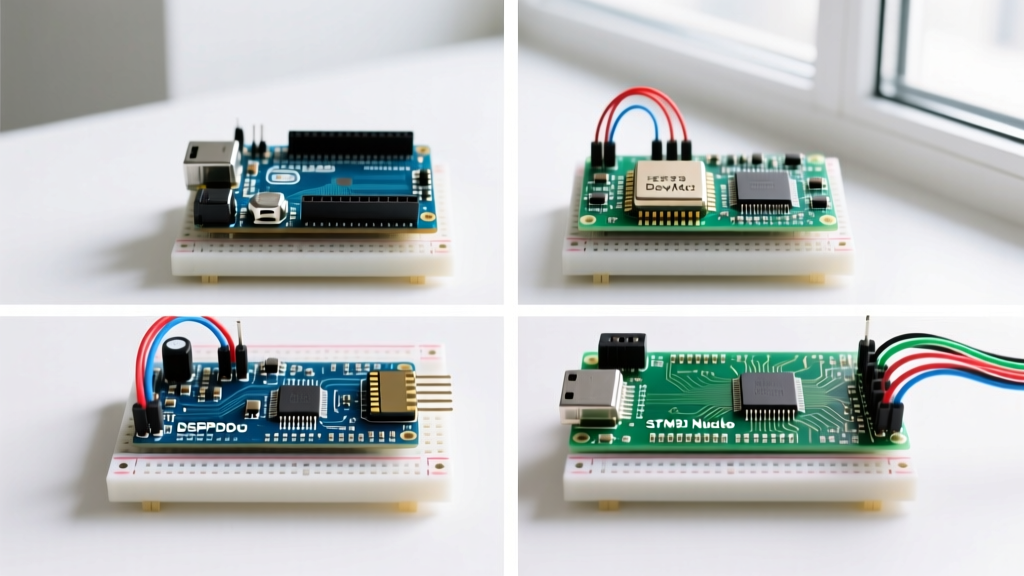
Replacing a 40-pin Z80 with a modern microcontroller requires fundamental architectural shifts. The Z80 relies on an external multiplexed address/data bus, external ROM, and external RAM. A modern ARM Cortex-M0+ (like the STM32G030F6P6) integrates Flash, SRAM, and the CPU core into a single 20-pin TSSOP package.
- Hardware Abstraction: You must rewrite the bare-metal assembly or C code. Z80 I/O port mapping (IN/OUT instructions) must be translated to ARM memory-mapped GPIO registers.
- Timing Corrections: Legacy code often relies on "instruction cycle counting" for software delays. A 64MHz ARM executes instructions in nanoseconds; you must replace cycle-counted loops with hardware timer interrupts.
- Cost Benefit: The STM32G030F6P6 costs approximately $1.15 in 2026, compared to $25.00+ for a broker-sourced Z80, while offering 32KB Flash, 8KB SRAM, and integrated ADCs.
Alternative 4: FPGA/CPLD Emulation (The Heritage Saver)
For legacy computing restorations, arcade board repairs, or aerospace applications where the original PCB traces cannot be altered, Field-Programmable Gate Arrays (FPGAs) offer a brilliant workaround. By loading a hardware description language (HDL) core into an FPGA, you can perfectly emulate the logic gates and timing of the obsolete electronic component.
Implementing an FPGA Emulator
Using a low-cost FPGA like the Lattice iCE40LP384-SG48 (approx. $4.50), you can synthesize open-source cores. For example, the TV80 or open-source Z80 cores available via the Yosys and NextPNR open-source synthesis toolchains can be compiled to mimic the exact bus-timing and wait-state behavior of the original silicon.
Engineering Insight: When emulating older NMOS processors on modern FPGAs, pay strict attention to bus contention. Legacy NMOS chips used open-drain outputs with passive pull-up resistors. Modern FPGAs use push-pull CMOS outputs. You must configure the FPGA I/O pins as open-drain in your Verilog/VHDL constraints to prevent shorting the bus when the legacy motherboard attempts to drive the same lines.
Comparison Matrix: Choosing Your Obsolescence Strategy
To help you decide which path to take, we have mapped the four alternatives against critical project constraints.
| Strategy | NRE (Non-Recurring Engineering) Cost | Time-to-Market | Long-Term Viability | Risk Profile |
|---|---|---|---|---|
| Gray Market Scavenging | $0 | Days (if stock exists) | Very Low | High (Counterfeits, degraded silicon) |
| Drop-In Replacement | Low ($500 - $2,000) | Weeks | High | Medium (Electrical mismatch edge cases) |
| Modern PCB Migration | High ($10,000+) | Months | Very High | Low (Future-proofed architecture) |
| FPGA/CPLD Emulation | Medium ($3,000 - $8,000) | Weeks to Months | Medium | Medium (Timing closure, signal integrity) |
Authorized Aftermarket Manufacturing: The Fifth Option
Before committing to a full PCB redesign, check if an authorized aftermarket manufacturer has acquired the original IP and tooling. Companies like Rochester Electronics specialize in obsolescence management. When a semiconductor giant EOLs a part, Rochester often purchases the wafers, die banks, and licensing rights to continue manufacturing the exact same component. While their per-unit pricing is higher than the original mass-market price, it guarantees 100% authentic, MIL-STD-883 compliant silicon without the need for redesign.
Summary and Best Practices
Encountering an obsolete electronic component is a catalyst for engineering evolution. While the gray market offers a temporary illusion of continuity, the risks of counterfeit silicon and degraded capacitors inside old packaging far outweigh the convenience.
For simple logic and analog parts, rigorously verify the electrical characteristics (not just the pinout) of drop-in CMOS replacements. For complex microcontrollers like the sunsetted Z80, embrace the opportunity to migrate to a modern 32-bit ARM architecture, utilizing the massive cost and performance benefits available in 2026. By maintaining a proactive Bill of Materials (BOM) lifecycle management strategy and monitoring PDNs before they hit the mainstream market, you can transition from reactive fire-fighting to strategic architectural upgrades.