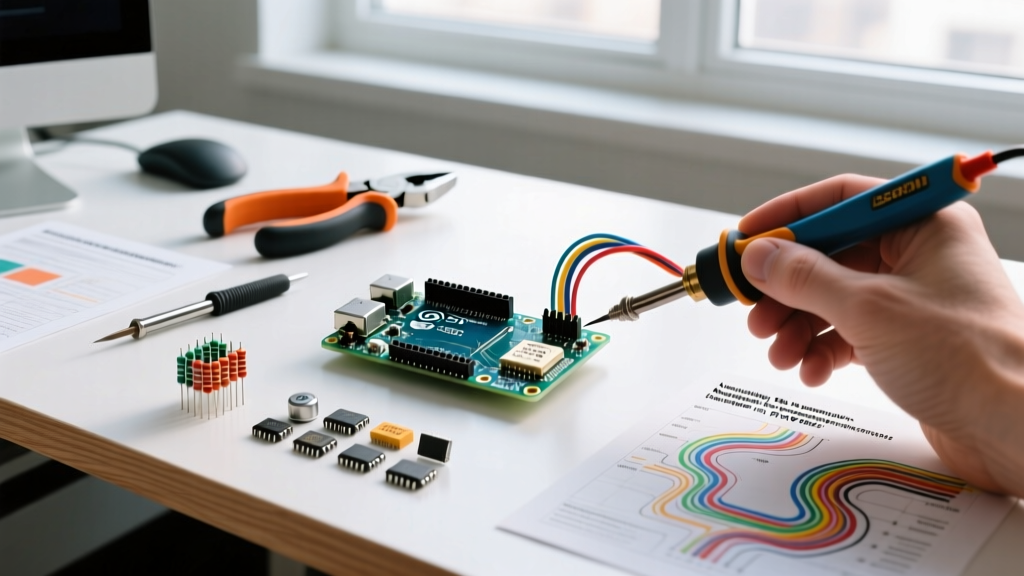

The Hidden Trap in Your Bill of Materials
You have spent three weeks perfecting the schematic for a custom IoT environmental monitor. The firmware is stable, the 3D-printed enclosure snaps together perfectly, and your breadboard prototype logs data flawlessly. You generate the Gerber files, finalize the Bill of Materials (BOM), and go to order 500 units of your core voltage regulator for a pilot production run. Then you see it: Discontinued by Manufacturer.
Welcome to the harsh reality of the electronic component lifecycle. In the stabilized but highly complex supply chain of 2026, simply picking parts that work on a breadboard is no longer enough. Whether you are scaling a DIY project into a Kickstarter product or designing a high-reliability sensor node for a university research lab, understanding where a component sits in its lifecycle is just as critical as its electrical specifications.
This guide uses a project-based learning approach to break down the lifecycle stages, decode manufacturer discontinuation notices, and implement actionable design strategies that protect your builds from premature obsolescence.
The 5 Stages of the Electronic Component Lifecycle
Every semiconductor and passive component goes through a predictable lifecycle. However, the duration of these stages varies wildly depending on the component type. Analog ICs and passives can remain in the 'Maturity' phase for decades, while specialized digital ICs or FPGAs might hit 'Decline' in just four to six years.
| Lifecycle Stage | Typical Duration | Pricing Trend | Project Risk Level | Recommended Action |
|---|---|---|---|---|
| 1. Introduction | 1 - 2 Years | Premium / High | High (Bugs, scarce supply) | Avoid for production; use only for R&D and proof-of-concept. |
| 2. Growth | 2 - 4 Years | Stabilizing | Medium (Allocations possible) | Design-in for new products; secure secondary suppliers. |
| 3. Maturity | 5 - 15+ Years | Lowest / Stable | Low (Multi-source available) | Ideal for new designs. Maximize footprint compatibility. |
| 4. Decline | 1 - 3 Years | Rising (Spotty stock) | High (Yield drops, NRND status) | Do not design-in. Begin validation of drop-in replacements. |
| 5. Phase-Out / EOL | N/A | Extreme (Gray market) | Critical (Counterfeit risk) | Execute Last Time Buy (LTB) or redesign the PCB immediately. |
Project Case Study: The 'FluxAir' Environmental Node
To see the electronic component lifecycle in action, let us examine a practical project: the 'FluxAir' indoor air quality monitor. This device measures VOCs, CO2, temperature, and humidity, transmitting data via Wi-Fi to a local MQTT broker.
Selecting the Microcontroller (Maturity Phase)
For the brain of the operation, we selected the ESP32-S3-WROOM-1 module. Espressif has committed to long-term availability for the S3 series, placing it firmly in the Maturity phase. At roughly $3.20 per unit in 1,000-piece reels, it offers a stable price point and abundant multi-source availability through authorized distributors like DigiKey and Mouser. Because it is mature, community support, errata sheets, and third-party toolchains are fully developed, minimizing firmware integration risks.
Selecting the Gas Sensor (Growth Phase)
For VOC detection, we chose the Sensirion SGP41. This MOx (Metal-Oxide) sensor is in the Growth phase. While it offers superior digital integration compared to older analog MOx sensors, its supply chain is still tightening as industrial and automotive clients ramp up adoption. Project Lesson: When designing with Growth-phase components, always implement an I2C abstraction layer in your firmware. If the SGP41 faces sudden allocation shortages, you can pivot to a Bosch BME688 with minimal code refactoring.
The Power Supply Trap (Decline Phase)
Suppose you pulled an old schematic from a 2018 tutorial and used the TI LM1117-3.3 linear regulator in an SOT-223 package. While the LM1117 is a legendary part, specific package variants and automotive-grade versions of older linear regulators frequently enter the Decline or Not Recommended for New Designs (NRND) phase as manufacturers shift silicon fab capacity to high-margin power management ICs (PMICs). If you design this into a custom PCB in 2026, you risk receiving a Product Discontinuation Notice (PDN) before your first pilot run ships.
Decoding the PDN: Your Early Warning System
A Product Discontinuation Notice (PDN) is the formal death certificate of a component. Manufacturers like Texas Instruments, STMicroelectronics, and NXP are legally and contractually obligated to issue these notices to direct customers, but they rarely make headlines. You must actively monitor them using tools like SiliconExpert's obsolescence management resources or by setting up BOM alerts on platforms like Octopart's engineering blog and dashboard.
ANATOMY OF A STANDARD PDN TIMELINE:
Notice Date: Day 0 (The day the manufacturer announces EOL).
Last Time Buy (LTB) Date: Typically 6 to 12 months after Notice Date. The final day you can place an order.
Last Time Ship (LTS) Date: Typically 6 months after the LTB. The final day the manufacturer will ship the parts to your dock.
Pro Tip: Always calculate your 2026 production forecast and add a 15% buffer for rework/scrap when executing an LTB. You cannot order more once the window closes.
Step-by-Step Lifecycle Mitigation Strategy
How do you protect your projects from the electronic component lifecycle without spending thousands of dollars on enterprise BOM management software? Follow this four-step mitigation flow.
- Standardize Footprints for Drop-In Replacements: Never use proprietary or obscure footprints. For LDOs, standard SOT-23-5 or SOT-223 footprints allow you to swap between TI, Microchip, and Diodes Inc. parts with only minor trace tweaks. For microcontrollers, design your PCB to accommodate both a QFN-32 and an SOIC-28 footprint if pin-compatible variants exist.
- Implement Hardware Abstraction Layers (HAL): Never write sensor-specific code in your main application loop. Create a C++ interface class (e.g.,
class AirSensor { virtual float getVOC() = 0; }). If your primary sensor hits the Decline phase, you can write a new driver for the replacement part that inherits from the same interface, leaving your business logic untouched. - Avoid 'Kitchen Sink' ICs: Highly integrated SoCs (System on Chip) that combine RF, MCU, and specialized analog front-ends are the first to be obsoleted when fab nodes change. Where space permits, separating the MCU from the RF module extends the lifecycle of your core logic board.
- Subscribe to Distributor API Webhooks: Use the DigiKey or Mouser APIs to set up automated stock and lifecycle status checks for your critical BOM items. If a part status changes from 'Active' to 'NRND', trigger an immediate alert to your project management dashboard.
Sourcing Alternatives: Authorized vs. Gray Market
When a component hits the EOL stage and you missed the LTB window, you are forced into the secondary market. Understanding the risks here is vital for project integrity.
Authorized Distributors (Mouser, DigiKey, Arrow, Farnell)
- Pros: 100% traceable to the original fab. Full manufacturer warranty. Guaranteed correct calibration data (critical for sensors like the SGP41).
- Cons: Once the LTS date passes, stock drops to absolute zero. You cannot buy EOL parts here.
Independent Brokers and Gray Market (Win Source, Utsource, eBay)
- Pros: Can often source 'new old stock' (NOS) or salvaged components years after EOL. Keeps legacy repair projects and low-volume prototypes alive.
- Cons: High risk of counterfeits. A counterfeit BME280 sensor might report temperature correctly but fail entirely on humidity due to a missing or cloned ASIC die. Reflow-salvaged parts may have degraded moisture sensitivity levels (MSL), leading to 'popcorning' during your PCB assembly.
Final Thoughts for the 2026 Builder
The era of hoarding components in plastic bins is over. Modern project-based engineering requires a proactive approach to the electronic component lifecycle. By selecting mature parts for your core architecture, designing flexible PCB footprints, and abstracting your firmware, you transform obsolescence from a project-killing crisis into a minor administrative task. Treat your BOM as a living document, and your DIY creations will survive long past the lifecycle of their individual silicon hearts.


