
The Hidden Hazards of Wire Connector Soldering
Soldering is a fundamental skill in electronics, but when you solder on wire connectors—such as ring terminals, spade lugs, butt splices, and solder-seal heat shrink tubing—the risk profile changes dramatically. Unlike soldering to a rigid, fire-resistant printed circuit board (PCB), wire connectors involve highly flammable polymer insulations, flexible strands prone to capillary wicking, and environments that often include enclosed automotive or aerospace harnesses.
A single mistake in thermal management or flux selection can lead to melted insulation, latent short circuits, toxic fume inhalation, or catastrophic electrical failures in high-vibration environments. According to the IPC/WHMA-A-620 standard for cable assemblies, improper soldering to wire connectors is a leading cause of field failures in critical systems. This guide outlines the uncompromising safety best practices required to protect both the operator and the integrity of the electrical system.
Pre-Soldering Safety Preparation and Workspace Setup
Before applying heat to any wire connector, your workspace must be configured to mitigate fire and chemical hazards. Wire insulation materials like PVC, polyolefin, and PTFE behave very differently under thermal stress.
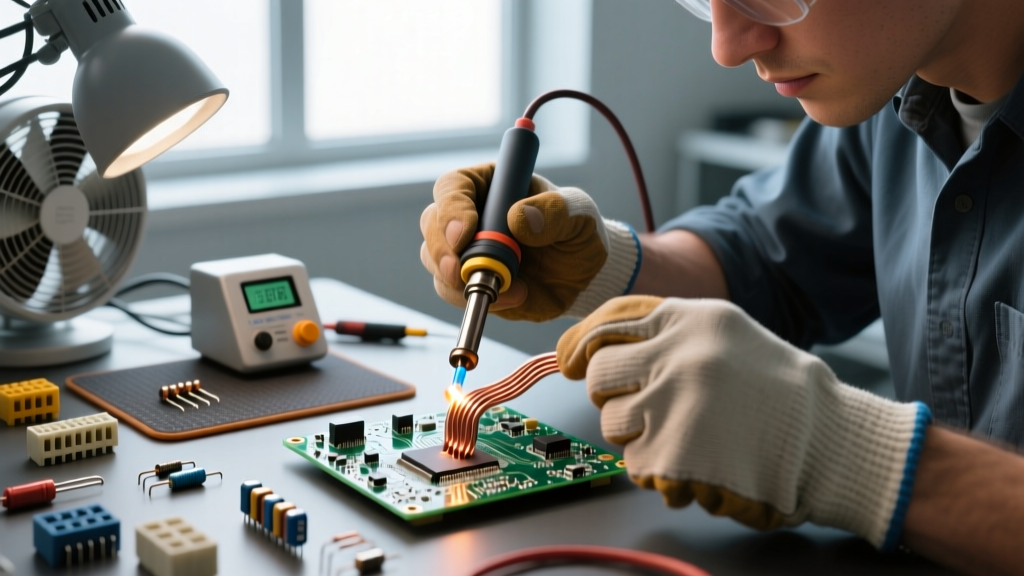
- ESD-Safe Silicone Mats: Never solder wire harnesses on standard plastic or wooden workbenches. Use a high-temperature, ESD-safe silicone mat rated for at least 500°C (932°F). Dropped solder irons or molten solder drips can instantly ignite wood shavings or melt through plastic bench protectors.
- Wire Stripping Precision: Use calibrated thermal wire strippers or high-quality mechanical strippers (like the Knipex MultiStrip 10). Nicking the copper strands during stripping creates micro-fractures that become structural failure points once heated, leading to arcing and localized heating later in the connector's life.
- Fire Suppression: Keep a Class C (electrical) fire extinguisher or a specialized lithium/copper fire blanket within arm's reach. Soldering near fuel lines, battery terminals, or solvent-soaked rags requires strict spatial awareness.
Thermal Management: Preventing Insulation Melt and Fires
The most immediate physical danger when you solder on wire connectors is thermal runaway. The polyolefin heat shrink used in solder-seal connectors (such as the popular TE Connectivity SolderSleeve series) typically begins to shrink at 120°C and fully recovers around 150°C. However, the solder inside these sleeves requires the iron tip to transfer enough heat to reach 183°C (for Sn63/Pb37) or 217°C (for lead-free SAC305) to achieve a proper wetting phase.
Temperature Profiling for Connectors
Using a fixed-wattage iron (like a cheap 40W pencil iron) is a severe safety hazard for wire connectors. These irons rely on the joint acting as a heat sink to regulate temperature. If the joint is small, the tip temperature can spike well over 450°C, instantly carbonizing the flux, melting the connector's plastic housing, and releasing toxic hydrochloric gas if PVC insulation is breached.
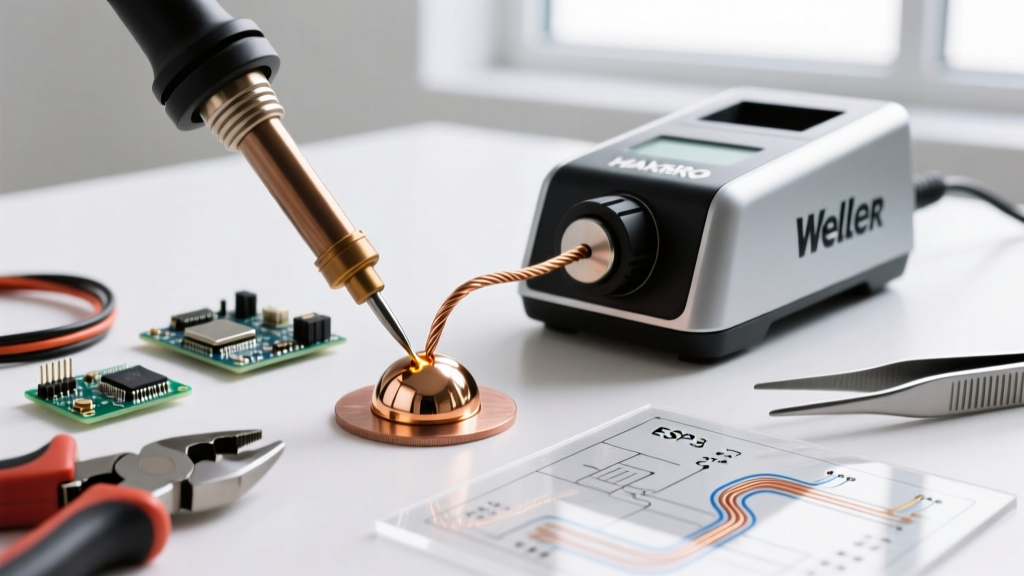
Expert Rule: Always use a temperature-controlled soldering station (e.g., Weller WE1010 or Hakko FX-888D). For standard ring terminals, set the dial to 350°C - 380°C. Apply heat for no more than 3 to 5 seconds. If the solder does not flow, stop, clean the tip, and reassess rather than holding the iron in place indefinitely.
The Heat Sink Technique
When soldering close to the wire's primary insulation, use a thermal heat sink. Clamping a copper alligator clip or a specialized hemostat between the solder joint and the wire insulation absorbs excess capillary heat. This prevents the insulation from melting back and exposing bare wire, which is a primary cause of accidental short circuits in tight harness bundles.
Chemical Safety: Flux Fumes and Lead Exposure Mitigation
The act of melting flux-core solder generates a plume of airborne particulates and volatile organic compounds (VOCs). The Harvard Environmental Health and Safety (EHS) guidelines explicitly warn that rosin-based (colophony) flux fumes are a known occupational asthmagen. Repeated exposure without extraction can lead to permanent respiratory sensitization.
Fume Extraction Protocols
Do not rely on simply "blowing" the smoke away or using a standard desk fan, which merely disperses the hazardous particulates around the room. You must use an active fume extractor equipped with a HEPA and activated carbon filter (such as the Hakko FA-400 or a dedicated BOFA extraction unit). Position the extraction nozzle exactly 2 to 4 inches from the solder joint to capture the plume before it reaches your breathing zone.
Handling Leaded Solder on Connectors
While lead-free solder is mandated in many commercial electronics (RoHS), aerospace, automotive, and high-reliability DIY projects still heavily rely on 63/37 leaded solder due to its superior resistance to tin whiskers and thermal fatigue. If using leaded solder on wire connectors:
- Never eat, drink, or touch your face while working.
- Wash hands thoroughly with cold water and specialized lead-removal soap immediately after the session.
- Wipe down the workspace with a damp disposable cloth to capture lead dust generated from handling the wire and connector terminals.
Failure Mode Analysis: When Poor Soldering Creates Safety Risks
A poorly executed solder joint on a wire connector isn't just an electrical nuisance; it is a latent safety hazard. Understanding failure modes helps you avoid practices that compromise the system.
The Danger of Solder Wicking
Capillary action causes molten solder to wick up into the stranded wire. If solder wicks under the primary wire insulation, the wire transitions from a flexible stranded cable to a rigid, brittle solid core exactly at the point of highest mechanical stress (the bend radius). According to NASA Workmanship Standards, solder wicking under insulation is a rejectable defect because vibration will eventually snap the brittle wire, leading to open circuits or arcing inside the harness.
Prevention: Apply flux only to the exposed terminal cup or splice area. Never pre-tin the entire length of a stranded wire before inserting it into a connector. Pre-tinning guarantees wicking and creates a high risk of mechanical failure.
Cold Joints and High-Resistance Heating
A "cold joint" occurs when the wire or connector is not heated sufficiently before the solder is applied, resulting in a grainy, dull connection that lacks metallurgical bonding. In high-current applications (e.g., automotive alternator wiring or solar battery banks), a cold joint introduces high electrical resistance. Under load, this resistance generates immense heat, which can melt the connector housing and start an electrical fire.
Comparative Data: Solder-Seal vs. Crimp Connectors for Safety
When deciding how to terminate a wire, understanding the safety profile of soldering versus crimping is vital, especially in high-vibration environments like automotive or marine applications.
| Safety & Reliability Metric | Solder-Seal Connectors | Properly Calibrated Crimp |
|---|---|---|
| Vibration Resistance | Moderate (Risk of fatigue if wicking occurs) | Excellent (Strands remain flexible) |
| Thermal Damage Risk | High (Requires 350°C+ heat source) | None (Cold process) |
| Environmental Sealing | Excellent (Integrated hot-melt adhesive) | Variable (Requires separate adhesive-lined shrink) |
| Operator Error Margin | Low (Highly dependent on iron temp and timing) | Low (Requires exact tool-to-wire gauge matching) |
| Current Carrying Capacity | Reduced if solder bridge is incomplete | Consistent gas-tight metallurgical bond |
Post-Soldering Verification and Electrical Isolation
Safety protocols do not end when the iron is turned off. Verifying the integrity of the soldered wire connector is the final barrier against catastrophic field failure.
- Visual Inspection: Use a magnifying lamp or digital microscope. The solder fillet should be smooth, shiny (for leaded), and exhibit a concave curve where it meets the wire and terminal. Look for "icicles" or solder spikes that could pierce adjacent heat shrink and cause a short circuit.
- The Tug Test: Give the wire a firm, deliberate pull. A proper metallurgical bond will not yield. If the wire pulls out, the joint was cold or contaminated with oil/oxidation. Do not simply add more solder; the connector must be replaced and the wire re-stripped.
- Dielectric Isolation Check: If working on multi-conductor connectors (like DB9 or Molex housings), use a digital multimeter in continuity mode to check for accidental solder bridges between adjacent pins. Flux residue can also become slightly conductive in high-humidity environments; clean the connector with 99% isopropyl alcohol and an ESD-safe brush if non-no-clean flux was used.
By treating the act of soldering wire connectors with the same rigorous safety and quality standards used in aerospace harness manufacturing, you eliminate the hidden risks of fires, toxic exposure, and catastrophic electrical failures.