
Decoding the Datasheet: What Is a Potentiometer Used For?
When hobbyists and engineers ask, "what is a potentiometer used for," the standard answer is usually "volume control" or "adjustable resistance." However, to truly master component selection for DIY audio, microcontrollers, and power electronics, you must look past the basic definition and read the manufacturer's datasheet. A datasheet does not just list resistance; it dictates the exact application, mechanical lifespan, and failure modes of the component.
In this guide, we will answer what a potentiometer is used for by breaking down real-world datasheets from industry-standard manufacturers like Bourns. By analyzing specific parameters such as taper codes, Contact Resistance Variation (CRV), and rotational torque, you will learn how to select the exact right component for your next prototyping project.
The Core Function: Voltage Division vs. Rheostat Mode
Before diving into specific datasheets, we must establish the two primary ways a potentiometer is used in a circuit. A standard 3-terminal potentiometer acts as a voltage divider. By tapping the wiper (terminal 2), you extract a variable voltage between 0V and your supply voltage. This is heavily used in microcontroller analog inputs (ADCs) and audio signal attenuation.
Conversely, when wired as a 2-terminal device (connecting the wiper to one outer terminal), it functions as a rheostat or variable resistor. Datasheets explicitly warn about power dissipation in this mode. While a voltage divider handles minimal current through the wiper, a rheostat configuration forces the entire circuit load current through the wiper contact, which can easily exceed the component's wiper current limit and cause catastrophic track burnout.
Case Study 1: Bourns PTV09A (Audio & Control Panels)
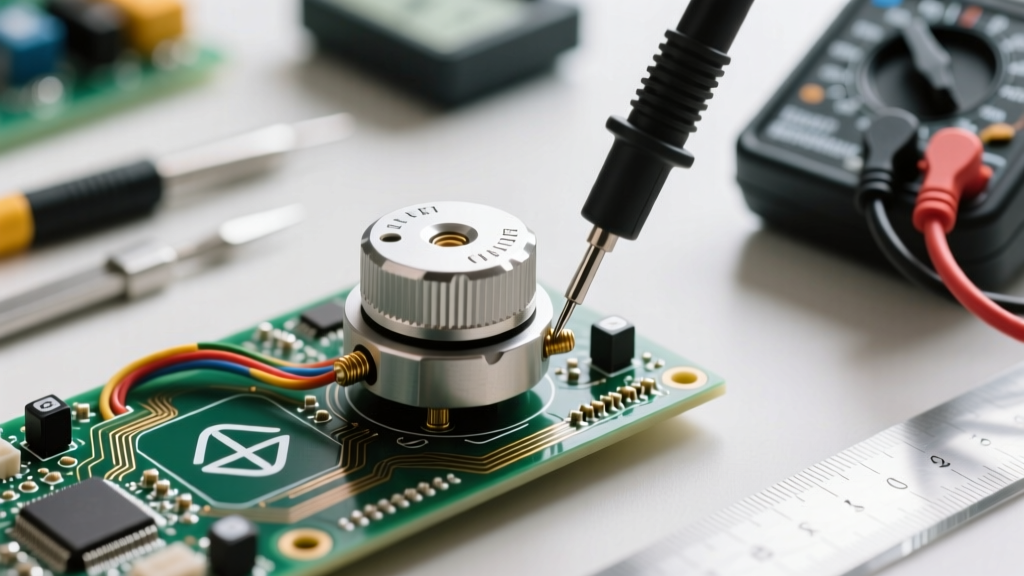
To understand what a standard panel-mount potentiometer is used for, let us examine the Bourns PTV09A Series Datasheet. This 9mm carbon composition potentiometer is ubiquitous in DIY guitar pedals, desktop audio mixers, and synthesizer control panels.
| Datasheet Parameter | Spec Value (PTV09A-4025F-B103) | What This Tells Us About Its Use |
|---|---|---|
| Power Rating | 0.05 Watt | Strictly for low-power signal control. Never use for motor speed or LED dimming. |
| Rotational Torque | 30 to 300 gf·cm | Provides physical "feel" resistance. Ideal for mixer knobs where users need tactile feedback. |
| Rotational Life | 100,000 Cycles | Suitable for daily user interaction (e.g., volume knobs) but not for continuous industrial automation. |
| Dielectric Strength | 500 VAC | Safe for standard low-voltage DC audio and microcontroller circuits (3.3V to 48V). |
Understanding Taper: The Secret to Audio vs. Linear Uses
The most critical part of the PTV09A datasheet is the taper code, which defines exactly what the potentiometer is used for in terms of human-machine interaction. The part number suffix dictates the taper:
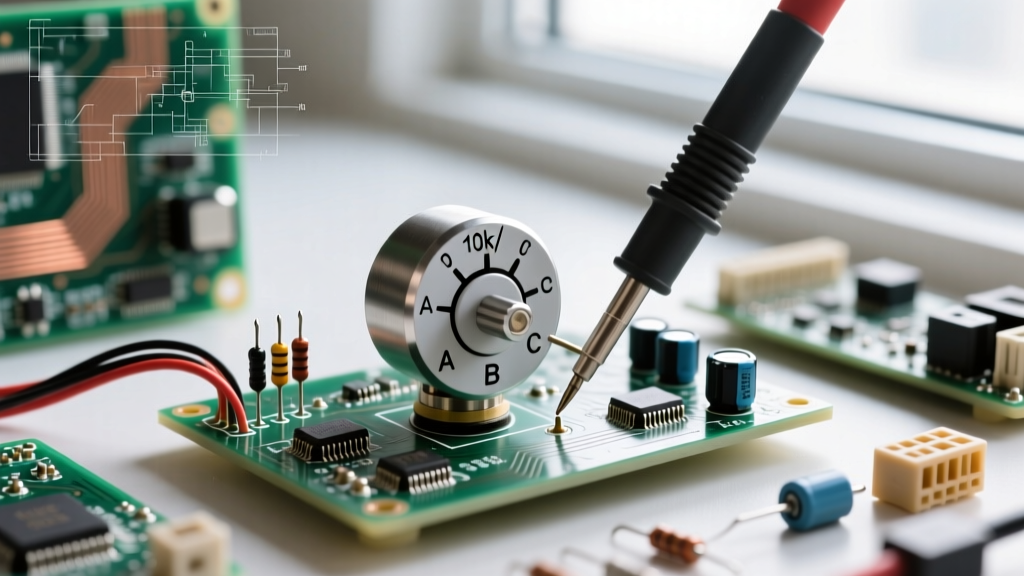
- B Taper (Linear): The resistance changes at a constant rate relative to the shaft rotation. A 10kΩ B-taper pot will measure exactly 5kΩ at the 50% rotation mark. This is used for microcontroller inputs, panning circuits, and motorized faders where the ADC expects a linear voltage mapping.
- A Taper (Audio/Logarithmic): The resistance changes exponentially. At 50% rotation, a 10kΩ A-taper pot might only measure 1.5kΩ. Why? Because human hearing perceives loudness logarithmically. If you use a linear pot for an amplifier volume control, 80% of the perceived volume change happens in the first 20% of the knob twist. An audio taper compensates for this biological quirk, making it the mandatory choice for DIY audio amplifiers.
Case Study 2: Bourns 3296W Trimpot (Calibration & Tuning)
Panel pots are for users; trimpots (trimming potentiometers) are for engineers. When evaluating what a trimpot is used for, we look at the Bourns 3296 Series Datasheet. These are the small blue, multi-turn cermet components you solder directly onto PCBs.
Why Cermet and Multi-Turn?
The 3296W uses a cermet (ceramic and metal) resistive track rather than carbon. The datasheet specifies a 25-turn adjustment. This mechanical gearing is used for ultra-precise calibration. For example, when building a DIY digital multimeter or tuning the feedback loop of a buck converter, you need to adjust the voltage by mere millivolts. A standard single-turn knob makes this impossible. The 25-turn trimpot allows you to sweep across the entire resistance range with 25 full rotations of a micro-screwdriver, providing immense precision.
Engineer's Note on Trimpot Failure: Datasheets for cermet trimpots note a higher Contact Resistance Variation (CRV) compared to conductive plastic pots. If you use a 3296W trimpot in an audio signal path instead of a DC bias calibration circuit, you will likely introduce severe "scratchy" noise due to the wiper bouncing microscopically across the granular cermet track.
Critical Datasheet Parameters You Cannot Ignore
When asking what a potentiometer is used for, the answer is often hidden in the "Electrical Characteristics" table of the datasheet. Here are three parameters that separate amateur builds from professional-grade prototypes:
1. Contact Resistance Variation (CRV)
CRV measures the maximum change in resistance between the wiper and the track as the shaft is rotated, excluding the intended resistive track value. In high-fidelity DIY audio preamps, a high CRV results in channel imbalance and audible popping. For audio applications, always look for pots with a CRV of less than 3% or conductive plastic elements which offer smoother wiper tracking than carbon composition.
2. Wiper Current Limit vs. Total Power Rating
A common prototyping mistake is looking at a pot's total power rating (e.g., 0.5W) and assuming it can handle 0.5W in any configuration. The datasheet will often include a "Wiper Current Limit" graph. In a rheostat configuration, the wiper contact point is incredibly small and can melt if subjected to high localized current, even if the total track can dissipate the heat. Always use voltage divider configurations for higher power circuits, or select heavy-duty wirewound potentiometers for power applications.
3. Environmental Sealing (IP Ratings)
If you are building a guitar pedal or an outdoor sensor array, standard open-frame pots will fail due to dust and humidity ingress. Datasheets for sealed potentiometers (like the Bourns PDB18 series) will explicitly state "Sealed for Wave Soldering and Cleaning." This means they are used for environments where conformal coating, flux washing, or high humidity is expected.
Practical Wiring: 3-Terminal vs 2-Terminal Configurations
Understanding what a potentiometer is used for requires knowing how to wire it. As detailed in resources like Electronic Tutorials, the wiring topology changes the component's fundamental behavior.
- Pin 1 to VCC, Pin 3 to GND, Pin 2 to ADC: Standard voltage divider. Used for reading sensor positions, user dials on an Arduino, and setting reference voltages for comparators.
- Pin 1 to Audio In, Pin 3 to GND, Pin 2 to Audio Out: Passive volume attenuation. The track resistance forms an impedance bridge. (Note: Ensure the pot's resistance is significantly lower than the source impedance but higher than the load impedance to prevent high-frequency roll-off).
- Pin 1 and Pin 2 tied together, Pin 3 to GND: Variable resistor (Rheostat). Used for tuning RC oscillator frequencies (like in a 555 timer astable circuit) or adjusting LED current limits (only for low-power indicator LEDs).
Summary: Selecting the Right Pot for Your Next Build
Ultimately, what a potentiometer is used for is entirely dictated by its material construction, taper, and mechanical specifications outlined in its datasheet. Use carbon composition A-taper pots for user-facing audio volume controls where logarithmic hearing compensation is required. Use linear B-taper pots for microcontroller ADC inputs and servo positioning. Rely on multi-turn cermet trimpots for one-time PCB calibration and bias tuning. By reading the CRV, torque, and wiper current limits, you ensure your DIY electronics not only function on the breadboard but survive long-term deployment in the real world.