
The Intersection of Physics and the National Electrical Code
Every electrical installation relies on the fundamental interplay between a conductor and insulator. While physics defines their basic roles—the conductor facilitates electron flow, and the insulator restricts it to prevent short circuits and ground faults—the National Electrical Code (NEC) dictates exactly how they must be manufactured, rated, and installed. For electricians, engineers, and advanced DIYers, understanding the intersection of material science and NEC Article 310 is non-negotiable. A mismatch between the conductor material and the insulator's thermal rating is one of the leading causes of termination failures, conduit meltdowns, and electrical fires.
From a code compliance perspective, the NEC does not merely view wire as a single entity. It heavily regulates the metallurgical purity of the metal and the chemical composition of the jacket. This guide breaks down the strict code standards governing the modern conductor and insulator, ensuring your next project meets both safety minimums and long-term reliability benchmarks.
The NEC Framework: Regulating the Conductor and Insulator
The primary authority governing wire in the United States is NFPA 70, widely known as the NEC. Specifically, Article 310 covers Conductors for General Wiring. However, the code relies on underlying product safety standards developed by Underwriters Laboratories (UL). For instance, thermoplastic-insulated wires must meet UL 83, while thermoset-insulated wires must meet UL 44.
When you purchase a spool of wire, the UL listing mark and the specific NEC letter designations printed on the jacket are your legal proof of compliance. The NEC requires that every conductor and insulator combination be marked with the maximum rated voltage, the proper letter type, the manufacturer's name, and the conductor size in AWG or kcmil. If the insulation lacks these markings, NEC 110.12 prohibits its use in a permanent installation, regardless of its physical quality.
Conductor Metallurgy: Copper vs. Aluminum Under the Code
The choice of conductor material fundamentally alters the sizing, termination, and handling requirements outlined in the NEC. While copper remains the undisputed king of residential and light commercial wiring due to its high tensile strength and superior conductivity, aluminum is heavily utilized in feeders and service entrance conductors for its cost-to-weight ratio.
However, the NEC has strict historical trauma regarding aluminum. In the 1970s, the use of AA-1350 aluminum alloy in branch circuits led to widespread fires due to thermal expansion, creep, and oxidation at termination points. To rectify this, the NEC now mandates specific alloy compositions.
NEC Conductor Material Specifications
| Material | NEC / ASTM Specification | Primary Application | Code Termination Requirement |
|---|---|---|---|
| Soft-Drawn Copper | ASTM B3 / NEC 310.106 | Branch circuits, feeders, control wiring | Standard CU/AL rated lugs; anti-oxidant not required |
| AA-8000 Series Aluminum | ASTM B800 / NEC 310.14 | Service entrances, large feeders, branch circuits >8 AWG | Must use CO/ALR or AL-rated lugs; requires listed anti-oxidant compound |
| AA-1350 Aluminum | Prohibited for branch circuits | Utility transmission, busbars | Not permitted under NEC for premises branch wiring |
According to the Copper Development Association, annealed copper sets the baseline for 100% IACS (International Annealed Copper Standard) conductivity. When sizing aluminum conductors, NEC Table 310.16 requires you to step up roughly two AWG sizes compared to copper to achieve the same ampacity, directly impacting conduit fill calculations.
Insulation Chemistry and the NEC Letter Codes
The insulator is arguably more complex than the conductor. It must provide dielectric isolation, resist thermal degradation, repel moisture, and withstand mechanical abrasion during conduit pulls. The NEC uses a standardized letter coding system to define the chemical and thermal properties of the insulator.
- T (Thermoplastic): Typically PVC (Polyvinyl Chloride). It melts when exposed to high heat and can become brittle in extreme cold.
- X (Cross-linked): Typically XLPE (Cross-linked Polyethylene). The molecular chains are chemically or electronically bonded, creating a thermoset material that will not melt, only char at extreme temperatures.
- H / HH (Heat / High Heat): Denotes the thermal rating. 'H' is rated for 75°C, while 'HH' is rated for 90°C.
- W (Water): Indicates the insulator is approved for wet locations, such as underground conduit or outdoor exposure.
- N (Nylon): A secondary outer jacket applied over PVC to provide exceptional mechanical toughness and resistance to gasoline, oil, and alkaline substances.
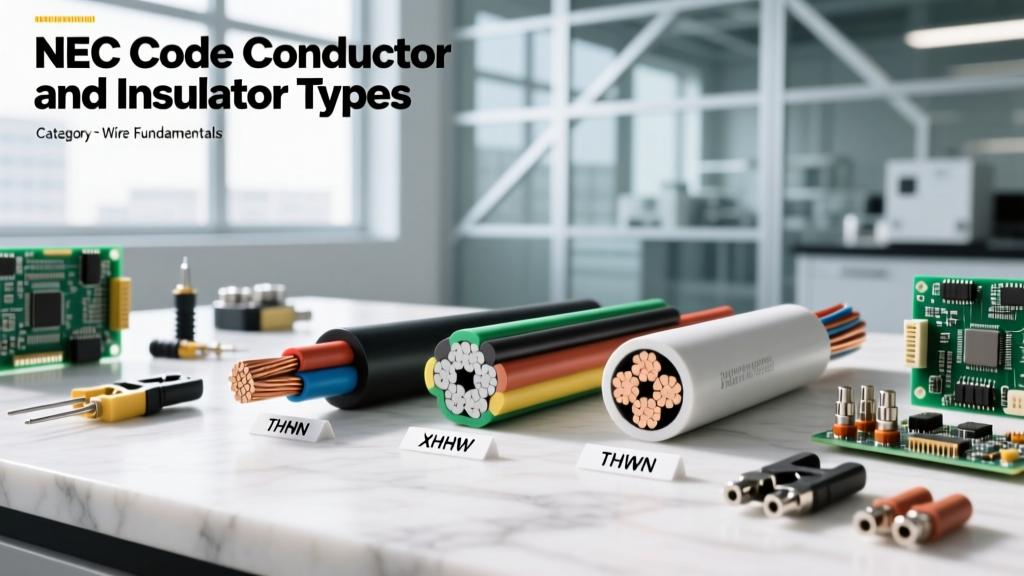
Comparing the Big Three: THHN, THWN-2, and XHHW-2
THHN (Thermoplastic High Heat-resistant Nylon-coated): The standard for dry, indoor commercial and residential conduit runs. The nylon jacket allows for easier pulling through PVC or EMT conduit due to its low coefficient of friction. However, nylon is highly susceptible to degradation in continuous wet environments.
THWN-2: The modern dual-rated standard. Most manufacturers produce a wire that meets both THHN and THWN-2 specifications. The '2' indicates it is rated for 90°C in both dry and wet locations, making it the most versatile thermoplastic wire on the market.
XHHW-2: The premium choice for commercial and industrial feeders. Because XLPE insulation has a higher dielectric strength than PVC, the insulation wall can be manufactured much thinner. This thinner profile means you can fit more XHHW-2 conductors into a single raceway before violating NEC Chapter 9 conduit fill tables. Furthermore, XHHW-2 is highly resistant to 'water treeing'—a phenomenon where micro-channels form in the insulation in wet environments, eventually leading to dielectric breakdown.
The 90°C Derating Trap: A Critical Code Warning
One of the most common violations among junior electricians and DIYers involves the misuse of the 90°C ampacity column in NEC Table 310.16. Because modern conductors like THHN and XHHW-2 are rated for 90°C, many assume they can safely run 40 amps on an 8 AWG copper wire (which is rated 55A at 90°C).
NEC 110.14(C) Termination Limitations: The temperature rating associated with the ampacity of a conductor shall be selected and coordinated so that the lowest temperature rating of any connected termination, conductor, or device is not exceeded. In almost all residential and commercial breakers, the lugs are rated for a maximum of 75°C.
The Correct Workflow: You are permitted to use the 90°C column of Table 310.16 to apply derating factors (such as bundling four current-carrying conductors in a single conduit, per NEC 310.15). However, after the derating math is complete, the final allowable ampacity must be capped at the 75°C or 60°C column, depending on the breaker terminals. The conductor and insulator must work together to survive the heat generated at the termination point, which is why the 75°C limit is strictly enforced.
Environmental Degradation and Wet Location Definitions
The NEC defines wet, damp, and dry locations in Article 100, and the insulator must be chosen accordingly. A location subject to saturation with water or unprotected exposure to weather is a 'Wet Location'. If you use a strictly THHN-rated conductor (without the THWN-2 dual rating) in an underground PVC conduit that has accumulated groundwater, the nylon jacket will absorb moisture and degrade. Over time, the PVC underneath will suffer from plasticizer loss, leading to micro-cracking. Once the insulator cracks, the conductor will fault to the grounded raceway, tripping the breaker or, worse, energizing the conduit.
For direct burial or underground wet locations, UF-B (Underground Feeder) or USE-2 (Underground Service Entrance) cables are required. USE-2 utilizes a rugged, sunlight-resistant, cross-linked thermoset insulator designed to withstand the harsh chemical environment of damp soil without the need for an additional conduit.
Summary: Matching the Conductor and Insulator to the Application
Selecting the right wire is not merely about matching the AWG size to the breaker. It requires a holistic understanding of how the conductor and insulator will perform under thermal stress, mechanical strain, and environmental exposure. By adhering strictly to NEC Article 310, respecting the 110.14 termination limits, and choosing the correct insulation chemistry (THWN-2 for versatility, XHHW-2 for high-capacity wet locations), you ensure an installation that is not only legally compliant but engineered for decades of safe operation. Always consult the latest edition of UL wire standards and the NEC to verify manufacturer specifications before pulling wire in complex commercial environments.