
When navigating the complex landscape of commercial and residential electrical infrastructure, metal sheathed wiring stands out for its mechanical durability, fire resistance, and EMI shielding. However, misinterpreting the National Electrical Code (NEC) regarding these cables is a frequent source of failed inspections, latent safety hazards, and costly rework. Many electricians and engineers still use the archaic term 'BX' to describe all metal-armored cables, a nomenclature error that masks critical code distinctions.
As a code and standards explainer, this guide dissects the precise NEC requirements for metal sheathed systems—specifically Armored Cable (Type AC) and Metal-Clad Cable (Type MC). We will explore the exact articles, bending limits, and grounding mechanisms required to ensure your installations meet the highest standards of safety and compliance.
Decoding the NEC: What Qualifies as Metal Sheathed Wiring?
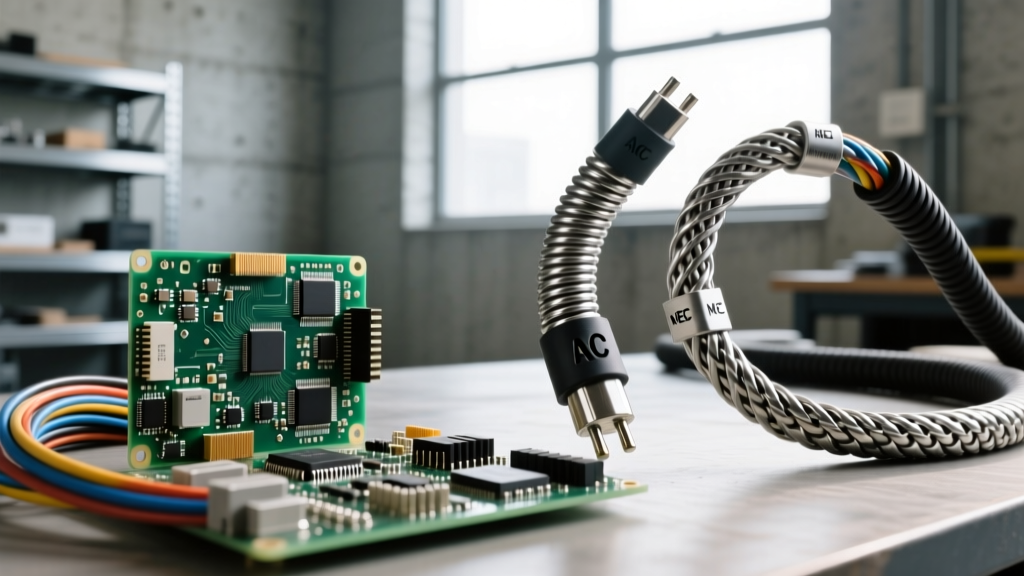
The NEC does not have a single, monolithic article for 'metal sheathed wiring.' Instead, the code categorizes these assemblies based on their internal construction, armor type, and grounding methodology. The three primary categories you will encounter in the field are:
- Type AC (Armored Cable): Governed by NEC Article 320. Features a flexible metal tape armor with an internal equipment bonding strip.
- Type MC (Metal-Clad Cable): Governed by NEC Article 330. Features interlocking metal tape or a smooth/corrugated metallic tube, containing a dedicated Equipment Grounding Conductor (EGC).
- Type MI (Mineral-Insulated): Governed by NEC Article 332. A copper sheath encasing ceramic-insulated conductors, used almost exclusively for extreme high-temperature and life-safety circuits.
Understanding the boundary between Type AC and Type MC is the most critical hurdle for electrical contractors, as their grounding methodologies and permitted use cases diverge significantly under the NEC.
Article 320 vs. Article 330: The Grounding Dilemma
The most profound difference between AC and MC metal sheathed wiring lies in how they handle fault currents. In a metal-clad system, the armor provides physical protection, but it is not necessarily the primary path for fault current.
The Type AC Bonding Strip Limitation
Under NEC 320.108, Type AC cable relies on the combination of the spiral metal armor and an internal, uninsulated equipment bonding strip (usually bare aluminum or copper) running in direct contact with the armor. This composite path must provide a low-impedance ground. However, because the spiral armor introduces inductance and the contact resistance can vary, the NEC restricts Type AC cable to circuits rated 600 volts or less, and it is heavily limited in high-fault-current commercial environments.
The Type MC Dedicated EGC Advantage
Type MC cable eliminates this ambiguity. Per AFC Cable Systems manufacturing standards and NEC 330.108, MC cable contains a dedicated, fully sized green Equipment Grounding Conductor (EGC) inside the sheath. While some modern MC cables feature 'continuous corrugated armor' that is UL-listed to serve as an EGC, standard interlocked MC relies on the internal copper wire. This makes MC cable the undisputed standard for commercial feeders, branch circuits, and critical infrastructure where reliable, low-impedance fault clearing is non-negotiable.
The Anti-Short Bushing Mandate: Preventing Arc Faults
One of the most frequently cited violations during rough-in inspections involves the termination of Type AC cable. When the spiral steel or aluminum armor is cut, it leaves a jagged, razor-sharp edge. If the THHN or THWN conductor insulation rubs against this edge during pulling or over time due to vibration, it will slice the insulation, energizing the metal armor and creating a severe shock and arc-flash hazard.
'The NEC mandates the use of insulating bushings to protect conductor insulation from the abrasive edges of cut metal armor. Skipping this step is an immediate red-tag violation.' — NEC Handbook Commentary, Section 320.40
NEC 320.40 strictly requires the insertion of an insulating anti-short bushing (colloquially known as a 'red head' due to its standard color) between the conductors and the armor edge at every termination. While Type MC cable with a smooth metallic sheath does not always require this if the sheath is cleanly deburred, interlocked MC and all AC cables demand rigorous attention to this termination detail.
Installation Metrics: Bending Radii and Support Spacing
Metal sheathed wiring cannot be bent like non-metallic (NM) Romex. Over-bending compromises the interlocking armor, causing the metal tape to kink, which can crush the internal conductors or slice the insulation binder tape. The NEC provides strict, mathematically defined bending radii based on the cable's outer diameter (O.D.).
| Cable Type | Armor Style | NEC Article | Minimum Bending Radius | Max Support Spacing |
|---|---|---|---|---|
| Type AC | Spiral Tape | 320.24 | 7 x Outer Diameter | 4.5 Feet (1.4 m) |
| Type MC | Interlocked Tape | 330.24(A) | 7 x Outer Diameter | 6 Feet (1.8 m) |
| Type MC | Smooth Sheath | 330.24(B) | 10 x Outer Diameter | 6 Feet (1.8 m) |
| Type MC | Corrugated Sheath | 330.24(C) | 7 x Outer Diameter | 6 Feet (1.8 m) |
Pro-Tip for Field Bending: When bending 1/2-inch trade size MC cable (typical O.D. of ~0.65 inches), the minimum bending radius is roughly 4.5 inches. Using a dedicated ratcheting cable bender designed for MC/AC prevents the 'kink-and-flatten' failure mode that occurs when electricians attempt to bend the cable around their knee or a sharp stud edge.
Environmental Limitations and Corrosion Failure Modes
While the metal sheath implies ruggedness, it introduces specific chemical and environmental vulnerabilities that the NEC addresses in Articles 320.12 and 330.12.
Galvanic Corrosion in Steel Framing
Standard MC and AC cables utilize aluminum interlocking armor. When this aluminum armor is pulled tightly through holes punched in galvanized or bare steel studs, and the environment experiences high humidity or condensation, a galvanic cell is formed. The aluminum acts as the anode and corrodes rapidly, eventually compromising the sheath's mechanical integrity. To mitigate this, the NEC requires the use of insulating grommets or bushings when passing metal sheathed wiring through metal framing members.
Wet Locations and Embedded Concrete
Standard metal sheathed wiring is strictly prohibited in wet locations or where embedded in poured concrete unless specifically listed for the use. The alkaline nature of wet concrete (high pH) aggressively attacks aluminum armor. For these environments, contractors must specify PVC-Jacketed MC Cable, which features an extruded polyvinyl chloride outer shell over the metal armor, providing a chemical barrier while maintaining the cable's crush resistance.
Practical Decision Framework: When to Specify Metal Sheath
Choosing between NM-B, AC, and MC requires balancing material costs, labor efficiency, and code mandates. Use this framework for your next project:
- Specify Type AC when: You are wiring residential retrofits or multi-family dwellings where the code requires metal sheathing (e.g., certain fire-rated assemblies or exposed runs in basements), but fault currents remain low and budget is a primary constraint.
- Specify Standard Type MC when: You are executing commercial tenant improvements, office build-outs, or retail spaces. The dedicated EGC ensures clean grounding for sensitive electronics, and the interlocked armor protects against accidental impacts from drywallers and HVAC contractors.
- Specify PVC-Jacketed MC when: Routing through outdoor concrete decks, parking garages, or agricultural facilities where corrosive gases and moisture are present.
- Specify Type MI when: Designing life-safety circuits (e.g., fire pump feeders, emergency stairwell lighting) that must maintain circuit integrity during a 2-hour fire exposure.
By treating metal sheathed wiring not just as a physical product, but as a code-defined system with specific electrical and mechanical boundaries, electrical professionals can eliminate rework, pass inspections on the first attempt, and deliver infrastructure that stands the test of time.