
The Verdict: Is the HC-SR04 Still Worth It in Your Parts Bin?
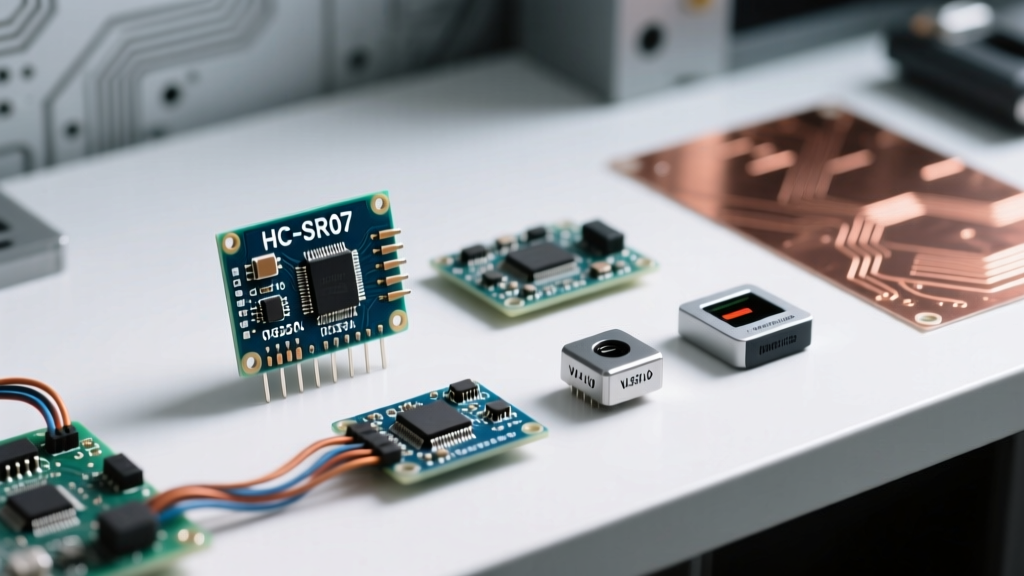
If you have ever built a DIY robot, a smart trash can, or an Arduino-based parking assistant, you have likely used the HC-SR04 ultrasonic sensor. Priced at roughly $1 to $2 in bulk, it is undeniably the '555 timer' of the distance-sensing world: ubiquitous, incredibly cheap, and fundamentally flawed. But does it still hold up against modern alternatives? As a tool review, the short answer is yes, but only if you understand its severe acoustic and electrical limitations. In this deep-dive review, we tear down the HC-SR04 ultrasonic sensor, examine its internal circuitry, expose its real-world failure modes, and provide a definitive buying guide for when you should use it—and when you must upgrade.
Under the Hood: HC-SR04 Technical Specifications & Reality Check
On paper, the HC-SR04 boasts a measurement range of 2cm to 400cm with a theoretical accuracy of 3mm. It operates by emitting an eight-pulse burst at 40kHz and measuring the time it takes for the acoustic echo to return to the receiver transducer. However, the reality of cheap manufacturing tells a different story.
The Internal Circuitry
Cracking open the datasheet and reverse-engineering the PCB reveals a surprisingly robust analog front-end for a $1 sensor. The transmitter circuit typically utilizes a MAX232 clone or a discrete voltage-doubling charge pump to drive the 40kHz transmitter transducer at roughly 20V peak-to-peak. This high voltage is necessary to generate enough acoustic pressure to bounce off distant, sound-absorbing targets. On the receiving end, an LM324 quad operational amplifier acts as a bandpass filter and comparator, isolating the faint 40kHz echo from ambient acoustic noise.
The 'Blind Spot' and Beam Angle Problem
Marketing materials often cite a 15-degree beam angle. In reality, the HC-SR04 suffers from severe acoustic side-lobes. While the main lobe is roughly 15 degrees, secondary side-lobes extend out to 30 or 40 degrees. If you place the sensor near a wall or a corner, these side-lobes will reflect off adjacent surfaces, returning to the receiver faster than the main lobe's reflection. This 'multipath error' results in the sensor reporting a distance that is significantly shorter than the actual target. Furthermore, the physical separation between the TX and RX transducers creates a mandatory blind spot of about 2cm to 3cm, making it useless for flush-mounting or precise short-range proximity detection.
Real-World Failure Modes (And How to Fix Them)
To use the HC-SR04 ultrasonic sensor effectively in 2026 and beyond, you must engineer around its inherent hardware and environmental flaws. Here are the most common failure modes encountered in the field.
1. Temperature and Humidity Drift
The HC-SR04 calculates distance based on the time-of-flight of sound, assuming a fixed speed of sound in air (roughly 343 meters per second). However, as documented by the Engineering Toolbox, the speed of sound is highly dependent on ambient temperature. At 0°C, sound travels at 331 m/s; at 30°C, it travels at nearly 349 m/s. If your code uses a hardcoded speed of sound and your robot moves from an air-conditioned room (20°C) to a hot outdoor environment (35°C), your distance measurements will drift by over 2.5%. For a 2-meter measurement, that is a 5cm error. The Fix: Integrate a cheap DHT22 or BME280 temperature sensor into your project and dynamically adjust the speed of sound variable in your C++ or Python code.
2. The 'Echo Pin Stuck High' Latch-Up
A notorious bug with clone HC-SR04 modules is the Echo pin getting 'stuck' in a HIGH state. This happens when the internal logic resets during the 40kHz burst phase, often due to a voltage brownout on the 5V rail. If your microcontroller is waiting for the pin to go LOW to calculate the pulse width, your entire program will hang indefinitely. The Fix: Never use a blocking pulse-read function without a timeout. In Arduino, always use pulseIn(echoPin, HIGH, 30000) to cap the wait time at 30 milliseconds. Additionally, solder a 100µF electrolytic capacitor directly across the VCC and GND pins on the sensor PCB to absorb the 20mA current spike during transmission.
3. Acoustic Cross-Talk and Soft Targets
If you deploy multiple HC-SR04 sensors on a single robot chassis, they will inevitably trigger each other, causing phantom readings. Furthermore, materials like cotton, acoustic foam, or heavily textured fabrics absorb 40kHz frequencies rather than reflecting them, leading to timeout errors. The Fix: Stagger the firing sequence of multiple sensors with at least a 60ms delay between triggers. For soft-target detection, abandon ultrasonics entirely and switch to Time-of-Flight (ToF) laser sensors like the VL53L0X.
Pro-Tip from the Bench: If your HC-SR04 is giving wildly fluctuating readings, check your power supply. USB ports on cheap laptops or unregulated breadboard power rails often introduce high-frequency ripple that interferes with the LM324 op-amp's analog filtering. Powering the sensor from a dedicated, clean 5V LDO regulator instantly stabilizes the output.
HC-SR04 vs. The Competition: Sensor Comparison Matrix
While the Adafruit Learning System provides excellent basic wiring guides for the HC-SR04, advanced projects often require stepping up to specialized hardware. Below is a comparison of the HC-SR04 against popular alternatives in the DIY and prototyping space.
| Sensor Model | Technology | Effective Range | IP Rating | Approx. Price | Best Use Case |
|---|---|---|---|---|---|
| HC-SR04 | 40kHz Ultrasonic | 3cm - 400cm | None (IP20) | $1.50 | Indoor robotics, basic level sensing, student projects. |
| JSN-SR04T | 40kHz Ultrasonic (Sealed) | 20cm - 600cm | IP67 (Waterproof) | $4.50 | Outdoor weather stations, sump pump monitoring, automotive. |
| RCWL-0516 | Microwave Doppler Radar | 5cm - 700cm | None | $1.20 | Motion detection through walls, presence sensing, security. |
| MaxBotix MB1010 | 42kHz Ultrasonic (Industrial) | 0cm - 645cm | IP67 (Optional) | $30.00 | Precision tank leveling, medical devices, commercial robotics. |
As noted in the MaxBotix Ultrasonic Sensor Guide, industrial sensors like the MB1010 utilize advanced digital signal processing (DSP) and tightly controlled beam patterns to eliminate the side-lobe issues and blind spots that plague the HC-SR04. However, for a hobbyist building a line-following robot, the MaxBotix is overkill, and the HC-SR04 remains the undisputed king of cost-to-performance.
Wiring and Code Optimization for 3.3V Microcontrollers
One of the most frequent mistakes made by modern makers is connecting the HC-SR04 directly to 3.3V microcontrollers like the ESP32, Raspberry Pi Pico, or STM32. The HC-SR04 requires a 5V supply to generate the necessary acoustic pressure. More importantly, its Echo pin outputs a 5V HIGH signal when an echo is received. Feeding a 5V signal into a 3.3V-tolerant GPIO pin will eventually degrade the silicon, leading to permanent hardware failure.
The Voltage Divider Solution
To safely interface the HC-SR04 with a 3.3V logic board, you must step down the Echo pin voltage using a simple resistor voltage divider. Using a 1kΩ resistor (R1) in series with the Echo pin, and a 2kΩ resistor (R2) to ground, the formula Vout = Vin * (R2 / (R1 + R2)) yields exactly 3.33V. This is perfectly safe for ESP32 and Pico GPIO pins. The Trigger pin, however, can be connected directly to the 3.3V microcontroller, as the HC-SR04's internal logic will reliably register a 3.3V pulse as a valid HIGH trigger signal.
Final Recommendation: When to Use (and Avoid) the HC-SR04
The HC-SR04 ultrasonic sensor is a masterpiece of cheap, accessible engineering, but it is not a precision instrument. We highly recommend it for educational environments, indoor mobile robotics, and non-critical proximity triggers where a 1cm margin of error is acceptable. Its massive community support and ease of use make it an essential tool for beginners learning about time-of-flight physics and microcontroller interrupts.
However, if your project involves outdoor environments, liquid level sensing, or requires detecting soft, sound-absorbing materials, skip the HC-SR04. Invest the extra few dollars in a JSN-SR04T for waterproofing, or pivot to infrared Time-of-Flight sensors for material-agnostic precision. By understanding its acoustic blind spots, temperature drift, and voltage requirements, you can extract remarkably reliable data from this humble, dollar-fifty component.