
The Undisputed King of Budget Distance Sensing
If you have ever built an obstacle-avoiding robot, a DIY parking sensor, or an automated liquid level monitor, you have likely encountered the HC-SR04 ultrasonic sensor. Priced at roughly $1 to $2 per unit, it is the undisputed "hello world" of distance measurement in the maker and engineering communities. However, not all HC-SR04 modules are created equal. The market is flooded with ultra-cheap clones that suffer from missing components, erratic logic levels, and cold solder joints. This comprehensive buying guide will help you navigate the HC-SR04 ecosystem, identify reliable manufacturing batches, and choose the right alternative when the standard module falls short.
The Anatomy of the HC-SR04: What You Are Actually Buying
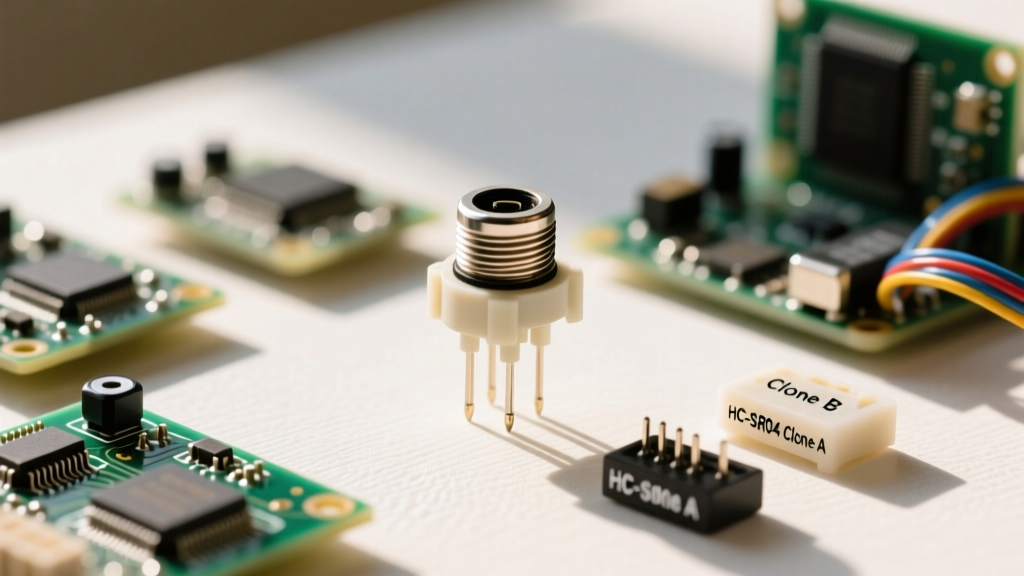
Before adding a 10-pack to your cart, it is crucial to understand what is actually on the PCB. The standard HC-SR04 relies on two silver-mesh 40 kHz ultrasonic transducers (one transmitter, one receiver), an 8 MHz crystal oscillator, and a comparator circuit (typically an LM393 or a clone equivalent) to measure the time-of-flight of an acoustic pulse. According to the Components101 HC-SR04 Datasheet, the module calculates distance by multiplying the echo time by the speed of sound, yielding a theoretical range of 2 cm to 400 cm.
When inspecting a batch you intend to buy, look closely at the PCB layout. High-quality boards feature clean flux washing, a clearly marked crystal oscillator, and a robust voltage regulator. Ultra-cheap clones often omit the filtering capacitors near the VCC pin. This lack of capacitance leads to massive voltage sag when the transmitter fires its burst of acoustic energy, which can cause brownouts on sensitive microcontrollers sharing the same 5V rail.
The 5V vs 3.3V Logic Trap: Protecting Your Microcontroller
The single biggest purchasing mistake beginners make is ignoring logic level compatibility. The standard HC-SR04 is a 5V device. When it sends the return pulse on the ECHO pin, it outputs a full 5V HIGH signal. If you wire this directly to a 3.3V microcontroller like the ESP32, Raspberry Pi Pico, or ESP8266, you risk permanently damaging the GPIO pin or frying the entire chip's silicon.
How to Buy for 3.3V Systems
If your project relies on 3.3V logic, you have three distinct buying options:
- Buy a Voltage Divider Kit: Purchase standard HC-SR04s alongside a pack of 10kΩ and 20kΩ resistors to step down the ECHO pin safely.
- Buy the HY-SRF05: This is a pin-compatible upgrade that often handles 3.3V logic better, though you must verify the specific vendor's schematic before bulk ordering.
- Buy the RCWL-1601: As highlighted by Adafruit's RCWL-1601 product page, this is a native 3.3V tolerant ultrasonic sensor that operates flawlessly with modern microcontrollers without extra resistors or level shifters.
Real-World Physics: Beam Angles, Blind Spots, and Temperature
Product listings often boast a "3mm accuracy" and a "2cm blind spot." In a controlled lab environment, this might be true. In the real world, physics intervenes. The 40 kHz transducers emit sound in a conical beam with an angle of roughly 15 to 20 degrees. This means the sensor does not measure a single point; it measures the closest object within a widening cone. If you are building a maze-solving micromouse, this beam width will cause "ghost readings" from adjacent walls.
Pro-Tip on Temperature Drift: The speed of sound is not a constant 343 m/s. It changes with ambient temperature (v ≈ 331.4 + 0.6T °C). If you are deploying an HC-SR04 outdoors or in a garage where temperatures swing from 10°C to 35°C, your distance calculations will drift by up to 5% unless you implement software-based temperature compensation or buy a sensor with an integrated thermistor.
Material Reflection: Why Your Sensor Fails on Fabric and Foam
Another critical factor often ignored in buying guides is acoustic impedance. Ultrasonic sensors rely on hard, flat surfaces to bounce the 40 kHz waves back to the receiver. If you are buying the HC-SR04 for a robotics project designed to detect people, clothing, or foam obstacles, you will experience massive failure rates. Soft, porous materials absorb high-frequency acoustic waves rather than reflecting them. For environments where you must detect soft materials or humans reliably, you should abandon ultrasonic sensors entirely and purchase a Time-of-Flight (ToF) LiDAR sensor like the VL53L0X, or an infrared optical sensor.
Sensor Showdown: HC-SR04 vs. The Upgrades
When browsing electronics suppliers, you will find several variants of the HC-SR04. Use this comparison chart to select the exact model your project demands.
| Sensor Model | Key Feature | Voltage / Logic | Best Use Case | Approx. Price |
|---|---|---|---|---|
| HC-SR04 | Standard baseline | 5V / 5V | Indoor Arduino projects, basic robotics | $1.50 |
| US-100 | Built-in Thermistor | 5V / 5V (UART capable) | Outdoor environments, variable temperatures | $3.50 |
| JSN-SR04T | Waterproof Transducer | 5V / 5V | Car parking sensors, marine, wash-down areas | $4.00 |
| RCWL-1601 | Native 3.3V Tolerant | 3.3V-5V / 3.3V | ESP32, Raspberry Pi Pico, IoT projects | $2.50 |
Out-of-the-Box Troubleshooting: The "Stuck High" Bug
When you buy a bulk pack of HC-SR04 sensors from third-party marketplace vendors, expect a 5% to 10% failure rate. The most common defect is the "Stuck High" bug, where the ECHO pin immediately goes HIGH and never returns LOW, causing standard pulseIn() functions in Arduino IDE to hang indefinitely. This is usually caused by a faulty comparator chip or a cold solder joint on the receiver transducer.
Testing Dead-on-Arrival Units with a Multimeter
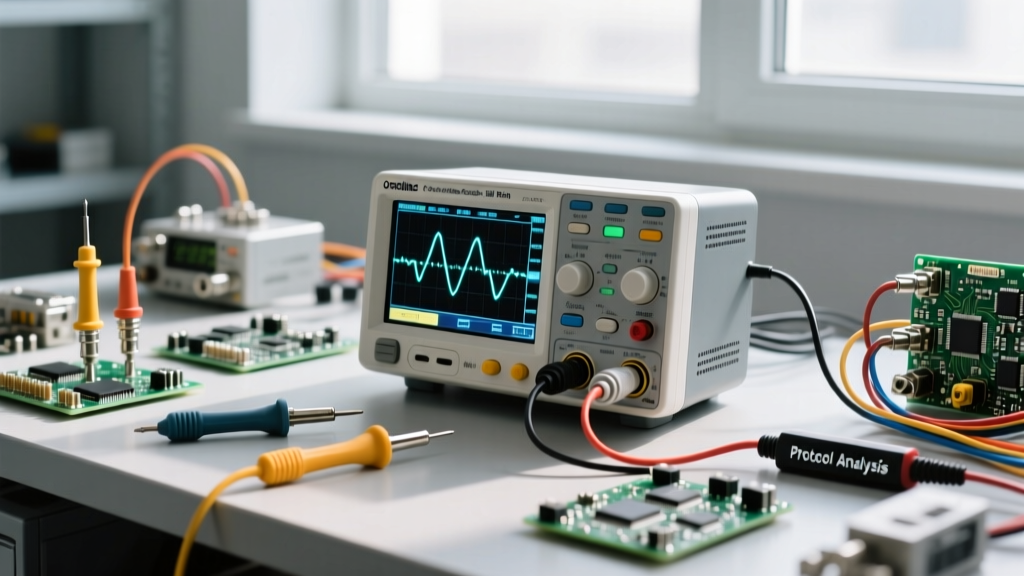
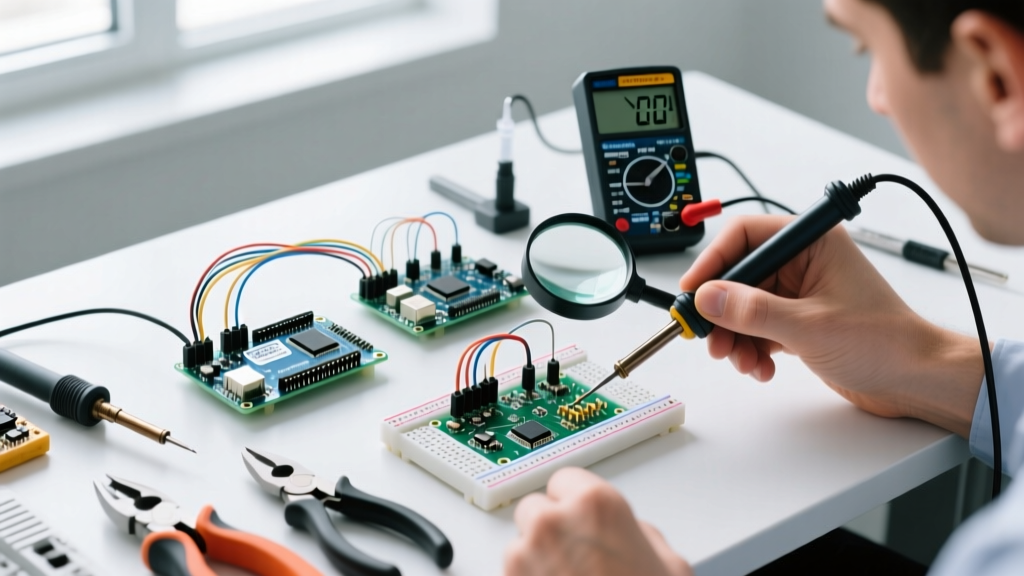
Before soldering headers, test your batch. Power the module with a clean 5V bench supply. Trigger the TRIG pin with a 10-microsecond HIGH pulse. If you have an oscilloscope or a logic analyzer, probe the transmitter pins; you should see a burst of 40 kHz square waves. If the signal is missing, the 8 MHz crystal oscillator or the driving transistor is dead. Furthermore, to mitigate the software hang issue, never use raw pulseIn() without a timeout parameter. Instead, utilize the SparkFun Ultrasonic Distance Sensor library or the widely respected NewPing library, which includes hardware-level timeout handling and median filtering to discard acoustic anomalies and stuck pins.
Final Verdict: What Should You Add to Your Cart?
If you are teaching a classroom of beginners using 5V Arduino Unos, buying a 20-pack of the standard HC-SR04 remains the most cost-effective choice. However, if you are designing a permanent IoT installation using an ESP32, skip the standard module and purchase the RCWL-1601 to save yourself the headache of soldering voltage dividers. For any automotive or outdoor application, the waterproof JSN-SR04T is mandatory, as humidity will quickly corrode the exposed silver mesh of a standard HC-SR04, leading to catastrophic signal attenuation. Choose wisely, and your distance sensing projects will survive long past the prototyping phase.