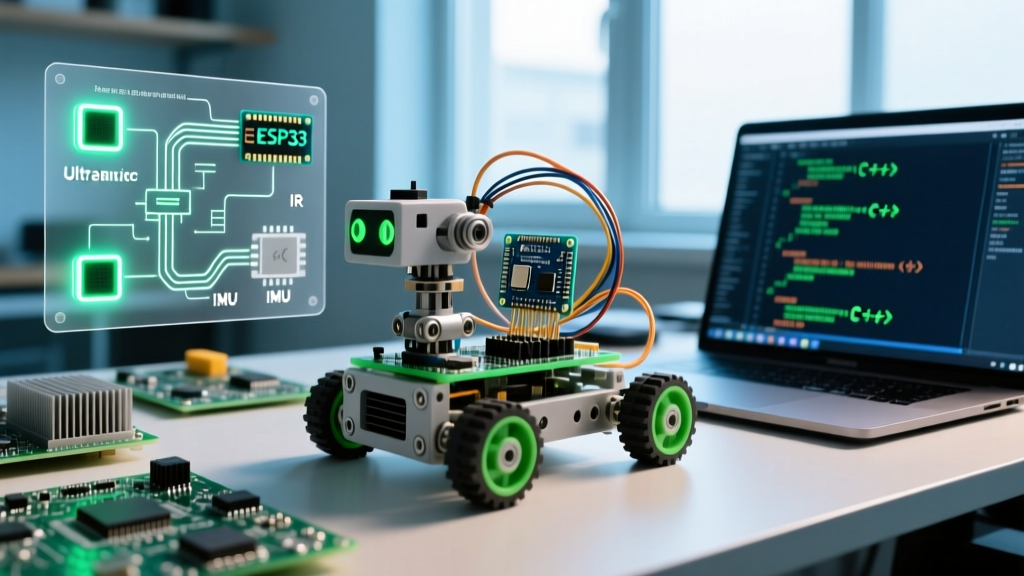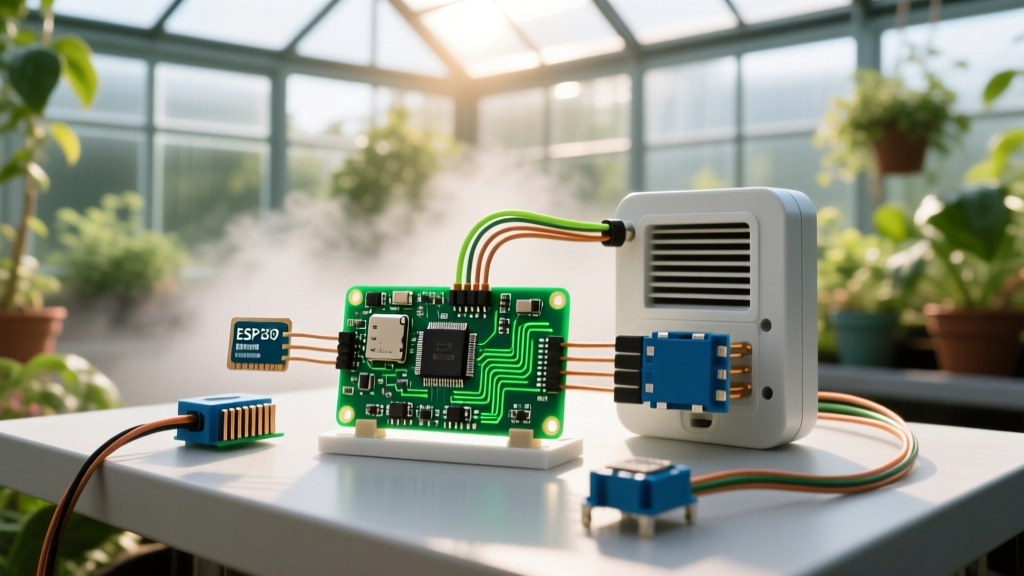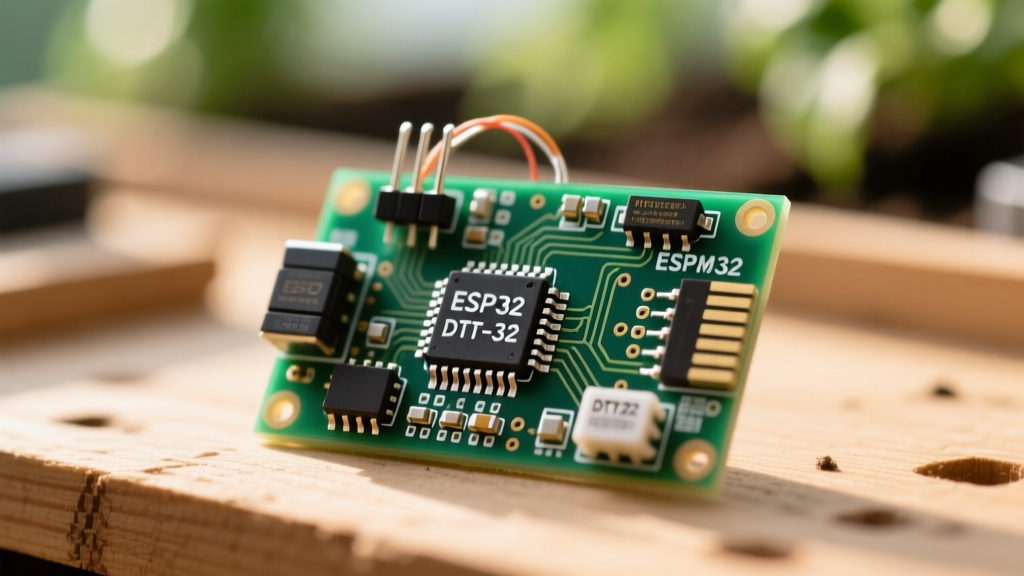

When designing an IoT connected device for agricultural or greenhouse environments, reliability and power efficiency are paramount. This comprehensive ESP32 WiFi project walks you through engineering a low-power, MQTT-enabled soil and climate monitoring node. Unlike basic tutorials that rely on blocking delays and unstable HTTP requests, we will implement asynchronous sensor polling, deep sleep wake-up stubs, and exponential backoff for WiFi provisioning.
The Architecture of a Reliable IoT Connected Device
A common failure mode in DIY IoT devices is the assumption that WiFi is always available. In a greenhouse, foliage and moisture absorb 2.4GHz RF signals, causing intermittent packet loss. Our architecture circumvents this by decoupling sensor reading from network transmission. The microcontroller wakes up, polls the I2C bus and analog pins, stores the payload in RTC memory, and only then powers up the WiFi radio to publish to an MQTT broker. If the connection fails, it logs the error and returns to sleep, preserving battery life.
Why the ESP32-WROOM-32E Outperforms the ESP8266
While the ESP8266 (NodeMCU) is a capable chip, the ESP32-WROOM-32E offers distinct advantages for battery-operated IoT nodes, specifically regarding RF sensitivity and ADC precision.
| Feature | ESP8266EX | ESP32-WROOM-32E |
|---|---|---|
| Deep Sleep Current | ~20µA | ~10µA |
| ADC Resolution | 10-bit (Flaky) | 12-bit (Calibrated) |
| CPU Cores | 1x 80/160MHz | 2x 240MHz |
| WiFi Antenna | PCB Trace | Improved PCB (E-series) |
Hardware Selection: Avoiding Common Sensor Failures
Selecting the right transducers is where most projects fail within the first month due to environmental degradation.
Capacitive vs. Resistive Soil Moisture Sensors
Never use resistive soil moisture sensors (the ones with two exposed metal prongs) for a permanent installation. Electrolysis causes galvanic corrosion, destroying the probes in weeks. Instead, use the Capacitive Soil Moisture Sensor v1.2. It measures the dielectric permittivity of the soil via a 555 timer circuit, outputting an analog voltage that inversely correlates with moisture content. To prevent corrosion on the exposed traces above the soil line, apply a layer of clear nail polish or acrylic conformal coating.
The BME280 over the DHT22
According to the Adafruit BME280 Sensor Guide, the BME280 uses an I2C interface and provides highly accurate temperature, humidity, and barometric pressure readings without the blocking 2-second delays required by the DHT series. This allows the ESP32 to read environmental data in milliseconds, drastically reducing active CPU time.
Wiring Diagram and Pinout Configuration
To minimize parasitic drain, we will power the sensors directly from a GPIO pin rather than the 3.3V rail. This allows the ESP32 to completely cut power to the sensors during deep sleep, eliminating their quiescent current draw.
| Component | ESP32 Pin | Notes |
|---|---|---|
| BME280 VCC | GPIO 13 (Output HIGH) | Switched power to save current |
| BME280 SDA | GPIO 21 | Default I2C Data |
| BME280 SCL | GPIO 22 | Default I2C Clock |
| Soil Sensor VCC | GPIO 27 (Output HIGH) | Switched power |
| Soil Sensor AOUT | GPIO 34 (Input) | ADC1 channel, safe for deep sleep |
Firmware Strategy: MQTT and ADC Calibration
For IoT communication, MQTT is vastly superior to HTTP REST APIs. As detailed in HiveMQ's MQTT Essentials, the protocol's lightweight publish-subscribe model minimizes payload overhead and keeps the WiFi radio active for mere milliseconds.
Handling the ESP32 ADC Non-Linearity
The ESP32's SAR ADC is notoriously non-linear at the voltage extremes (below 100mV and above 3.1V). To ensure accurate soil moisture readings, always use the analogReadMilliVolts() function introduced in ESP32 Arduino Core v2.0+. This function utilizes the chip's internal eFuse calibration data to provide accurate millivolt readings, bypassing the raw 12-bit integer inaccuracies.
Expert Calibration Tip: Take your capacitive sensor readings in millivolts. Dry air typically reads around 2800mV, while submerged in water it drops to roughly 1200mV. Map these integer values directly to a 0-100% scale using the map() function to avoid floating-point math overhead on the microcontroller.
JSON Payload Structure and QoS Levels
Keep your MQTT payloads compact. Use short key names to save bytes. When publishing over an unstable greenhouse WiFi network, stick to MQTT QoS 0 (Fire and Forget). QoS 1 guarantees delivery but requires an ACK packet, keeping the WiFi radio active longer and draining the battery. Rely on the hourly transmission frequency to ensure eventual data capture.
{
  "id": "gh01",
  "t": 24.5,
  "h": 65.2,
  "s": 1450,
  "v": 3.82
}
Power Optimization: Voltage Regulation and Deep Sleep
A critical aspect of any remote IoT connected device is power management. Powering an ESP32 directly from a 4.2V Li-Ion cell will destroy it. You need a step-down regulator. Avoid linear LDOs like the AMS1117-3.3, which waste excess voltage as heat and draw a high quiescent current (up to 5mA). Instead, use a micro-power buck converter like the Texas Instruments TPS62740 or a pre-built MT3608 module configured for 3.3V. This reduces quiescent current to microamps, preserving your deep sleep calculations.
Calculating Battery Life with Microamp Precision
Referencing the Espressif Sleep Modes Documentation, we configure the wake-up source using esp_sleep_enable_timer_wakeup(). Here is the real-world power budget for a 1-hour cycle:
- Active State: 160mA for 4 seconds (Sensor read + WiFi connect + MQTT publish) = 0.177 mAh
- Deep Sleep: 0.015mA for 3596 seconds = 0.015 mAh
- Total per Hour: ~0.192 mAh
- Daily Consumption: ~4.6 mAh
With a standard 2000mAh 18650 battery, accounting for 20% self-discharge and DC-DC converter inefficiencies, you can expect roughly 8 to 10 months of autonomous operation before needing a recharge.
Provisioning and Handling WiFi Dropout Scenarios
Greenhouses are RF-hostile environments. If the ESP32 fails to connect to your WPA2 network within 10 seconds, the firmware must abort the network sequence, log the failure to RTC memory, and return to deep sleep to prevent battery drain. Implement a timeout wrapper around WiFi.waitForConnectResult() to ensure the device never hangs in an infinite loop while the battery bleeds out.
Final Assembly and IoT Dashboard Integration
Once the MQTT broker (like Eclipse Mosquitto running on a Raspberry Pi) receives the JSON payload, you need a visualization layer. Home Assistant's MQTT Discovery protocol can automatically ingest the gh01 topic. By defining the device class as sensor and setting the unit_of_measurement to % for soil moisture, you can instantly generate historical trend graphs to automate your greenhouse irrigation valves via a secondary ESP32 relay node.
To survive high humidity, coat the ESP32 and sensor breakout boards with an acrylic conformal coating (e.g., MG Chemicals 419D). Do not coat the BME280's vent hole or the soil sensor's capacitive pads. Use a slotted Stevenson screen to house the electronics, allowing ambient air flow while shielding the components from direct water splashes and UV degradation.