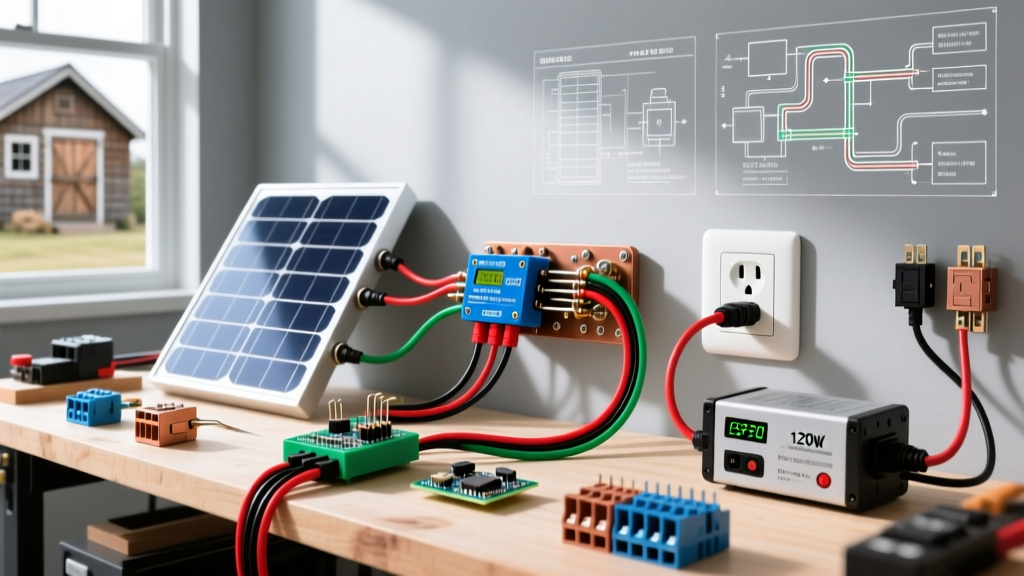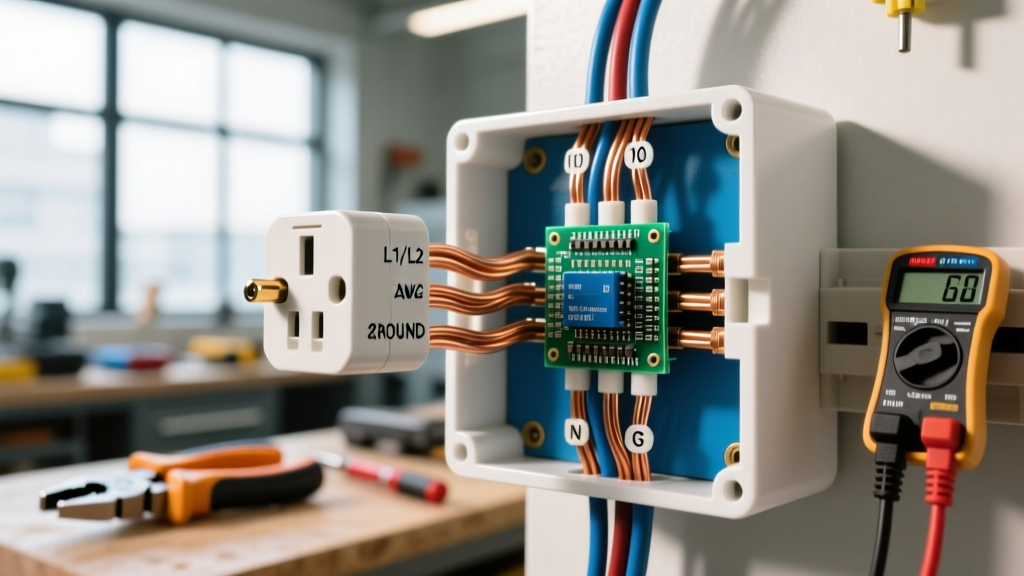

Wiring a 240V plug means connecting a high-power appliance to a residential split-phase electrical system using two 120V hot legs, an equipment ground, and often a neutral, to deliver double the voltage for heavy loads. In a real circuit, stepping up to 240V halves the amperage required for a given wattage, which drastically reduces wire gauge requirements and minimizes I²R heating losses over long runs. The most common mistake DIYers make is confusing the neutral (a current-carrying conductor for 120V taps) with the equipment ground (a non-current-carrying safety path), or wrongly assuming 240V requires a commercial 3-phase supply.
The Core Concept: Split-Phase 240V Explained
To understand 240V, you have to look at the transformer on the pole outside your house. North American residential power is delivered as split-phase 120/240V. The utility transformer has a center-tapped secondary winding. That center tap is bonded to ground and becomes your Neutral wire.
The two ends of the winding are your Hot legs (L1 and L2). Measured from L1 to Neutral, you get 120V. Measured from L2 to Neutral, you get 120V. But because the two hot legs are exactly 180 degrees out of phase with each other, measuring from L1 directly to L2 gives you the full 240V. You are not combining two 120V sources; you are utilizing the entire potential difference across the transformer coil.
The Math: Why We Double the Voltage
Let us run a worked numeric example to see why 240V is mandatory for heavy loads. Imagine you are installing a 7,200-watt electric range or a heavy-duty workshop welder.
- At 120V: Using the formula Watts = Volts × Amps, a 7,200W load draws 60 amps. To safely carry 60A, you would need massive 4 AWG copper wire, and a 60A breaker. The voltage drop over a 50-foot run would be severe, and the physical plug would be enormous.
- At 240V: That same 7,200W load draws only 30 amps. You can now use standard 10 AWG copper wire (rated for 30A at 60°C/75°C) and a common 30A double-pole breaker.
Think of it like a garden hose: if you need to deliver a specific volume of water (watts) per minute, you can either use a massive, floppy hose at low pressure (120V/high amps), or a narrower, rigid hose at high pressure (240V/low amps). The high-pressure approach is vastly more efficient for moving large amounts of energy over distance.
Where You Meet This in Practice
You will encounter 240V plugs in any high-draw residential application. According to the Department of Energy's home charging guidelines, Level 2 EV chargers, electric dryers, and HVAC compressors all rely on these configurations. Here are the three most common NEMA plug styles you will wire:
| NEMA Config | Poles/Wires | Max Amps | Common Applications |
|---|---|---|---|
| 14-50 | 3-Pole, 4-Wire | 50A | EV chargers, electric ranges, RV hookups |
| 6-50 | 2-Pole, 3-Wire | 50A | Welders, plasma cutters, air compressors |
| L14-30 | 3-Pole, 4-Wire (Twist-Lock) | 30A | Portable generators, transfer switches |
The critical distinction here is the presence of the neutral wire. A NEMA 6-50 (welder) has two hots and a ground; it has no neutral because the machine only needs 240V. A NEMA 14-50 (range or EV charger) has two hots, a neutral, and a ground, because ranges need 120V for the digital clock and interior lights, while EV chargers use the neutral for specific diagnostic or legacy communication protocols.
Scenario Walkthrough: The Melted NEMA 14-50
Theory is clean; the jobsite is not. Here is a real-world failure scenario that highlights what happens when 240V theory meets poor installation practices.
The Setup
A homeowner decides to wire a NEMA 14-50 outlet in their detached garage for a new 40-amp continuous Level 2 EV charger. The run is 80 feet from the main panel through buried PVC conduit.
The Numbers
Under the National Electrical Code (NEC), a 40A continuous load requires the circuit to be sized at 125%, meaning a 50A breaker. For a 50A breaker, 6 AWG THHN copper wire is the minimum requirement. At 80 feet, the voltage drop on 6 AWG at 40A is roughly 1.7%, which is well under the 3% recommended limit. The math is solid.
The Outcome
The installer pulls the 6 AWG wire, strips it, and lands it on a standard residential-grade 14-50 receptacle purchased from a big-box store for $12. They tighten the lugs with a standard screwdriver until they feel tight. The charger works perfectly for the first two weeks, delivering a full 9.6 kW to the vehicle overnight.
What Went Wrong
On day 15, the charger faults out, and the homeowner smells burning plastic. The face of the NEMA 14-50 receptacle is melted, and one of the hot prongs on the EV plug is scorched black.
- The Hardware Failure: The $12 residential receptacle used thin, stamped-metal internal contacts that cannot handle 40A of continuous thermal cycling.
- The Torque Failure: The installer did not use a calibrated torque screwdriver. The terminal screw was under-torqued.
- The Physics: As the 40A load heated the wire, the metal expanded. When the charging session ended, it cooled and contracted. Over 14 days, this thermal cycling loosened the under-torqued lug. A loose connection increases electrical resistance. High resistance at 40 amps generates massive heat (I²R losses), ultimately melting the plastic housing and creating a severe fire hazard.
Common Confusions and Critical Mistakes
When wiring 240V plugs, a few specific misconceptions lead to failed inspections or dangerous faults.
Confusing Neutral and Ground
In a 4-wire setup (like a 14-50), the neutral (white wire) carries the unbalanced 120V return current. The ground (bare or green wire) carries zero current under normal operation; it only exists to trip the breaker during a short circuit. Never bond the neutral and ground at the receptacle. They are only bonded together at the main service disconnect panel.
The 3-Phase Myth
Many hobbyists see a large 240V plug and assume they need a commercial 3-phase supply. You do not. Residential split-phase is technically a single-phase system that delivers 240V. True 3-phase power (like 208V or 480V) is reserved for industrial motors and commercial HVAC. If you buy a used industrial machine that requires 3-phase, you will need a rotary phase converter or a Variable Frequency Drive (VFD) to run it on your residential 240V split-phase supply.
Using the Wrong Breaker Type
A 240V circuit requires a double-pole breaker with an internal handle tie or a common trip mechanism. This ensures that if a short circuit occurs on L1, L2 is also instantly disconnected. Never use two independent single-pole breakers side-by-side to create a 240V circuit; if one trips, the other remains live, leaving 120V flowing through the appliance and creating a lethal shock hazard.
Frequently Asked Questions
Can I wire a 240V plug without a neutral wire?
Yes, if the appliance only requires 240V. Tools like welders, air compressors, and baseboard heaters use a 3-wire setup (two hots and a ground), typically utilizing a NEMA 6-50 or 6-20 plug. However, appliances with 120V control boards (like ranges and dryers) strictly require the neutral.
Why does my 240V breaker have two hot wires of the same color?
In a 240V-only circuit (like a water heater or welder), both hot legs carry the full 240V load. Because there is no 120V neutral return, the NEC allows both hot wires to be black (or red). However, best practice and modern code updates prefer you to mark the second hot wire with red tape or use red THHN to visually indicate the two distinct phases.
What size wire do I need for a 50-amp 240V plug?
For a standard 50-amp breaker, you need 6 AWG copper wire (rated at 65A in the 75°C column). If you are using aluminum wire, you must step up to 4 AWG. Always check the temperature rating of both your breaker terminals and your receptacle; if either is rated only for 60°C, you must size the wire using the 60°C ampacity column, which would require 4 AWG copper for 50 amps.