
Introduction to 3-Phase Receptacle Hazards
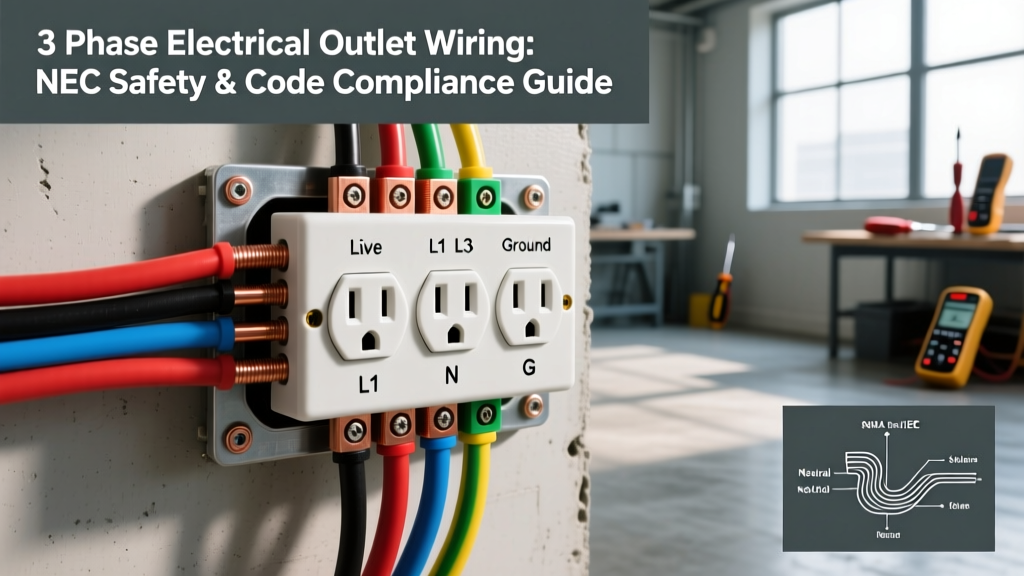
Wiring a 3 phase electrical outlet is fundamentally different from terminating a standard 120V residential receptacle. In industrial, manufacturing, and heavy commercial workshop environments, 3-phase power (typically 208V, 480V, or 600V) delivers the high torque and continuous load capacity required by CNC machines, heavy compressors, and industrial HVAC systems. However, the stakes for improper installation are exponentially higher. A wiring fault on a 480V 3-phase circuit does not just trip a breaker; it can trigger a catastrophic arc flash event, destroy thousands of dollars in motor windings, or cause fatal electrocution.
As we navigate the 2026 enforcement cycles of the National Electrical Code (NEC), facility managers and industrial electricians must adhere to stringent safety protocols, updated Ground Fault Circuit Interrupter (GFCI) mandates, and precise phase rotation verification. This guide provides an exhaustive, code-compliant framework for specifying, installing, and troubleshooting 3-phase receptacles.
NEMA vs. IEC 60309: Selecting the Correct 3 Phase Electrical Outlet
The first step in code compliance is selecting the correct receptacle configuration. The NEC requires that receptacles be rated for the specific voltage and amperage of the circuit, and that configurations prevent the accidental insertion of incompatible plugs (NEC Article 406.4). In North America, you will primarily encounter two standards: NEMA Twist-Lock and IEC 60309 Pin-and-Sleeve.
| Standard | Model Example | Rating & Config | Primary Application | Avg. Cost (2026) |
|---|---|---|---|---|
| NEMA Twist-Lock | Hubbell HBL2620R (L6-20R) | 20A, 250V, 2-Pole, 3-Wire | Light commercial 3-phase motors, small welders | $35 - $55 |
| NEMA Twist-Lock | Leviton 2620 (L21-20R) | 20A, 120/208V, 3-Phase, 4-Pole, 5-Wire | Commercial food service, portable distribution boxes | $60 - $90 |
| NEMA Twist-Lock | Hubbell HBL460R7W (L16-30R) | 30A, 480Y/277V, 3-Phase, 3-Pole, 4-Wire | Heavy industrial machinery, high-voltage pumps | $85 - $130 |
| IEC 60309 | Hubbell 4100P6W (Pin & Sleeve) | 100A, 200-250V, 2-Pole, 3-Wire | High-amperage temporary power, marine, mining | $250 - $400 |
Expert Insight: For environments with high moisture, dust, or washdown requirements (such as food processing plants), IEC 60309 pin-and-sleeve connectors are vastly superior to NEMA twist-locks. The IEC standard utilizes a clock-face keyway system (e.g., 6 o'clock for 200-250V) that physically prevents mating a 480V plug into a 208V receptacle, a critical safety feature recognized by the NFPA 70 National Electrical Code.
NEC Code Compliance: The GFCI Mandate for 3-Phase Circuits
Historically, GFCI protection was largely reserved for single-phase, 125V, 15A and 20A residential and light commercial circuits. However, recent NEC revisions have drastically expanded these requirements, fundamentally changing how 3-phase outlets are wired in the field.
Understanding NEC Article 210.8(B) and 406.3
Under the latest NEC guidelines, GFCI protection is now mandated for all 3-phase receptacles rated up to 100 amperes and 150 volts to ground (which includes 208Y/120V systems) installed in commercial and industrial settings. Furthermore, Article 406.3 requires that replacement receptacles in areas requiring GFCI protection must themselves be GFCI protected.
- The Challenge: Finding 3-phase, 100A GFCI circuit breakers can be difficult and expensive. A standard 3-pole 30A breaker might cost $60, but a 3-pole 50A GFCI breaker (e.g., Eaton FD series) can easily exceed $600 to $900.
- The Solution: Utilize GFCI equipment protection devices or specialized 3-phase GFCI receptacles where available, ensuring the equipment grounding conductor (EGC) is continuous and unbroken.
- Exception: Receptacles supplying specific fire pumps or life-safety systems where power continuity is paramount may be exempt, but this requires explicit AHJ (Authority Having Jurisdiction) approval.
Safety Warning: Never use a 3-phase motor protector or standard overload relay as a substitute for a NEC-mandated GFCI device. Overload relays protect the motor windings from thermal damage; GFCIs protect human life from ground-fault electrocution by detecting leakage currents as low as 4-6mA.
Phase Rotation: The Silent Equipment Killer
When wiring a 3 phase electrical outlet, matching the phase sequence (L1, L2, L3 or A, B, C) is just as critical as matching the voltage. If you terminate the conductors in the wrong sequence, the resulting phase rotation will reverse. While a reversed phase rotation won't immediately trip a breaker, it will cause any connected 3-phase induction motor to spin in the opposite direction.
The Real-World Consequences of Reverse Rotation
According to the Department of Energy Motor Systems Basics, 3-phase motors rely on the sequential energizing of stator windings to create a rotating magnetic field. If the sequence is reversed:
- Centrifugal Pumps: Will run backward, failing to move fluid, potentially running dry and destroying the mechanical seals within minutes.
- HVAC Compressors: Scroll and screw compressors running in reverse will not build pressure and can suffer catastrophic internal mechanical failure due to lack of lubrication.
- CNC Spindles: Will cut in the wrong direction, ruining workpieces and snapping expensive carbide end mills.
Verification Protocol
Before energizing the newly installed outlet, or immediately after energizing but before plugging in the load, you must verify phase rotation.
- Use a dedicated phase rotation indicator, such as the Fluke 9040 or Extech PRT01.
- Connect the test leads to the line-side terminals of the receptacle (or the breaker load-side before termination).
- Confirm the indicator displays 'ABC' (Clockwise/Right) as required by the equipment nameplate.
- If the sequence is 'ACB' (Counter-Clockwise/Left), swap any two of the three hot conductors at the breaker or receptacle terminal to reverse the sequence.
Torque, Termination, and Conductor Sizing
Loose connections on a 480V 3-phase circuit are a primary cause of electrical fires. The NEC (Article 110.14(D)) strictly requires that terminations be torqued to the manufacturer's specifications using a calibrated torque tool.
Sizing the Equipment Grounding Conductor (EGC)
Do not undersize the ground wire. Table 250.122 in the NEC dictates the minimum size for the EGC based on the rating of the overcurrent device. For a 60A 3-phase breaker, you must use a minimum of 10 AWG copper EGC. However, if you have upsized your current-carrying conductors to mitigate voltage drop (e.g., using 4 AWG instead of 6 AWG for a long run to a 60A outlet), you must proportionally increase the size of the EGC per NEC 250.122(B).
Torquing Specifications
Most heavy-duty NEMA and IEC receptacles utilize box-style or clamp-style terminals. Typical torque specifications range from 20 in-lbs to 45 in-lbs depending on the wire gauge and terminal screw size. Always use an insulated, calibrated torque screwdriver (such as the Wera VDE series) and verify the torque setting before every panel termination.
Lockout/Tagout (LOTO) and Arc Flash Boundaries
Working inside a 3-phase panel to install a new receptacle circuit exposes you to severe arc flash hazards. The OSHA Control of Hazardous Energy (LOTO) standard mandates strict procedures before any electrical work begins.
- Identify all sources: Ensure the main disconnect and any back-fed sources (like solar inverters or backup generators) are isolated.
- Apply LOTO devices: Use individualized padlocks and tags on the upstream breaker.
- Test Before You Touch: Use a Category III or IV rated multimeter (e.g., Fluke 87V) to verify zero energy. Test phase-to-phase (L1-L2, L2-L3, L1-L3) and phase-to-ground on all conductors.
- PPE Requirements: When racking breakers or testing for voltage, wear appropriate Arc Flash PPE, including a balaclava, face shield, and voltage-rated gloves with leather protectors, as dictated by the panel's Arc Flash Label (NFPA 70E).
Common Failure Modes & Troubleshooting
Even with perfect installation, 3-phase outlets in harsh environments can fail. Here is how to diagnose the most common edge cases:
1. Neutral Terminal Overheating (L21-30R Configurations)
Symptom: Discoloration or melting around the neutral (W) terminal on a 4-pole, 5-wire 120/208V receptacle.
Cause: Non-linear loads (like VFDs and switching power supplies) generate triplen harmonics (3rd, 9th, 15th). These harmonics do not cancel out in the neutral; they add together, causing neutral currents to exceed phase currents.
Fix: Upgrade the neutral conductor to 200% of the phase conductor ampacity, or install K-rated transformers and harmonic filters upstream.
2. Intermittent Phase Loss
Symptom: Motor hums, overheats, and trips the overload relay, but the breaker does not trip.
Cause: Single-phasing. One of the three hot conductors has a high-resistance connection or a broken wire inside the insulation.
Fix: Perform a continuity test on all three phases. Check the receptacle pins for pitting or carbon tracking. Replace the receptacle if the internal contacts have lost their spring tension.
Frequently Asked Questions
Can I wire a 3-phase outlet without a neutral wire?
Yes, if the equipment does not require 120V or 277V line-to-neutral power. A 3-pole, 4-wire configuration (like a NEMA L15-30R or L16-30R) provides three hot legs and a ground, omitting the neutral. This is standard for pure 240V or 480V 3-phase motors and heaters.
Is it legal to use a 3-phase receptacle for temporary power on a construction site?
Yes, but NEC Article 590 (Temporary Installations) requires that all 15A, 20A, and 30A 125V/250V single-phase and specific 3-phase receptacles on construction sites have GFCI protection. Furthermore, the receptacles must be rated for wet/damp locations and be elevated off the ground to prevent water ingress.
What is the difference between a Wye and Delta 3-phase receptacle?
The receptacle itself does not dictate Wye or Delta; the upstream transformer and panel do. However, a Wye system (e.g., 208Y/120V or 480Y/277V) provides a neutral point, allowing for 4-wire or 5-wire receptacles. A Delta system (e.g., 240V Delta) typically does not have a neutral (or has a high-leg/high-wild leg), requiring 3-wire or 4-wire (with ground) receptacles. Never wire a standard 120/208V plug into a 240V High-Leg Delta system, as connecting to the high leg will instantly destroy 120V components.