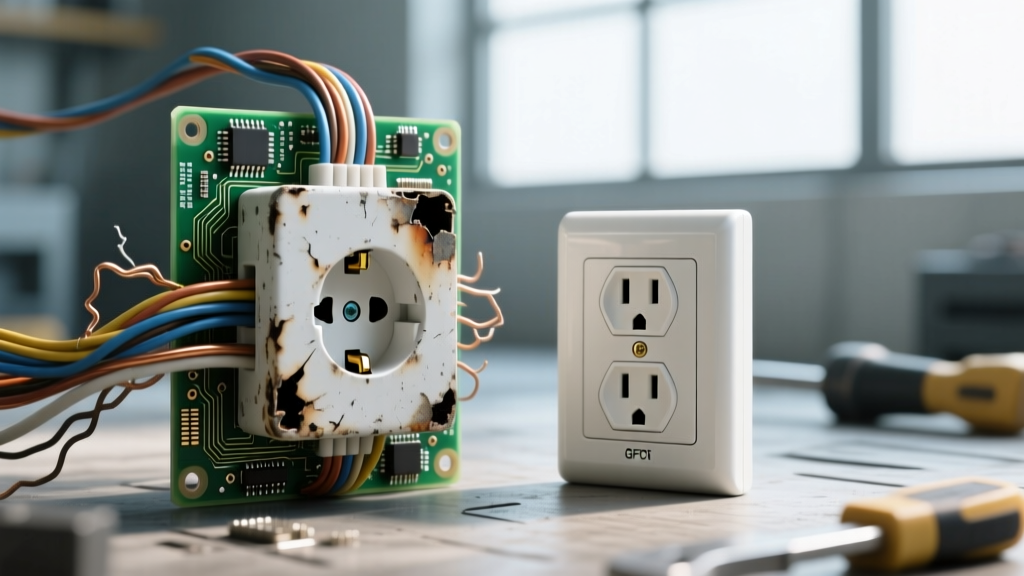

The Physics of a Receptacle Shock: Static vs. Fault Current
Experiencing a shock from outlet receptacles is a jarring event that demands immediate diagnostic attention. However, not all shocks are created equal. Before tearing into your drywall or replacing a circuit breaker, it is critical to differentiate between a harmless capacitive discharge and a dangerous ground fault. A static shock typically occurs in low-humidity environments when you, the user, have built up a localized charge and discharge it upon touching the metal grounding strap or screw of the faceplate. This is a microsecond event, entirely dependent on your body's capacitance, and is not a failure of the outlet itself.
Conversely, a true electrical shock from an outlet indicates a severe failure in the receptacle's internal architecture or the branch circuit's grounding path. According to data published by the U.S. Consumer Product Safety Commission (CPSC), thousands of residential electrical injuries occur annually due to degraded receptacles, missing grounds, and improper wiring. When you feel a continuous tingling, a sharp bite, or a muscle contraction when plugging in an appliance or touching a metal plug prong, you are experiencing current leakage. The human 'let-go' threshold—the point where muscle contractions prevent you from releasing the energized object—is dangerously low, typically between 6 and 9 milliamps. Upgrading your failing receptacles is not just a cosmetic choice; it is a critical life-safety intervention.
Diagnostic Triage: Why Your Outlet is Failing
To properly upgrade and replace a hazardous outlet, you must first identify the mechanical or electrical failure mode. Receptacles are not solid-state devices; they rely on physical brass and nickel-plated wipers to maintain friction and electrical continuity with plug blades. Over years of insertion and withdrawal cycles, these wipers lose their spring tension.
| Failure Mode | Primary Symptom | Internal Damage Mechanism | Required Upgrade |
|---|---|---|---|
| Worn Contact Tension | Plugs fall out easily; faint burning smell; arcing pops. | Brass wipers stretch and fail to grip prongs. High resistance causes localized heat, melting the nylon housing and exposing live parts. | Standard 15A/20A Tamper-Resistant (TR) Duplex Receptacle. |
| Backstabbed Connections | Intermittent power; shock when touching plugged-in appliance casing. | Push-in wire connectors loosen over time due to thermal expansion/contraction, causing arcing that degrades internal insulation. | Receptacle with side-wiring or screw-clamp terminals; rewiring with pigtails. |
| Missing/Broken Ground | Tingling shock from metal appliance chassis or plug prongs. | The grounding path is severed or never installed (common in pre-1960s homes), leaving fault currents with no path but the user. | GFCI Receptacle (labeled 'No Equipment Ground') or running a new EGC. |
| Moisture Ingress | Sharp shock in kitchens, bathrooms, or garages; breaker trips. | Water bridges the gap between the hot terminal and the ground strap or faceplate screw. | Weather-Resistant (WR) GFCI with an in-use bubble cover. |
The Upgrade Standard: Selecting the Right Replacement Receptacle
When addressing a shock from outlet hazards, you must upgrade to modern, code-compliant devices. The National Electrical Code (NEC) has evolved significantly to address these exact failure modes. Here are the specific upgrades you should install based on your diagnostic triage.
1. Standard Tamper-Resistant (TR) Duplex
If your outlet is simply worn out and failing to grip plugs, replace it with a high-grade TR receptacle. The Leviton T5320-W or the Hubbell HBL5262TR are excellent choices, typically costing between $2.50 and $4.50. These feature internal shutter mechanisms that require simultaneous, equal pressure on both prongs to open, preventing foreign object insertion. More importantly, premium models use thicker brass alloys that maintain UL 498 insertion-force standards (requiring a minimum pull force to remove a plug) for decades, preventing the arcing and heat buildup that melts housings and causes shocks.
2. Ground Fault Circuit Interrupter (GFCI)
If you are experiencing shocks in areas near water, or if your home lacks a proper equipment grounding conductor (EGC), a GFCI is mandatory. The Leviton GFTNL-W (approximately $28.00) monitors the current differential between the hot and neutral wires. If it detects a leakage as small as 4 to 6 milliamps—the exact threshold that causes dangerous physiological shocks—it trips the internal solenoid in under 25 milliseconds. This completely neutralizes the shock hazard, even if the user becomes the path to ground.
3. Dual-Function (AFCI/GFCI)
For older homes with degraded wiring that presents both a shock hazard (ground faults) and a fire hazard (arc faults from loose connections), upgrade to a Dual-Function receptacle like the Pass & Seymour 2097TRCLR (around $38.00). This device provides the shock protection of a GFCI alongside the advanced waveform-recognition technology of an Arc-Fault Circuit Interrupter, protecting against the exact type of series arcing caused by worn outlet contacts.
Addressing the 'Bootleg Ground' and Ungrounded Circuits
One of the most insidious causes of a shock from outlet receptacles in older homes is the 'bootleg ground.' This is an illegal and highly dangerous wiring trick where a previous owner connected the neutral terminal to the ground screw to trick a standard 3-prong outlet tester into showing a 'correct' wiring reading. In reality, the metal faceplate and the grounding holes are tied to the current-carrying neutral wire. If the neutral connection ever breaks upstream, the entire metal faceplate and any plugged-in appliance chassis become energized at 120 volts.
NEC 406.4(D)(2) Compliance Note: If you are replacing an ungrounded outlet and cannot run a new ground wire to the panel, the NEC allows you to install a GFCI receptacle. You must label it with the included stickers reading 'GFCI Protected' and 'No Equipment Ground.' The GFCI will protect you from lethal shocks, but it will not provide a true ground for surge protectors or sensitive electronics.
Professional Replacement Protocol
Upgrading a hazardous outlet requires precision. Relying on push-in backstab connectors is a leading cause of future thermal failures and shocks. Follow this protocol for a permanent fix:
- Lockout and Verify: Turn off the breaker and use a non-contact voltage tester (NCVT), followed by a digital multimeter (like the Fluke 117) set to AC voltage. Test hot-to-neutral, hot-to-ground, and neutral-to-ground to ensure the circuit is completely de-energized and free of induced voltages.
- Inspect the Box: Look for melted nylon, scorch marks, or brittle insulation. If the wire insulation is cracked and crumbling, you must strip it back to fresh copper and use a wire nut to attach a pigtail.
- Prepare the Conductors: Strip exactly 5/8 inch of insulation from the solid copper wire. Do not nick the copper, as this creates a weak point prone to snapping under screw pressure.
- Terminate via Side-Wiring or Pigtails: Wrap the bare copper clockwise around the brass (hot) and silver (neutral) terminal screws. Tighten using a torque screwdriver set to the manufacturer's specification (typically 14 in-lbs for standard 15A/20A devices). This ensures optimal surface contact and prevents thermal loosening.
- Secure and Test: Push the wires neatly into the back of the electrical box, avoiding pinching the ground wire against the hot terminal. Mount the receptacle, install a UL-listed faceplate, restore power, and verify operation using a GFCI tester and a receptacle tension tester.
Eliminating a shock from outlet hazards requires moving beyond temporary fixes. By understanding the mechanical degradation of brass contacts, identifying missing grounds, and upgrading to modern TR and GFCI receptacles using proper torque-terminated side-wiring, you permanently secure your home's electrical infrastructure against both shock and fire risks.