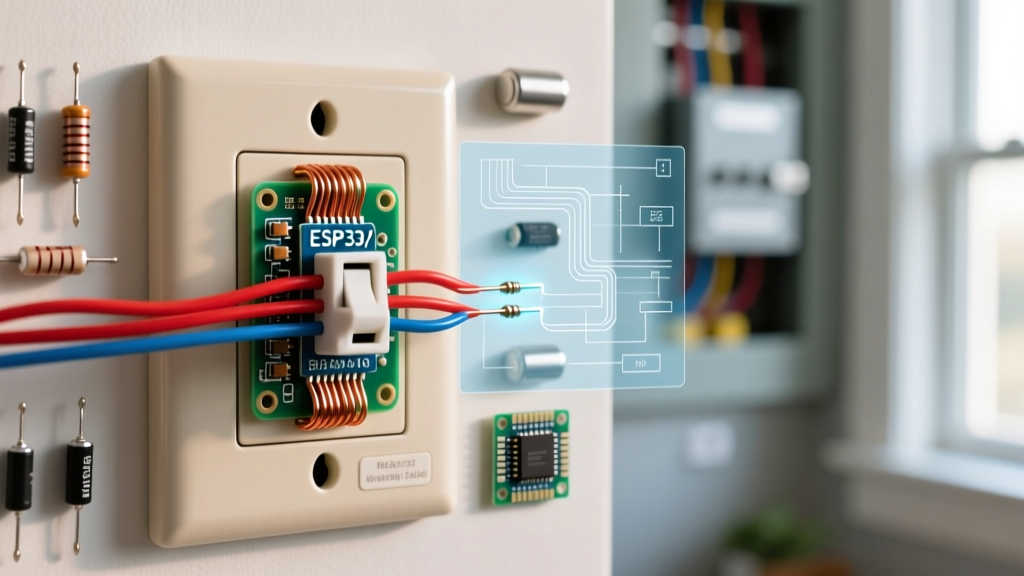

The Paradox of the 'Hot' Dead Receptacle: Voltage vs. Current
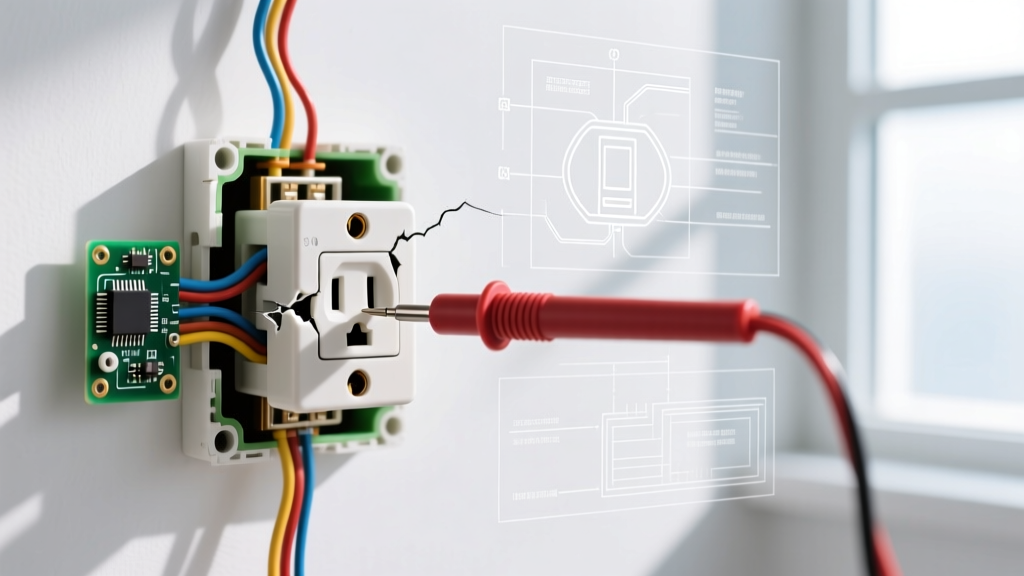
You are facing one of the most common and misunderstood electrical diagnostics in residential wiring: an electrical outlet not working but has power. You touched a non-contact voltage tester (NCVT) to the receptacle, and it beeped and flashed red. Yet, when you plug in a lamp or a phone charger, nothing happens.
From a safety and National Electrical Code (NEC) compliance perspective, this is not a 'ghost' issue; it is a critical circuit fault. Voltage is simply electrical pressure (potential difference), while current (amperage) is the actual flow of electrons doing the work. When an outlet shows 120V but delivers zero functionality, you have a high-resistance fault or an open return path. According to the National Fire Protection Association (NFPA 70 / NEC), these conditions violate fundamental safety requirements for continuous circuit integrity and can lead to resistive heating, arcing, and electrical fires.
⚠️ SAFETY WARNING: Never assume a circuit is safe to touch just because a device won't turn on. An 'open neutral' condition means the grounded return path is broken, but the ungrounded (hot) conductor is still energized at 120V. Touching the neutral bus or downstream neutral wires in this state can result in a fatal shock.
The 4 NEC Code Violations Causing Phantom Power
When diagnosing an electrical outlet not working but has power, licensed electricians look for four specific failure modes. Each represents a distinct code violation or degradation of safety standards.
1. The Open Neutral Fault (NEC 200.4 & 210.4)
An open neutral occurs when the white (grounded) wire is disconnected somewhere upstream or at the receptacle itself. Because the hot (black) wire is still connected to the breaker, an NCVT will detect the electromagnetic field and indicate 'power.' However, without a continuous path back to the panel's neutral bus, current cannot flow.
The MWBC Hazard: If this outlet is on a Multi-Wire Branch Circuit (MWBC) sharing a neutral with another phase, an open neutral in the junction box or panel can force 120V appliances into a 240V series circuit. This will instantly destroy plugged-in electronics and violates NEC 210.4, which mandates simultaneous disconnecting means for MWBCs to prevent exactly this scenario.
2. Backstabbed Push-In Connector Thermal Fatigue (NEC 110.14)
Cheap builder-grade receptacles (like standard $0.90 models) feature push-in 'backstab' terminals. These rely on a tiny brass spring clip to grip the 14 AWG or 12 AWG copper wire. Over years of thermal cycling (heating up under load and cooling down), the brass loses its temper and spring tension.
A digital multimeter (DMM) has an input impedance of roughly 10 Megohms. It draws microamps of current, easily passing through the degraded, high-resistance backstab connection, reading a perfect 120V. But plug in a 1500W space heater (12.5 Amps), and Ohm's Law dictates that the massive resistance at the failing clip causes a severe voltage drop. The outlet might drop to 20V under load, failing to power the device while generating dangerous heat inside the wall cavity. NEC 110.14 requires terminations to be secure and rated for the conditions of use; failing backstabs violate this mandate.
3. Bootleg Grounds and Reversed Polarity (NEC 250.148 & 406.4)
In older homes, a DIYer may have installed a jumper wire between the neutral (silver) screw and the ground (green) screw to trick a 3-prong receptacle tester into reading 'Correct.' This is a bootleg ground. If the neutral wire subsequently falls off the terminal, the hot wire still energizes the receptacle slots, but the current attempts to return via the equipment grounding conductor (EGC). This energizes the metal chassis of any plugged-in appliance, creating a lethal shock hazard in direct violation of NEC 250.148 and NEC 406.4(D).
4. Downstream GFCI Internal Faults (NEC 210.8)
If the dead outlet is downstream of a Ground Fault Circuit Interrupter (GFCI), the upstream GFCI may have tripped internally due to a ground fault or surge. While the line-side power is still present in the feed cable, the internal relay has opened the load-side circuit. Standard NCVTs can sometimes pick up capacitive coupling (phantom voltage) through the tripped GFCI's internal electronics, giving a false 'hot' reading on the dead downstream receptacle.
Diagnostic Matrix: Multimeter Readings vs. Actual Fault
To separate phantom voltage from a true open neutral or backstab failure, you must test under load. The Fluke Corporation notes that phantom voltage is easily dissipated by a low-impedance tester. Use a solenoid voltage tester (like a Wiggy) or a DMM with a low-Z (low impedance) setting.
| Symptom / Test | NCVT Reading | DMM (High-Z) Hot to Neutral | DMM (High-Z) Hot to Ground | Diagnosis & Code Action |
|---|---|---|---|---|
| Device won't turn on, NCVT beeps | HOT (Beeps) | 120V | 120V | Open Neutral. Neutral wire disconnected. Check upstream wire nuts and backstabs. |
| Device won't turn on, NCVT beeps | HOT (Beeps) | 45V - 80V (Fluctuating) | 120V | Phantom Voltage / Capacitive Coupling. Circuit is actually dead. Induced voltage from adjacent live cable. |
| Device won't turn on, NCVT beeps | HOT (Beeps) | 120V (No Load) / 15V (Under Load) | 120V | High-Resistance Backstab. Push-in terminal failing. Must replace receptacle and use screw terminals. |
| Device works, but chassis tingles | HOT (Beeps) | 120V | 0V | Bootleg Ground / Open Ground. Neutral and Ground bonded at receptacle. Severe shock hazard. |
Step-by-Step Load Testing Procedure
Before tearing open the drywall or pulling wires, perform a safe, code-compliant load test using a plug-in circuit analyzer with a load button (such as the Klein Tools RT310, approx. $35 in 2026).
- Verify Baseline Voltage: Plug the RT310 into the suspect outlet. Note the indicator lights. If it shows 'Open Neutral,' proceed to step 2.
- Apply the Load: Press and hold the 'Load' or 'GFCI Test' button on the analyzer for 3 seconds. This connects an internal resistor across the hot and neutral slots, drawing roughly 1 to 2 Amps.
- Observe the Drop: If the outlet has a failing backstab connection, the internal resistor will force the high-resistance joint to drop the voltage. The analyzer's lights will shift, or a connected digital readout will plummet from 120V to under 50V.
- Isolate the Fault: If the load test confirms an open neutral or high-resistance fault, turn off the breaker at the main panel. Verify the circuit is dead with your NCVT, then remove the receptacle cover to inspect the physical terminations.
Code-Compliant Repair Solutions & Material Costs
Once the fault is isolated, repairs must meet current Consumer Product Safety Commission (CPSC) and NEC guidelines for residential safety. Do not simply push the wire back into a failing terminal.
1. Abandon Backstabs and Use Pigtailing
Never use the push-in backstab holes on any receptacle. If the box is crowded, or if this outlet feeds downstream devices, use a 'pigtail' method. Connect all incoming and outgoing hot (and neutral) wires together using a wire nut or a push-in connector like the WAGO 221 (rated for 32A, approx. $0.60 each). Run a single 6-inch 12 AWG or 14 AWG THHN jumper (pigtail) to the receptacle's side-wire screw terminal. This ensures that downstream outlets do not lose power if the receptacle itself is removed for servicing, aligning with best practices for circuit continuity.
2. Upgrade to Tamper-Resistant (TR) Receptacles
Under NEC 406.12, all 15A and 20A, 125V and 250V receptacles installed in dwelling units must be Tamper-Resistant (TR). When replacing the faulty unit, purchase a commercial or spec-grade TR receptacle.
Recommended Model: Leviton 5320-W (15A, 125V, TR, side-wire only, no backstabs). Cost: ~$3.50 each. These feature robust brass contact strips and deep wire wells that prevent the thermal fatigue issues inherent in builder-grade models.
3. Torque Verification
While standard 15A receptacles do not always have printed torque specifications, the industry standard for terminal screws on 14 AWG and 12 AWG copper is approximately 14 in-lbs. Using a calibrated torque screwdriver (like the Klein Tools 70001) ensures the wire is clamped tightly enough to prevent arcing, but not so tight that it strips the brass threads or shears the copper conductor.
Frequently Asked Questions (Edge Cases)
Can a bad breaker cause an outlet to have power but not work?
Yes, but it is rare. A breaker with severe internal corrosion or a loose bus-bar stab connection can exhibit high resistance. A high-impedance DMM will read 120V through the corrosion, but under load, the voltage will collapse. This is a severe fire hazard at the panel and requires immediate replacement of the breaker and inspection of the panel bus bar for scorching.
My NCVT beeps on the neutral wire. Is that normal?
No. If your NCVT detects voltage on the white neutral wire, you likely have an open neutral upstream of your test point, and the neutral wire is being backfed with 120V through a plugged-in appliance on the same circuit. Treat the neutral wire as 'hot' and shut off the breaker immediately.