
Understanding the Code: Electrical Light Switch Wiring Fundamentals
When planning or executing electrical light switch wiring, adherence to the National Electrical Code (NEC) is not just a legal requirement—it is the baseline for preventing electrical fires and ensuring long-term system reliability. As jurisdictions continue to adopt the 2023 NEC well into 2026, inspectors are scrutinizing switch installations more closely than ever, particularly regarding box fill, neutral conductor availability, and arc-fault protection.
This guide breaks down the critical code requirements governing switch wiring, moving beyond basic DIY tutorials to provide the exact calculations, product specifications, and failure modes that master electricians use on the job.
NEC Article 380: Switch Interrupting and Enclosure Rules
Article 380 of the NEC specifically governs switches. Two sections are paramount for standard residential and commercial lighting circuits:
- NEC 380.2 (Switch Interrupting Rating): Switches must be used within their marked voltage and current ratings. A standard 15-amp toggle switch (like the Leviton 1451-2W, typically priced around $1.50) can only control a 15A circuit. However, a 20-amp switch (e.g., Leviton 1653-2W, ~$3.50) can be used on either a 15A or 20A circuit. You cannot use a 15A rated switch on a 20A circuit, even if the connected lighting load is only 2 amps.
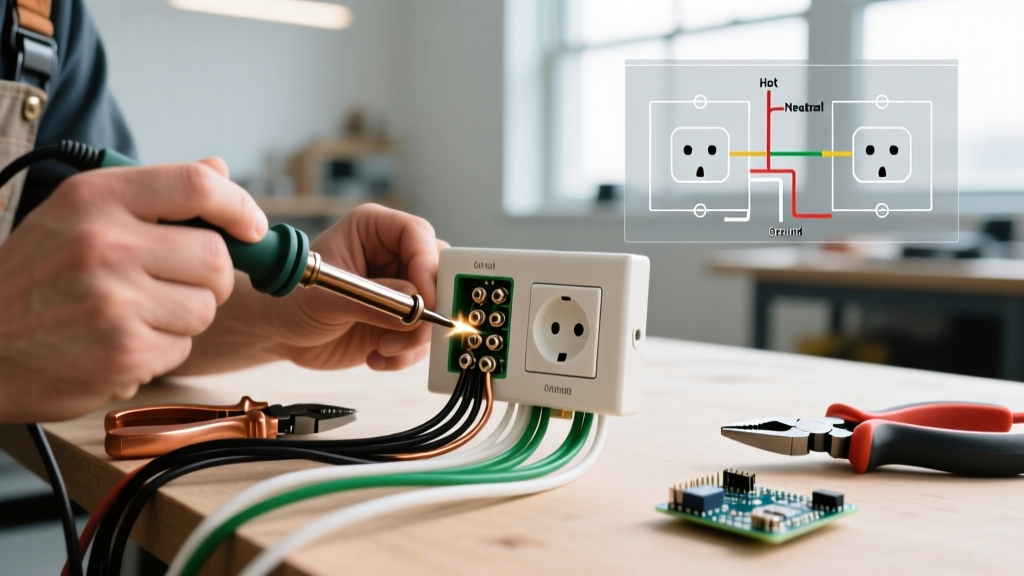
- NEC 380.4 (Enclosure Grounding): Metal switch boxes must be grounded. Furthermore, the switch yoke (the metal strap holding the device) must be bonded to the equipment grounding conductor. In metal boxes, this is often achieved via the metal mounting screws making contact with the grounded metal box, but best practice (and a requirement in many commercial applications) dictates running a dedicated grounding pigtail directly to the switch's green grounding screw.
Box Fill Calculations: Avoiding the Most Common Violation
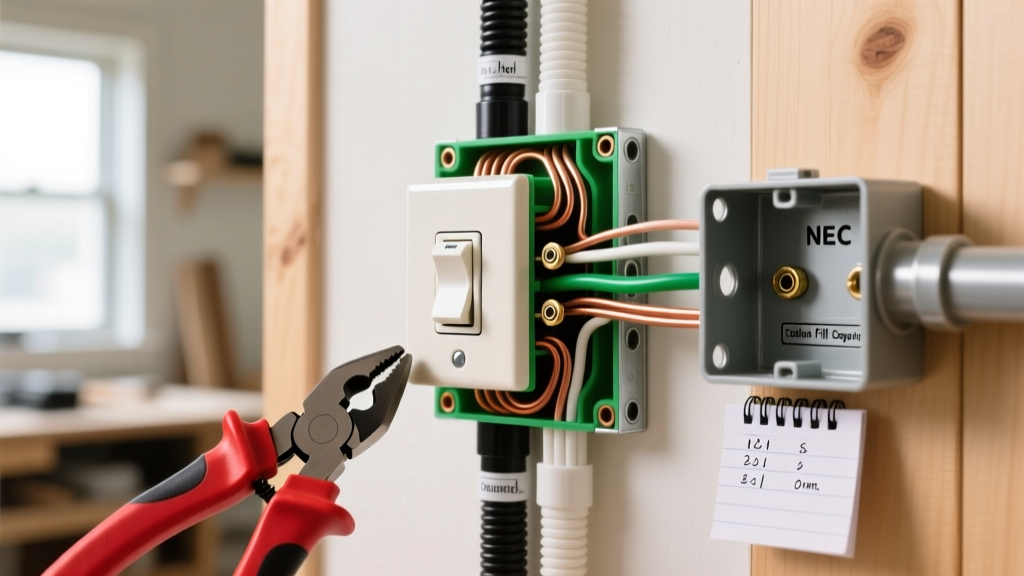
Overcrowded electrical boxes cause wires to pinch, insulation to tear, and heat to build up. NEC Article 314 dictates strict volume allowances for National Fire Protection Association (NFPA) compliance. Every conductor, clamp, and device inside the box consumes a specific amount of cubic inches.
Box Volume Allowance Matrix
| Conductor Size | Volume per Conductor | Switch Device Allowance | Grounding Allowance (Total) | Internal Clamp Allowance |
|---|---|---|---|---|
| 14 AWG | 2.0 cu in. | 4.0 cu in. (counts as 2) | 2.0 cu in. (counts as 1) | 2.0 cu in. (counts as 1) |
| 12 AWG | 2.25 cu in. | 4.5 cu in. (counts as 2) | 2.25 cu in. (counts as 1) | 2.25 cu in. (counts as 1) |
Real-World Calculation Example
Imagine you are wiring a single-pole switch on a 15A circuit (14 AWG wire) in a standard plastic single-gang box. The box has no internal clamps (cable is secured outside the box within 8 inches). You have one 14/2 NM-B cable entering (Line) and one 14/2 NM-B leaving (Load).
- Hot Conductors: 2 wires (Line in, Load out) x 2.0 = 4.0 cu in.
- Neutral Conductors: 2 wires (Line in, Load out) x 2.0 = 4.0 cu in.
- Grounding Conductors: 2 wires count as 1 allowance = 2.0 cu in.
- Switch Device: 1 switch counts as 2 allowances = 4.0 cu in.
- Total Required Volume: 14.0 cubic inches.
A standard 'old work' plastic box is typically 14 to 18 cubic inches, which passes. However, if you add a smart switch with a bulky wire-nut bundle or upgrade to 12 AWG wire, you must upgrade to a 22.5 cu in. 'deep' box to remain code-compliant.
The Neutral Conductor Requirement (NEC 404.2)
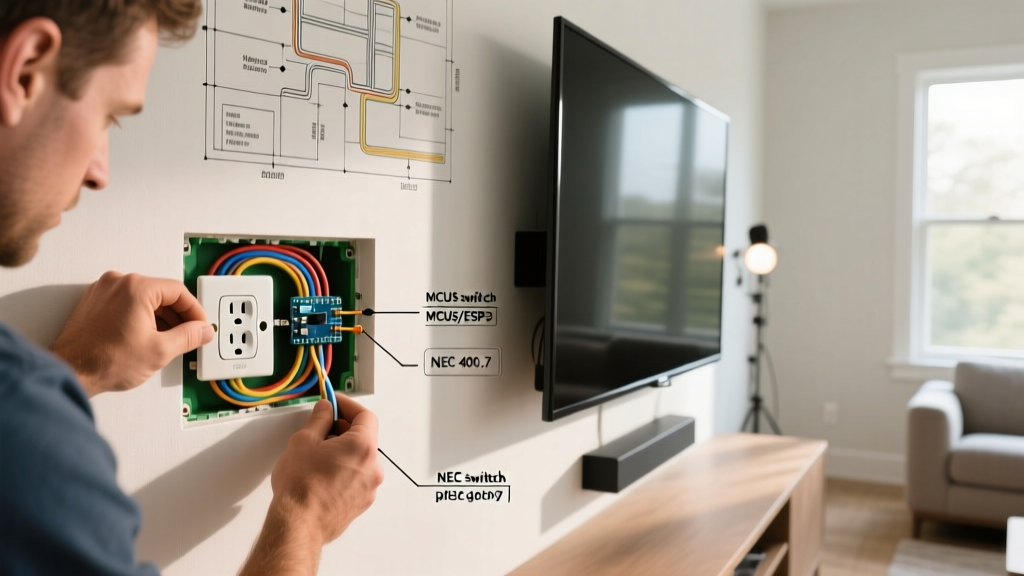
One of the most significant shifts in modern electrical codes—fully enforced in 2026—is the requirement for a grounded circuit conductor (neutral) at nearly all switch locations controlling lighting loads. This was introduced to accommodate smart switches, timers, and occupancy sensors that require continuous standby power.
Pro-Tip for Smart Switch Selection: If you are retrofitting an older home (pre-2011) where the switch box lacks a neutral wire, you cannot simply pull a new neutral without opening the walls. Instead, use a switch specifically designed to operate without a neutral, such as the Lutron Caseta PD-5S-DV (approx. $65). Conversely, Wi-Fi enabled switches like the Leviton Decora Smart D215S-2RW (approx. $32) strictly require a neutral connection to power their internal radios.
Exceptions to the Neutral Rule
NEC 404.2(C) provides two main exceptions where a neutral is not required at the switch box:
- Conduit Installations: If the switch is wired using raceway (like EMT or ENT conduit) that is large enough to easily pull a neutral wire later if needed.
- Specific Switch Loops: If the switch controls a specific lighting load and the manufacturer's instructions do not require a neutral, though this exception is shrinking as more jurisdictions mandate the neutral regardless of the immediate device installed.
AFCI Protection for Lighting Circuits
According to NEC 210.12, Arc-Fault Circuit Interrupter (AFCI) protection is required for all 120-volt, single-phase, 15- and 20-amp branch circuits supplying outlets and devices in dwelling unit bedrooms, living rooms, hallways, and closets. Because light switches are considered 'devices' on these circuits, the breaker feeding your electrical light switch wiring must be a Combination-Type AFCI breaker. Standard thermal-magnetic breakers will fail inspection for new residential lighting circuits in these areas.
Common Code Violations and Failure Modes
Even experienced DIYers and novice electricians make critical errors when wiring switches. According to safety data from the Occupational Safety and Health Administration (OSHA), improper terminations are a leading cause of residential electrical fires. Avoid these specific failure modes:
- Backstabbing on 20A Circuits: Many cheap switches feature 'push-in' (backstab) terminals. These are only rated for 14 AWG solid copper wire. If you are wiring a 20A circuit with 12 AWG wire, you must use the side-screw terminals or the screw-clamp back-wiring feature. Forcing 12 AWG into a 14 AWG push-in hole will damage the internal spring and cause a high-resistance arc fault.
- Over-Stripping Wire Insulation: Standard side-wiring requires exactly 3/4 inch of stripped insulation. Stripping 1 inch leaves exposed bare copper outside the switch yoke, creating a shock hazard and a potential short circuit against a metal wall plate or grounded box.
- Missing Pigtails for Grounding: Daisy-chaining the ground wire from the incoming cable, through the switch grounding screw, and out to the next device is a violation if cutting the wire breaks the ground path to downstream devices. Always use a wire nut to pigtail the grounds together, with a single tail going to the switch.
- Incorrect Torque Application: While residential toggle switches rarely specify exact torque values, commercial-grade switches (like the Hubbell Heavy Duty series) often require terminations tightened to 14 in-lbs. Under-tightening causes thermal expansion/contraction cycles that eventually loosen the wire, leading to arcing.
Summary: Plan Before You Pull
Successful electrical light switch wiring requires looking past the physical connection and understanding the spatial and electrical constraints of the environment. Always calculate your box fill before purchasing materials, verify the presence of a neutral conductor before buying smart home devices, and ensure your breaker panel is equipped with the correct AFCI protection. When in doubt, consult your local Authority Having Jurisdiction (AHJ), as local amendments can sometimes exceed baseline NEC requirements.