
The Reality of Aging Japanese Electrical Outlets
Japan’s electrical infrastructure is a marvel of reliability, operating at a standardized 100V with a unique 50Hz (Eastern Japan) and 60Hz (Western Japan) frequency split. However, if you are renovating a Showa-era home (built before 1989) or upgrading an older apartment, you will inevitably encounter the ungrounded 2-prong Japanese electrical outlet. While these receptacles are perfectly adequate for low-draw, double-insulated (Class II) electronics like phone chargers and lamps, they pose a significant safety risk for high-draw, metal-chassis appliances such as microwaves, washing machines, and desktop PC setups.
Upgrading an ungrounded 2-prong receptacle to a modern, grounded JIS C 8303 3-prong standard is one of the most impactful safety improvements you can make in a Japanese home. This guide covers the technical nuances, legal requirements, and step-by-step wiring procedures for executing this upgrade in 2026, ensuring your home meets modern safety expectations without violating local electrical codes.
JIS C 8303 vs. US NEMA: What Expats and DIYers Get Wrong
A common mistake among expats and foreign DIYers in Japan is assuming that a US-standard NEMA 5-15 receptacle is a drop-in, code-compliant replacement for a Japanese outlet. While the physical pin geometry of a grounded Japanese electrical outlet and a US NEMA 5-15 are nearly identical, their internal tolerances, certification requirements, and rating labels differ significantly.
All electrical components installed in Japan must bear the PSE (Product Safety Electrical Appliances and Materials) mark. Installing an unmarked or UL-listed-only US receptacle in a Japanese wall box violates the Electrical Appliance and Material Safety Act (PSE Law). Furthermore, Japanese wiring heavily relies on specific push-in terminal depths designed for metric VVF (Vinyl Insulated Vinyl Sheathed Flat) cables.
| Feature | US NEMA 5-15 | Japanese JIS C 8303 (Grounded) |
|---|---|---|
| Rated Voltage | 125V AC | 125V AC (Operates at 100V) |
| Frequency | 60Hz | 50Hz / 60Hz (Region Dependent) |
| Ground Pin | Standard Round | Standard Round or JIS-specific Earth Screw |
| Wire Terminals | Screw / Push-in (AWG) | Push-in / Screw (Metric 1.6mm/2.0mm VVF) |
| Certification | UL Listed | PSE Mark (JET or equivalent) |
Legal Prerequisites: The Denki Koji Shi Ho
Before you touch a screwdriver, you must understand the Denki Koji Shi Ho (Electrician Law). In Japan, replacing a simple plug head on a cord is considered 'minor work' and can be done by an unlicensed individual. However, removing a hardwired wall receptacle and connecting new wires to the junction box requires a Class 2 Electrical Engineer license (第二種電気工事士).
Legal Disclaimer: If you are not a licensed electrician in Japan, you must hire a certified professional to perform hardwired receptacle replacements. This guide is intended for educational purposes, licensed professionals, and those working on legal, off-grid DIY test benches. Unauthorized electrical work can void your home fire insurance and result in severe fines.
Step-by-Step Upgrade: 2-Prong to Grounded JIS Receptacle
For licensed individuals or those studying for their Class 2 exam, here is the precise methodology for upgrading to a grounded Japanese electrical outlet, utilizing the industry-standard Panasonic Cosmos 21 or Full Color series receptacles.
Step 1: Isolate the Circuit and Verify
Locate your home’s distribution board (bunpai-ban). Turn off the specific MCB (Miniature Circuit Breaker) for the room, followed by the main ELB (Earth Leakage Breaker). Japanese circuits are typically 100V/20A. Use a non-contact voltage tester and a digital multimeter to confirm 0V across the Line, Neutral, and any existing Ground terminals.
Step 2: Remove the Old Receptacle
Older Japanese outlets are often mounted on a standard rectangular junction box embedded in the drywall or wooden stud. Remove the single central screw holding the faceplate, then unscrew the top and bottom mounting screws securing the receptacle yoke to the box. Gently pull the receptacle out, noting the wire routing.
Step 3: Prepare the VVF Cable
Japanese residential wiring predominantly uses VVF 1.6mm or 2.0mm solid copper cable. Modern Panasonic JIS receptacles feature 'speed wiring' push-in terminals. Critical Detail: You must strip exactly 12mm of insulation using a specialized VVF stripper (such as the Hozan P-958). Stripping too little will result in a high-resistance connection; stripping too much will expose live copper outside the terminal, creating an arc-flash hazard.
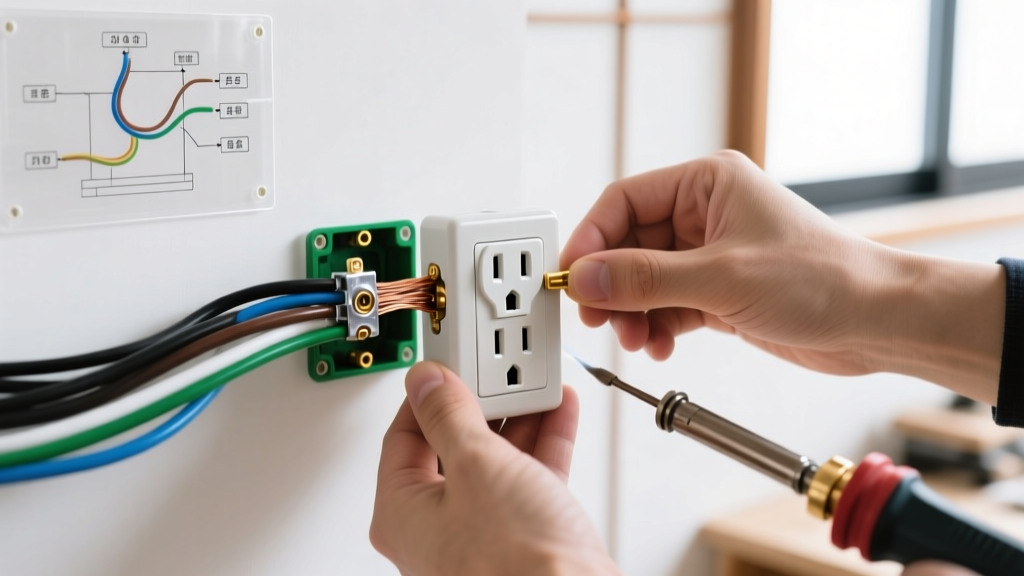
Step 4: Wire the Grounded JIS Receptacle
Using a model like the Panasonic WN1318 (15A 125V Grounded Receptacle):
- Line (Hot): Insert the black (or white, if acting as hot in older non-polarized runs) wire into the terminal marked 'L' or the side with the narrower slot.
- Neutral: Insert the white wire into the terminal marked 'N' or the side with the wider slot.
- Earth (Ground): Connect the green or bare copper ground wire to the green grounding screw or the dedicated push-in earth terminal. If your receptacle features an external 'Earth' screw for an appliance ground cord, ensure the internal ground pigtail is securely fastened to the junction box's ground bus.
Step 5: Secure and Test
Push the receptacle back into the box, ensuring no bare wire is visible outside the terminals. Secure the yoke, snap on the PSE-certified faceplate, and restore power. Test the receptacle with a JIS-compatible polarity and ground fault tester.
Edge Case: No Ground Wire in the Junction Box
What happens if you open the wall box and find only two wires (Line and Neutral) with no ground wire available? This is incredibly common in homes built prior to the 1980s. Never bootleg the ground by jumpering the neutral terminal to the ground screw. If a neutral wire disconnects upstream, the metal chassis of your appliance will become energized at 100V, posing a lethal shock hazard.
Instead, you have two code-compliant options:
- Install a GFCI Receptacle: While true JIS-compliant GFCI wall receptacles are rare and expensive in Japan compared to the US, you can install a JIS-certified GFCI adapter or replace the circuit's breaker with a modern 30mA / 0.1s ELB (Earth Leakage Breaker). This provides ground-fault protection without a physical ground wire.
- Retrofit a Ground Wire: Hire a licensed electrician to run a new 2.0mm ground wire from the receptacle back to the main distribution board's grounding bus, or to an approved grounding rod (Type D grounding, 100 ohms or less) driven into the earth outside.
Sourcing Authentic JIS Components in 2026
To ensure safety and compliance, avoid importing unverified receptacles from overseas marketplaces. Source your Japanese electrical outlet components from authorized domestic distributors. As of 2026, standard grounded JIS receptacles like the Panasonic WN1318 retail between ¥450 and ¥700 ($3.00 - $4.50 USD), while advanced models with integrated USB-C PD (Power Delivery) ports, such as the Panasonic WN7518 series, range from ¥3,500 to ¥5,500.
Reliable sourcing channels include:
- MonotaRO: Japan's premier B2B industrial supplier, offering bulk pricing on Panasonic and Toshiba JIS wiring devices.
- DCM & Cainz Home Centers: Ideal for single-unit DIY purchases (for licensed individuals), carrying the Full Color and Cosmos 21 lines.
- Yodobashi Camera / Bic Camera: Surprisingly robust electrical supply aisles for modern smart-home JIS receptacles.
Expert Insights on Frequency and Motor Loads
When upgrading outlets for specific appliances, always consider Japan's frequency divide. If you are upgrading an outlet in Tokyo (50Hz) to power a heavy appliance imported from Osaka (60Hz), or vice versa, the appliance's AC motor will run at an incorrect speed, potentially overheating and causing a fire. Always verify the appliance's nameplate for '50/60Hz' compatibility before plugging it into your newly upgraded JIS receptacle.
Authoritative References
For the most current regulations regarding the PSE mark and electrical safety standards in Japan, consult the Ministry of Economy, Trade and Industry (METI). Additionally, the Japan Electrical Safety & Environment Technology Laboratories (JET) provides comprehensive, up-to-date testing criteria and certification databases for JIS C 8303 compliant wiring devices.