
Navigating the Electrical Outlet Austria Landscape
When installing, upgrading, or troubleshooting an electrical outlet Austria infrastructure, technicians and DIY enthusiasts must navigate a highly regulated environment governed by strict national safety codes. Austria operates on a 230V/50Hz AC supply and utilizes the Type F (Schuko / CEE 7/3) receptacle standard. However, physical compatibility is only the baseline; true compliance requires adherence to the Österreichischer Verband für Elektrotechnik (OVE) regulations, specifically the ÖVE/ÖNORM E 8001 series.
Unlike regions with more lenient residential wiring codes, Austrian electrical law mandates that all permanent fixed installations be executed or formally inspected by a certified electrician (Konzessionierte Elektriker). This guide provides a deep-dive technical breakdown of the code requirements, wiring topologies, and testing protocols necessary to ensure your Austrian socket installations are safe, legal, and optimized for modern 2026 electrical loads.
⚠️ Code Alert: The Legal BoundaryUnder Austrian trade regulations (Gewerbeordnung), replacing a damaged receptacle faceplate with an identical model is generally permissible for a knowledgeable homeowner. However, extending a circuit, adding a new socket, or altering the main distribution board (Verteiler) strictly requires a licensed professional to issue an E-Check certification and update the installation log (Anlagendokumentation).
ÖVE/ÖNORM E 8001: The Core Compliance Standard
The ÖVE/ÖNORM E 8001-1 is the definitive standard for the erection of low-voltage electrical installations in Austria. Regularly updated to integrate European harmonizations (HD 60364), the standard dictates everything from cable routing depths to mandatory protective device coordination.
Type F (Schuko) Receptacle Anatomy & Orientation
The standard Austrian wall socket is the Schuko (Schutzkontakt) receptacle. It features two 4.8mm diameter pins for Line and Neutral, and two lateral grounding clips for the Protective Earth (PE). According to the IEC World Plugs database, Type F is rated for 16A at 250V AC.
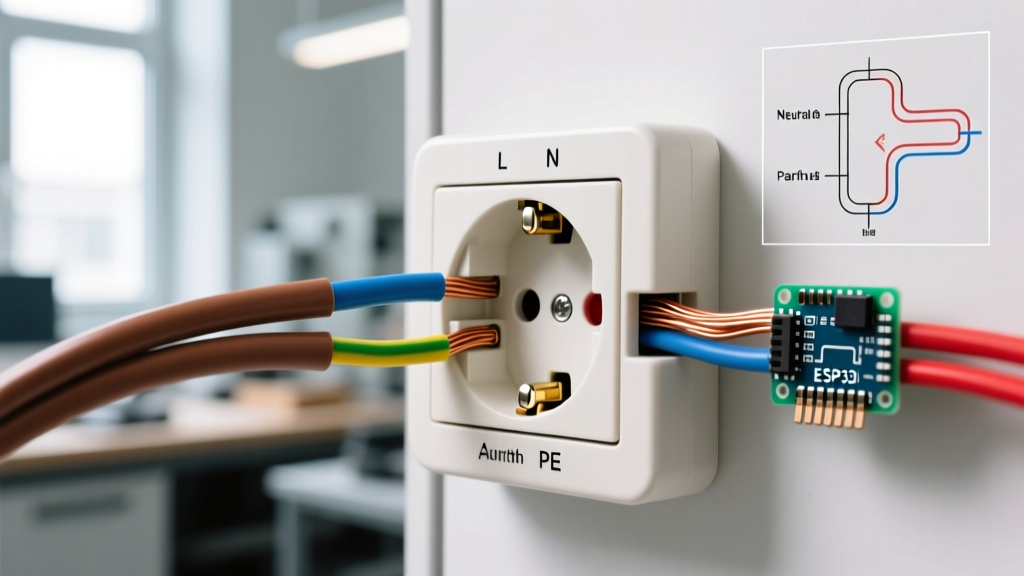
While the Schuko plug is physically reversible and unpolarized, the ÖVE strongly recommends a standardized wiring orientation for fixed wall receptacles to ensure safety when integrating single-pole smart switches or inline appliance switches:
- Line (L / Phase): Brown wire, terminated to the right socket terminal (when facing the receptacle).
- Neutral (N): Blue wire, terminated to the left socket terminal.
- Protective Earth (PE): Green/Yellow wire, terminated to the central earth busbar connected to the lateral clips.
Expert Tip: When using modern spring-clamp receptacles (e.g., Legrand Valena Life or Schneider Electric Exxact), strip exactly 12mm of insulation. For screw-terminal variants, apply a precise torque of 1.2 Nm to prevent cold-creep loosening over thermal cycles, which is a leading cause of arc faults in Austrian households.
Wiring Matrix: Cable Sizing & Breaker Coordination
Selecting the correct cable cross-section and pairing it with the appropriate miniature circuit breaker (MCB / Leitungsschutzschalter) is critical. In Austria, the B-characteristic curve is standard for residential socket circuits to handle moderate inrush currents without nuisance tripping.
| Application Scenario | Cable Type (NYM-J) | Cross-Section | MCB Rating | Max Continuous Load |
|---|---|---|---|---|
| General Living Room / Bedroom Sockets | 3x1.5 mm² | 1.5 mm² | B16A | ~3.6 kW |
| Kitchen Countertop / High-Draw Appliances | 3x2.5 mm² | 2.5 mm² | B16A or B20A | ~4.6 kW |
| Dedicated Washing Machine / Dryer | 3x2.5 mm² | 2.5 mm² | B16A | ~3.6 kW (Dedicated) |
| EV Wallbox (Single Phase Schuko Adapter) | 3x2.5 mm² | 2.5 mm² | B16A | 2.3 kW (Continuous 10A) |
Note: While a 1.5 mm² cable can theoretically handle 16A under optimal installation conditions (Reference Method B2), Austrian inspectors frequently mandate 2.5 mm² for kitchen circuits to mitigate voltage drop and thermal degradation in bundled conduits.
Mandatory RCD (FI-Schutzschalter) Integration
The most critical safety evolution in the ÖVE/ÖNORM E 8001 standard is the universal mandate for Residual Current Devices (RCDs), known locally as FI-Schutzschalter. As of the latest code cycles, every socket outlet rated up to 32A intended for general use must be protected by an RCD with a maximum tripping current of 30mA.
Choosing the Correct RCD Type
Not all RCDs are created equal. Selecting the wrong type is a frequent compliance failure in modern Austrian smart homes:
- Type AC (Obsolete for new installs): Only detects pure sinusoidal AC fault currents. Banned for new socket circuits under current ÖVE guidelines.
- Type A (Standard): Detects AC and pulsating DC fault currents. Mandatory for all standard household socket circuits.
- Type F (High Frequency): Required for circuits supplying modern frequency-controlled appliances (e.g., advanced HVAC, modern washing machines) where fault currents may contain mixed frequencies up to 1kHz.
- Type B (Universal / EV Charging): Detects smooth DC fault currents. If you are installing a dedicated socket for a portable EV charger (ICCPD) that lacks internal DC fault detection, a Type B RCD is legally required to prevent the blinding of upstream Type A RCDs.
Advanced Protection: AFDDs (Brandschutzschalter)
Arc Fault Detection Devices (AFDDs) represent the cutting edge of fire prevention in Austrian electrical codes. While not universally mandated for every single socket in a standard concrete apartment, ÖVE/ÖNORM E 8001 strictly requires AFDDs for socket circuits in specific high-risk environments:
- Buildings constructed primarily of combustible materials (e.g., timber-frame houses).
- Sleeping areas and bedrooms.
- Facilities catering to vulnerable populations (elderly care, kindergartens).
- Rooms storing highly flammable materials.
An AFDD continuously monitors the high-frequency noise signature of the circuit, distinguishing between harmless appliance arcing (like a vacuum cleaner motor) and dangerous series/parallel arc faults caused by crushed cables or loose terminal connections.
Grounding Topologies: TN-C-S vs. TT Systems
Understanding the local grounding topology is essential for correctly wiring the PE terminal of an electrical outlet in Austria.
- TN-C-S Network (Standard Urban/Suburban): The utility provides a combined PEN (Protective Earth and Neutral) conductor to the main distribution board. Inside the premises, the PEN is split into separate PE and N bars. Critical Rule: The main equipotential bonding (Hauptpotentialausgleich) must connect the PE bar to the building's foundation earth, water pipes, and gas lines. RCDs must be installed after the PEN split point.
- TT Network (Rural / Alpine Regions): The utility provides only the Phase and Neutral. The Protective Earth is generated locally via a grounding rod (Fundamenterder) at the property. Because earth fault loop impedance can be high in rocky alpine soil, 30mA RCDs are not just a code requirement—they are the only mechanism ensuring rapid fault clearance, as MCB magnetic trips may fail to activate.
Verification & Testing Protocols
According to the Austrian Labour Inspectorate and OVE guidelines, visual inspection is insufficient. Every new or altered socket circuit must undergo instrumental verification using a calibrated installation tester (e.g., Metrel Eurotest XT or Benning IT 130).
The 3-Step Compliance Test
- Continuity of Protective Conductors: Verify the PE path from the socket's earth clip back to the main distribution board. Resistance must typically be < 1.0 Ω.
- Loop Impedance (Schleifenimpedanz): Measure the L-PE loop impedance at the furthest socket on the circuit. For a B16A breaker, the measured impedance ($Z_s$) must be low enough to guarantee the magnetic trip activates within 0.1 seconds. The theoretical maximum is $230V / (5 \times 16A) = 2.87 \Omega$, but ÖVE requires a safety margin; inspectors look for values < 2.0 Ω.
- RCD Ramp & Trip Test: Inject a gradually increasing fault current. A 30mA Type A RCD must trip between 15mA and 30mA. Furthermore, at 5x $I_{\Delta n}$ (150mA), the trip time must be < 40ms to prevent ventricular fibrillation in humans.
"Compliance in Austria is not merely about making the outlet function; it is about engineering a predictable failure path. A correctly wired Schuko receptacle, backed by a coordinated Type A RCD and precise loop impedance, ensures that a fault in a connected appliance becomes a momentary inconvenience rather than a fatal hazard."
Summary Checklist for Installers
Before energizing any electrical outlet in Austria, verify the following:
- [ ] Cable cross-section matches the MCB rating and installation method (1.5mm² or 2.5mm²).
- [ ] Phase (Brown) is routed to the right terminal; Neutral (Blue) to the left.
- [ ] PE (Green/Yellow) is securely terminated with no exposed copper outside the terminal block.
- [ ] Circuit is protected by a 30mA Type A (or Type F/B where applicable) RCD.
- [ ] Loop impedance and RCD trip times have been measured and logged in the Anlagendokumentation.
By strictly adhering to the ÖVE/ÖNORM E 8001 standards, you ensure that your Austrian electrical installations remain robust, legally compliant, and fundamentally safe for decades to come.