
The Core Toolkit: Essential vs. Pro-Grade Upgrades
Learning how to add an electrical outlet to a wall is a foundational DIY electrical skill, but the success of the project hinges entirely on the quality of your tools and materials. Using undersized wire, incorrect wall boxes, or dull wire strippers can lead to high-resistance connections, arcing, and eventual fire hazards. According to the Electrical Safety Foundation International (ESFI), electrical receptacles are involved in thousands of home fires annually, often traced back to improper installation and substandard components.
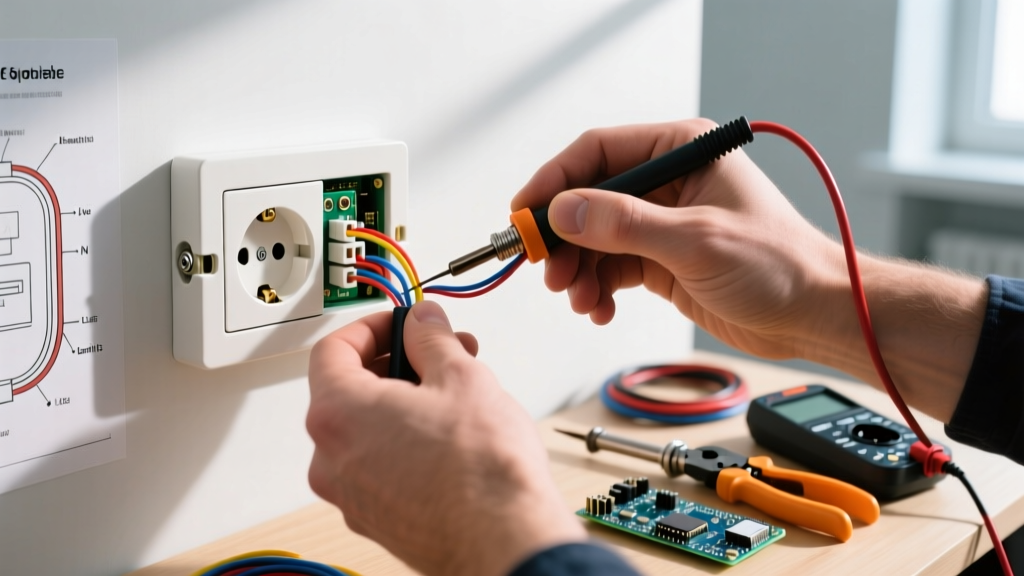
Before cutting into your drywall, you need a specialized toolkit designed for copper conductors and confined junction boxes. Here is the exact gear required for a safe, code-compliant installation.
Voltage Testers and Multimeters
Never rely solely on the breaker panel labels. You must verify the absence of voltage at the source and the destination.
- Budget/Standard: Klein Tools NCVT-2 Non-Contact Voltage Tester (~$25). This dual-range tester detects 12-1000V AC and 70-1000V AC, allowing you to test both standard line voltage and low-voltage thermostat wires.
- Pro Upgrade: Fluke 117 True-RMS Multimeter (~$220). For verifying exact voltage drop and testing continuity on long wire runs through walls, a True-RMS meter is non-negotiable for professionals.
Wire Strippers and Cutters
Standard pliers will nick the copper conductor, creating a weak point that can snap inside the wall box or cause localized heating.
- Top Pick: Klein Tools 11057 Wire Stripper/Cutter. Calibrated specifically for 10-20 AWG solid copper wire (the exact gauges used in 14/2 and 12/2 Romex). It strips the insulation cleanly without scoring the copper.
- Cable Ripper: Romex Splitter Tool (~$15). Slices the outer PVC jacket of NM-B cable without damaging the inner paper or individual wire insulation.
Material Selection: Matching the Right Outlet to the Wall
When figuring out how to add an electrical outlet to a wall, the physical receptacle and the housing box are your most critical material choices. The National Fire Protection Association (NFPA) updates the National Electrical Code (NEC) regularly, and 2026 enforcement strictly mandates specific safety features for new installations.
15A vs. 20A Receptacles and TR Requirements
Most general-purpose living areas require 15-amp circuits, but kitchens, dining rooms, and garages often require 20-amp circuits.
- 15A Receptacle: Leviton T5320-WCP (15-Amp Tamper-Resistant Duplex). Costs around $3.50. The 'TR' stamp is mandatory per NEC Article 406.12 for all new installations in dwelling units to prevent children from inserting foreign objects.
- 20A Receptacle: Leviton T5262-WCP (20-Amp TR). Features the distinctive horizontal T-slot on one of the vertical prongs to accept heavy-duty appliance plugs. Costs around $5.00.
CRITICAL NEC WARNING: Never install a 20A receptacle on a 15A breaker circuit. However, you are permitted by code to install 15A receptacles on a 20A circuit, provided there is more than one receptacle on that circuit (NEC 210.21(B)(3)).
NM-B Cable Sizing: 14/2 vs. 12/2
For a standard 15A circuit, 14 AWG copper (14/2 NM-B) is the minimum code requirement. However, many master electricians exclusively pull 12/2 NM-B (12 AWG) even on 15A breakers. Why? 12 AWG wire significantly reduces voltage drop over long runs (over 50 feet) and allows the homeowner to upgrade the breaker to 20A in the future without ripping out the drywall to replace the wire. Southwire and CerroWire 12/2 NM-B costs approximately $0.85 per foot, compared to $0.65 for 14/2.
Junction Box Sizing and Box Fill Calculations
The most common failure point in DIY outlet additions is using a wall box that is too small, violating NEC Article 314.16 (Box Fill Calculations). Overcrowded boxes trap heat and make it impossible to fold the wires safely behind the receptacle.
The Math Behind the Box
Let us calculate the required cubic inch (cu in) volume for adding a single standard duplex outlet using 12/2 NM-B cable:
- Hot and Neutral Wires (2 conductors entering, 2 leaving): 4 conductors x 2.25 cu in (for 12 AWG) = 9.0 cu in.
- Equipment Grounding Wires: All grounds count as 1 volume = 2.25 cu in.
- Internal Cable Clamps: Count as 1 volume = 2.25 cu in.
- The Device (Receptacle): Counts as 2 volumes = 4.5 cu in.
- Total Required Volume: 18.0 cubic inches.
Material Pick: The Carlon B618R Old Work Outlet Box provides 22.5 cubic inches of space and features heavy-duty flip-clamps for secure drywall mounting. At roughly $3.50 per unit, it provides ample room for pigtailing and smart-plug depth clearance.
Tool & Material Cost Matrix
| Category | Item / Model | Estimated Cost | Purpose & Code Relevance |
|---|---|---|---|
| Testing | Klein NCVT-2 | $25.00 | Verifies de-energized state before contact. |
| Prep | Klein 11057 Strippers | $32.00 | Prevents copper scoring on 10-20 AWG. |
| Box | Carlon B618R (22.5 cu in) | $3.50 | Meets NEC 314.16 box fill for 12 AWG. |
| Device | Leviton T5320-WCP (TR) | $3.50 | Tamper-Resistant, NEC 406.12 compliant. |
| Connectors | Ideal 341 Wire Nuts | $0.15 ea | UL listed for 3x 12 AWG pigtails. |
Wiring Techniques: Side-Wiring vs. Push-In Backstabbing
When connecting your materials to the Leviton or Eaton receptacle, you will notice two connection methods: the terminal screws on the side and the push-in holes on the back.
Never use the push-in backstab connections. While technically UL-listed, they rely on a tiny internal spring-metal tang to grip the wire. Over time, thermal expansion and contraction from electrical loads cause these tangs to loosen, creating high-resistance arcing faults behind the drywall. Always use the side terminal screws. Wrap the stripped copper wire clockwise around the screw terminal so that tightening the screw pulls the wire loop tighter rather than pushing it out. Torque the screw to the manufacturer's specification (usually around 14 inch-pounds for standard 15A devices).
AFCI and GFCI Code Considerations for 2026
Depending on where you are adding this outlet, your material list may need to expand to include specialized protection. The Occupational Safety and Health Administration (OSHA) and local inspectors strictly enforce arc-fault and ground-fault protection.
- AFCI (Arc-Fault Circuit Interrupter): Required in almost all living spaces (bedrooms, living rooms, hallways). If your breaker panel does not have an AFCI breaker for this circuit, you must use an AFCI receptacle at the first point of the circuit, or upgrade the breaker.
- GFCI (Ground-Fault Circuit Interrupter): Mandatory for any new outlet added in kitchens, bathrooms, garages, outdoors, or within 6 feet of a water source. A standard Leviton 7899-GFCI costs around $22.00 and requires a deeper wall box (minimum 22.5 cu in) due to the bulky internal electronics.
Frequently Asked Questions
Can I daisy-chain the new outlet from an existing one?
Yes, provided the existing circuit is not a dedicated appliance line (like a refrigerator or microwave) and the total load does not exceed 80% of the breaker's capacity. Always use 'pigtailing' (connecting the incoming hot, outgoing hot, and a short jumper wire together with a wire nut) rather than using the receptacle's internal brass plate to pass power downstream. Pigtailing ensures that if the new outlet fails or is removed, the downstream outlets remain powered.
What if my house has no ground wire?
If you are adding an outlet to an older home with ungrounded (2-prong) wiring, NEC code allows you to install a GFCI receptacle and label it 'No Equipment Ground'. The GFCI will protect against shock hazards by detecting current imbalances, even without a physical ground wire. However, this will not protect sensitive electronics from surges, and you cannot legally add a ground wire by simply connecting it to a metal water pipe.