
Understanding the Croatia Electrical Outlet Standard
Whether you are an expat renovating a coastal stone villa in Dalmatia, a digital nomad setting up a home office in Zagreb, or an electrical engineer adapting international equipment, understanding the local electrical infrastructure is critical. The standard Croatia electrical outlet operates on the harmonized European grid standard. As of 2026, with the strict enforcement of the EU Energy Performance of Buildings Directive (EPBD), local wiring practices have evolved to integrate smart metering and EV-readiness, but the fundamental receptacle standard remains unchanged.
Croatia utilizes the Type F (CEE 7/3) socket, universally known as the "Schuko" (short for Schutzkontakt, meaning protective contact). For low-power, double-insulated devices, the ungrounded Type C (CEE 7/16) Europlug is also universally compatible with these sockets.
Core Electrical Specifications
| Parameter | Specification | Notes |
|---|---|---|
| Voltage | 230V (±10%) | Harmonized EU standard (historically 220V) |
| Frequency | 50 Hz | Affects motorized appliance speeds |
| Primary Socket | Type F (CEE 7/3) | Schuko, 16A max, side grounding clips |
| Standard Breaker | 16A (Type B or C) | Minijaturni prekidač (MCB) |
| Wire Colors (Modern) | Brown / Blue / Green-Yellow | Phase / Neutral / Protective Earth |
According to the International Electrotechnical Commission (IEC), Type F plugs feature two 4.8mm round pins spaced 19mm apart, with grounding contacts on the top and bottom edges. Unlike the UK or US systems, the Schuko system is non-polarized, meaning the plug can be inserted upside down. However, professional Croatian electricians adhere to strict phase-alignment conventions for safety and diagnostic consistency.
Common Wiring Scenarios in Croatian Properties
Wiring a Croatia electrical outlet requires adapting to the building's age. The electrical codes and material standards shifted dramatically following the country's independence in the 1990s and subsequent EU integration.
Scenario 1: Modern EU-Standard Wiring (Post-2005)
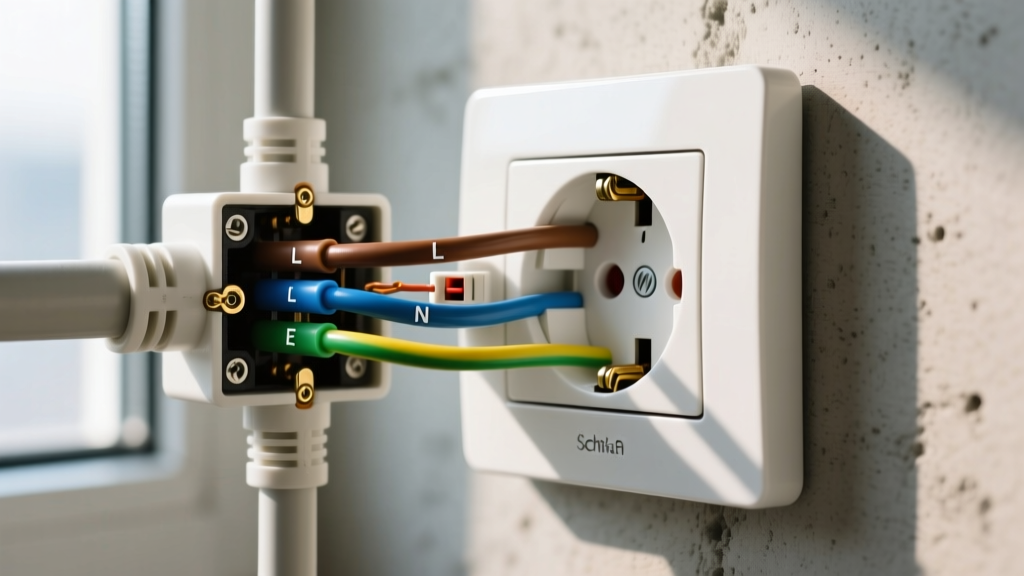
In modern builds or fully renovated properties, wiring follows the strict IEC 60446 color code standard. When opening a modern flush-mounted wall box (typically 68mm diameter in Europe), you will encounter:
- Phase (L): Brown
- Neutral (N): Blue
- Protective Earth (PE): Green-Yellow striped
These circuits are protected by a 16A MCB and, crucially, a 30mA FI sklopka (the local Croatian term for a Residual Current Device or RCD). The FI sklopka is legally mandatory for all bathroom outlets, kitchen counter receptacles, and outdoor sockets.
Scenario 2: Legacy Yugoslav-Era Wiring (Pre-1990s)
If you are renovating an older apartment in Split or a socialist-era block in Rijeka, you will likely encounter legacy wiring. Never trust the wire colors in pre-1990 Croatian buildings. During the Yugoslav era, local electricians often used available materials or followed older DIN/VDE standards that conflict with modern EU codes.
⚠️ CRITICAL SAFETY WARNING: In older Croatian properties, Phase might be Black or Red, Neutral might be Grey or White, and Earth might be bare copper or even Yellow. Always use a CAT III rated multimeter to verify voltage between Phase-Neutral (230V), Phase-Earth (230V), and Neutral-Earth (~0V) before making any terminations.
Furthermore, older properties often lack a continuous Protective Earth (PE) conductor to the outlet boxes, relying instead on "neutral bonding" (connecting the ground terminal to the neutral wire at the socket). This is highly dangerous and illegal under modern HEP (Hrvatska elektroprivreda) grid codes. If you encounter this, you must pull new 3x2.5mm² NYM-J cable from the distribution board to install a grounded Type F outlet safely.
Scenario 3: 2026 EPBD Compliance & EV-Ready Conduits
Under the 2026 EU EPBD mandates, any major renovation in Croatia now requires "EV-readiness." When wiring new ground-floor or garage outlets, electricians are required to install dedicated 3-phase (400V) conduits or at least 6mm² single-phase lines to support future 11kW-22kW wallbox chargers. Standard 16A Schuko outlets are not rated for continuous 16A EV charging loads (which can cause thermal degradation over 8+ hours); thus, dedicated Type 2 EV sockets must be wired on separate 20A or 32A circuits with specific Type B RCDs to handle DC fault currents.
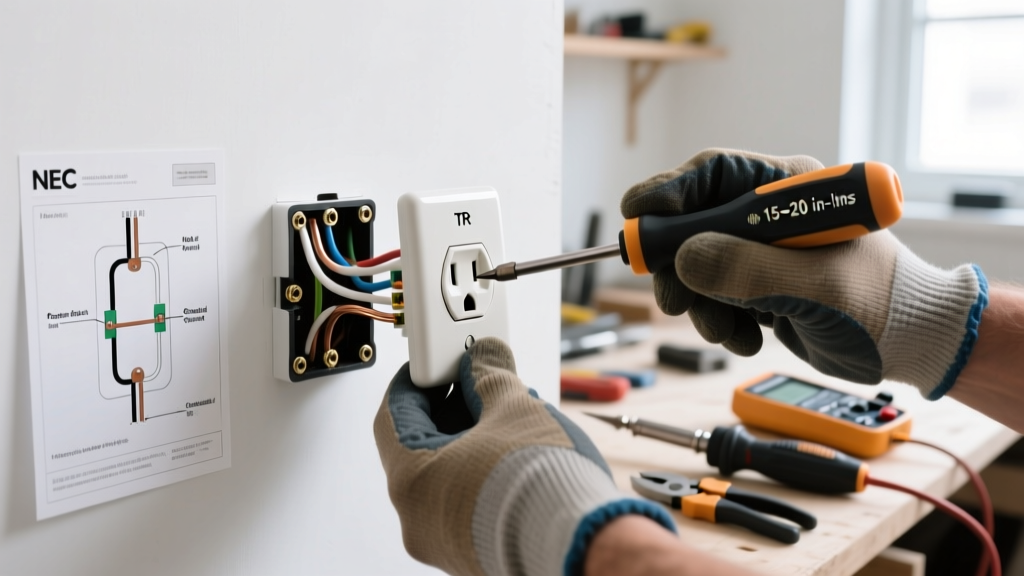
Step-by-Step: Wiring a Type F Schuko Receptacle
When installing a high-quality receptacle (such as a Schneider Electric Odace or Legrand Valena Life, popular in the Croatian market), follow these precise termination steps to prevent thermal failures.
- Isolate the Circuit: Turn off the 16A MCB at the main razdjelni ormarić (distribution board). Lock out the panel if possible.
- Verify Dead: Use a non-contact voltage tester, followed by a multimeter probe test across L-N, L-PE, and N-PE.
- Strip the Insulation: Strip exactly 12mm to 14mm of insulation from the 2.5mm² solid copper conductors. Stripping too much leaves exposed copper; stripping too little causes the terminal screw to bite into the insulation, leading to high-resistance arcing.
- Terminate Protective Earth (PE): Connect the Green-Yellow wire to the central grounding screw. This screw is mechanically linked to the two side grounding clips of the Schuko socket. Torque to 0.8 Nm.
- Terminate Phase (L) and Neutral (N): While Schuko is non-polarized, Croatian convention dictates Phase (Brown) on the right and Neutral (Blue) on the left when facing the installed socket. Insert the wires into the brass terminal blocks and tighten securely.
- Mount the Receptacle: Use the two M4 machine screws to secure the socket to the 68mm wall box, ensuring the leveling claws (if used) do not pierce any nearby cables. Screw on the faceplate.
For detailed physical dimensions and tolerance standards of the Schuko socket recess, refer to the World Standards Type F documentation, which outlines the 4.8mm pin requirements and side-clip grounding mechanics.
Adapting North American Appliances to Croatian Outlets
A common scenario for expats is attempting to use US/Canadian 120V/60Hz appliances in Croatia. The physical plug difference is only half the battle; the electrical physics dictate what will actually survive.
- Switch-Mode Power Supplies (Laptops, Phones, Camera Chargers): These are universally rated for 100-240V, 50/60Hz. You only need a simple, ungrounded Type C travel adapter or a replacement Type F "Mickey Mouse" (IEC C5) power cord.
- Resistive Loads (Hair Straighteners, Toasters): These will work on 50Hz but will draw excessive current and burn out instantly on 230V. You must use a heavy, expensive step-down transformer (230V to 120V) rated for at least 1.5x the appliance's wattage.
- Motorized Appliances (Blenders, Stand Mixers, Hair Dryers): Do not bring these. Even with a step-down transformer, the 50Hz frequency will cause 60Hz AC motors to run 20% slower, draw higher current, overheat, and potentially catch fire. Purchase local 230V/50Hz appliances upon arrival in Croatia.
Frequently Asked Questions
Can I use a UK Type G plug in a Croatia electrical outlet?
No. The physical pins of a UK Type G plug will not fit into a Type F Schuko socket. While you can buy travel adapters, it is highly recommended to cut off the UK plug and wire on a high-quality 16A Type F Schuko plug (available at any local električni materijal hardware store) to ensure a secure, grounded connection.
Are Type C (Europlug) devices safe in Type F sockets?
Yes. Type C plugs are designed to fit perfectly into Type F sockets. Because Type C devices are "Class II" (double-insulated), they do not require a protective earth connection. The Schuko socket's recessed design ensures that you cannot touch the pins while they are partially inserted, preventing shock hazards.
What is the maximum continuous load for a standard Croatian wall outlet?
A standard Type F outlet is rated for 16 Amps at 230V, equating to roughly 3,680 Watts. However, for continuous loads (running for 3 hours or more, such as space heaters or EV chargers), electrical codes require derating the circuit by 20%. Therefore, the safe continuous draw is about 2,900 Watts (12.5 Amps).
Final Thoughts on Local Compliance
Working with electricity in Croatia requires respect for both modern EU directives and the quirks of legacy infrastructure. Always ensure your distribution board features up-to-date surge protection devices (SPD) and that all wet-area circuits are protected by a 30mA FI sklopka. When in doubt, hire a certified local electrician (ovlašteni električar) who can provide a valid ispitivanje instalacija (installation testing certificate) required for property insurance and grid connection.