
The Deceptive Simplicity of the White Wire
In standard residential NM-B (Romex) cable, the electrical wiring white wire is universally recognized by novices as the grounded neutral conductor. However, in the professional electrical sphere, treating the white wire as an absolute neutral is a fast track to arc faults, melted panels, and fatal shocks. As smart home retrofits surge in 2026 and older homes undergo remodels, the misidentification of the white wire remains one of the most common and dangerous errors in DIY electrical work.
This analysis breaks down the critical divergence between DIY assumptions and professional execution regarding the white wire, referencing the latest National Electrical Code (NEC) standards and real-world failure modes.
The 'White Means Neutral' Fallacy
The most pervasive DIY mistake is assuming that every white wire in a junction box is a neutral. According to the National Fire Protection Association (NFPA), which publishes the NEC, a white or gray wire is typically the grounded conductor. However, NEC Article 200.7(C) explicitly allows the white wire to be used as an ungrounded (hot) conductor in specific scenarios, provided it is permanently re-identified.
Pro Insight: A professional electrician never trusts the color of the wire insulation. They trust their meter. A DIYer sees a white wire and connects it to the silver neutral bus bar; a pro tests it for voltage potential to ground before making any terminations.
Where DIYers Get Burned: Switch Loops
In homes wired prior to the 2011 NEC cycle, standard switch loops were often pulled using 14/2 or 12/2 cable. The black wire carried the hot feed down to the switch, and the white wire carried the switched hot back up to the light fixture. If a DIYer replaces a standard toggle switch with a modern smart switch (like a Lutron Caséta or Kasa Smart Dimmer) that requires a true neutral, they will mistakenly use the re-identified white wire as a neutral. This results in an immediate dead short or a fried smart switch.
Multi-Wire Branch Circuits (MWBC): The Shared Neutral Trap
Nowhere is the DIY vs. Professional gap more dangerous than in Multi-Wire Branch Circuits. An MWBC uses a 12/3 or 14/3 cable (Black, Red, White, Bare) to supply two 120V circuits that share a single white neutral wire.
The Vector Math Failure Mode
When installed correctly by a professional, the black and red wires are connected to breakers on opposite phases (Leg A and Leg B) of the 240V split-phase panel. Because the sine waves are 180 degrees out of phase, the current on the shared white neutral is the difference between the two legs. If Leg A draws 10A and Leg B draws 8A, the white neutral only carries 2A.
The DIY Catastrophe: If a DIYer replaces the panel or moves breakers and places both the black and red wires on the same phase leg, the currents no longer cancel out; they add together. 10A + 8A = 18A. The 14 AWG white neutral wire is now carrying 18A on a conductor rated for 15A, but the 15A breakers will not trip because neither individual hot leg is overloaded. The result is an overheated, melted neutral bus bar or an in-wall fire.
To prevent this, NEC Article 210.4(B) mandates that MWBCs must have a simultaneous disconnect mechanism. Professionals use approved handle ties (like the Siemens Q21520 or Eaton CHMIT) or factory-tied tandem breakers to ensure both legs trip together, protecting the shared white wire.
Execution Matrix: DIY Approach vs. Professional Standard
| Scenario | Typical DIY Execution | Professional Standard (NEC Compliant) |
|---|---|---|
| Switch Loop Re-identification | Leaves white wire bare; assumes it is neutral at the fixture canopy. | Wraps black or red electrical tape (or uses phase-tape) around both ends of the white wire per NEC 200.7(C)(2). |
| MWBC Breaker Placement | Places breakers on whatever slots are available, often resulting in same-phase sharing. | Verifies opposite-phase leg placement with a multimeter (reading 240V across hot-to-hot) and installs a handle tie. |
| Smart Switch Retrofit | Ties the smart switch neutral pigtail to the white wire in an old switch loop, causing a short. | Pulls new 14/3 cable to provide a true neutral, or installs a micro-module at the fixture where a true neutral exists. |
| Neutral Continuity | Pigtails neutrals but occasionally relies on the device yoke to carry the neutral feed-through. | Strictly adheres to NEC 300.13(B), ensuring the grounded (white) conductor is continuous and not dependent on the device terminal. |
Pro Troubleshooting Protocol: Verifying the White Wire
When a professional electrician opens a legacy junction box and encounters multiple white wires, they follow a strict diagnostic protocol to separate true neutrals from switched hots or traveler wires.
- Visual Inspection for Re-identification: Check for faded black tape, paint marks, or heat-shrink tubing at the wire jacket entry point.
- Non-Contact Voltage Test: Use a high-sensitivity tester like the Klein Tools NCVT-3. If the white wire registers voltage while the switch is ON, it is likely a switched hot or a traveler in a 3-way setup.
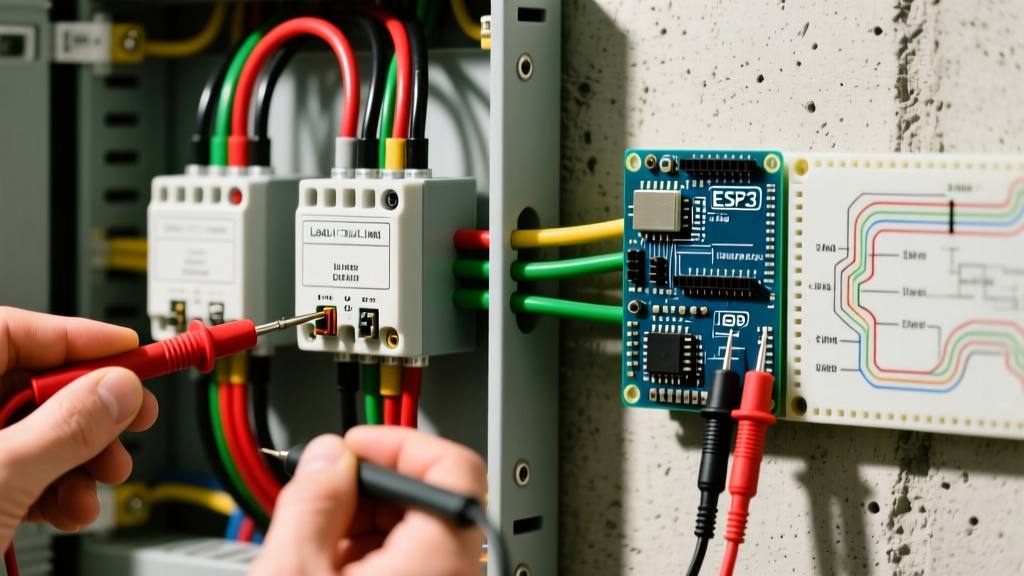
- Load Testing with a Digital Multimeter: Using a true-RMS meter (such as the Fluke 117), measure Hot-to-White (should read ~120V) and White-to-Ground. A true neutral under load will show a minor voltage drop (typically 0.5V to 2.0V) relative to the grounding conductor. A white wire acting as a hot leg will read 0V to the bare ground wire if the circuit is open, or 120V if it is back-fed.
The Financial Impact of Neutral Mistakes
Miswiring the electrical wiring white wire is not just a code violation; it carries severe financial consequences. Data from the U.S. Consumer Product Safety Commission (CPSC) consistently highlights electrical distribution failures as a leading cause of residential fires, many stemming from overloaded or loose neutral connections.
| Failure Type | Root Cause | Estimated Remediation Cost (2026) |
|---|---|---|
| Melted Neutral Bus Bar | MWBC same-phase overload or loose termination torque. | $450 - $850 (Panel repair/bussing replacement) |
| Fried Smart Home Hub | Connecting neutral pigtail to a re-identified white switch leg. | $150 - $300 (Device replacement + troubleshooting) |
| Arc Fault / In-Wall Fire | Broken neutral continuity causing high-resistance arcing. | $2,500 - $10,000+ (Drywall repair, rewiring, fire damage) |
Conclusion: Respect the Conductor, Not the Color
The electrical wiring white wire is a critical component of a safe, functioning electrical system, but its color is merely a starting point for identification, not a guarantee of function. As the Electrical Safety Foundation International (ESFI) emphasizes, electrical systems demand respect for the physics of current flow and strict adherence to code.
While DIY enthusiasts can successfully navigate basic fixture swaps, any encounter with switch loops, MWBCs, or panel modifications requires the analytical approach, specialized testing equipment, and code knowledge that only a licensed professional brings to the table. When in doubt about the true identity of a white wire, stop work, cap the conductors, and call a professional.