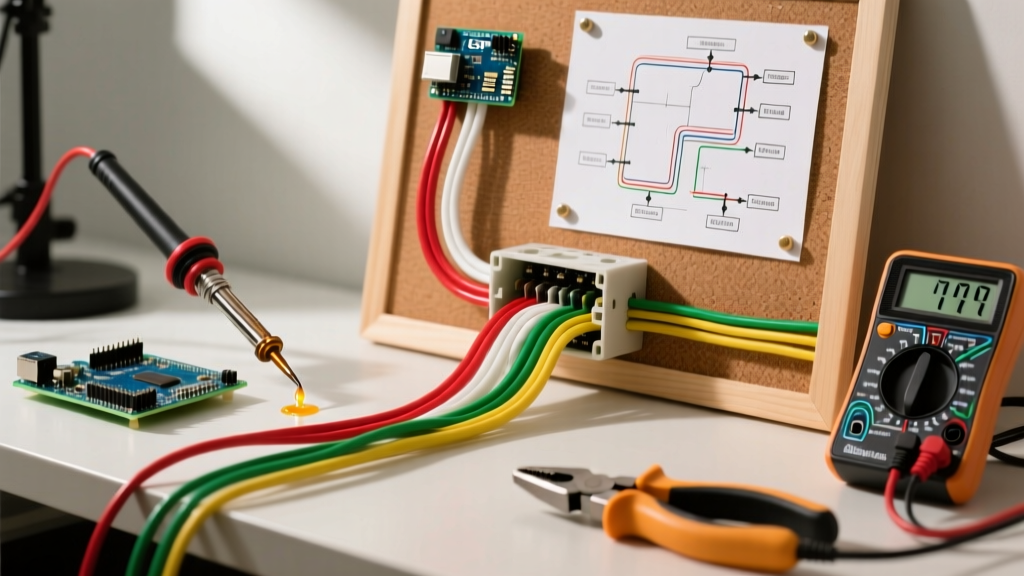

The Foundation: US AC Power Color Codes
When tackling a home remodel, adding a new circuit, or replacing a receptacle, guessing the function of a wire based on its color is a dangerous gamble. Misidentifying a neutral conductor as a hot wire can lead to dead shorts, destroyed appliances, or fatal electrical shocks. In the United States, residential wiring is governed by the National Electrical Code (NEC), published by the National Fire Protection Association (NFPA). While the NEC mandates strict color rules for grounded (neutral) and grounding conductors, ungrounded (hot) conductors follow established industry conventions rather than rigid color mandates for single-phase systems.
Safety Warning: Never assume wire colors are correct, especially in older homes or properties with a history of DIY repairs. Always verify voltage with a multimeter before touching exposed conductors. The Occupational Safety and Health Administration (OSHA) consistently cites electrical hazards as a leading cause of residential and commercial worksite injuries.
Standard Single-Phase Color Matrix
The following table outlines the standard color code wiring electrical conventions for 120V/240V single-phase residential systems in North America.
| Wire Color | Function | NEC Reference | Common Home Application |
|---|---|---|---|
| Black | Ungrounded (Hot) | Art. 310.12 (Convention) | Primary hot feed for 120V circuits, switches, and receptacles. |
| Red | Ungrounded (Hot) | Art. 310.12 (Convention) | Secondary hot for 240V appliances, MWBCs, and smoke detector interconnects. |
| Blue | Ungrounded (Hot) | Art. 310.12 (Convention) | Third hot in 3-phase panels or complex multi-way switch travelers. |
| White | Grounded (Neutral) | Art. 200.2 | Return path for 120V circuits. Must be white or gray. |
| Gray | Grounded (Neutral) | Art. 200.2 | Alternative neutral, often used in 3-phase systems to distinguish from white. |
| Green / Bare | Equipment Ground | Art. 250.119 | Safety fault path. Connects to grounding bus bar and metal boxes. |
Decoding NM-B (Romex) Cable Jackets
In modern residential construction, nonmetallic-sheathed cable (commonly known by the brand name Romex) is the standard for branch circuits. The outer jacket color of NM-B cable indicates the wire gauge inside, which directly correlates to the circuit's amperacity.
- White Jacket (14/2 or 14/3): Contains 14 AWG copper. Rated for 15-amp circuits. Commonly used for general lighting and bedroom receptacles.
- Yellow Jacket (12/2 or 12/3): Contains 12 AWG copper. Rated for 20-amp circuits. Required for kitchen, bathroom, and garage receptacles.
- Orange Jacket (10/3): Contains 10 AWG copper. Rated for 30-amp circuits. Used for heavy-duty appliances like electric dryers and water heaters.
Inside a standard 12/2 NM-B cable, you will find one black (hot), one white (neutral), and one bare copper (ground) wire. In a 12/3 cable, an additional red (hot) wire is included, which is essential for Multi-Wire Branch Circuits (MWBC) or 240V baseboard heaters.
Critical Edge Cases: When White Isn't Neutral
The most common cause of DIY electrical accidents is the assumption that a white wire is always a neutral. The NEC outlines specific scenarios where white wires are legally used as ungrounded (hot) conductors.
1. Switch Loops and Re-Identification
Historically, electricians used a 2-wire cable (black and white) to run power from a light fixture down to a switch. The white wire carried the hot feed down, and the black wire carried the switched hot back up. Under current NEC rules (specifically NEC 404.2(A)), a neutral wire is now required at the switch box to accommodate smart switches and timers. However, in older switch loops where the white wire is used as a hot, NEC 200.7(C)(2) requires the white wire to be permanently re-identified with black paint, tape, or a sleeve at both ends. If you open a switch box and see a white wire connected to a standard toggle switch with no black tape, you are looking at a code violation and a potential shock hazard.
2. 240V Dedicated Circuits
For pure 240V loads that do not require a neutral (such as older electric water heaters or baseboard heaters), a 2-wire cable (black and white) is often used. In this scenario, the white wire serves as the second hot leg. Just like switch loops, the NEC mandates that this white wire must be re-identified with black or red tape at the panel and the appliance junction box to warn future electricians that it carries 120V to ground.
The Danger Zone: Older Homes and Cloth Wiring
If your home was built before 1960, standard modern color code wiring electrical rules may not apply. Pre-1950s installations often utilized cloth-sheathed wiring or Knob-and-Tube (K&T) systems.
- Faded Insulation: Early rubber and cloth insulation was often black for hot and white for neutral. However, decades of heat exposure cause the white insulation to turn brown, yellow, or gray, making it indistinguishable from the hot wire.
- Lack of Ground: K&T and early cloth wiring do not include an equipment grounding conductor (bare/green wire). Upgrading receptacles in these homes requires installing GFCI (Ground Fault Circuit Interrupter) outlets to provide shock protection in the absence of a physical ground wire, per NEC 406.4(D).
Trust but Verify: Essential Testing Tools
Because color codes can be ignored by previous homeowners or unlicensed handymen, you must verify every wire before making a connection. Invest in these specific, industry-trusted tools:
- Non-Contact Voltage Tester (NCVT): The Klein Tools NCVT-3 (approx. $35) is a dual-range tester that detects both standard voltage (70-1000V) and low voltage (12-70V). It is your first line of defense to ensure a circuit is dead before removing wire nuts.
- True-RMS Digital Multimeter: For definitive testing, use a Fluke 117 True-RMS Multimeter (approx. $190). Use it to measure voltage between the suspected hot and the ground wire. A reading of 120V confirms the hot; a reading of 0V between white and ground confirms a properly functioning neutral.
Frequently Asked Questions
Can I use green tape to mark a hot wire?
No. NEC 250.119 strictly reserves green, green with yellow stripes, and bare copper exclusively for equipment grounding conductors. Using green tape on a hot wire is a severe code violation that creates a lethal electrocution risk for anyone who assumes the wire is a safety ground.
What color is the neutral wire in a 3-phase commercial panel?
In a 3-phase 4-wire system, the neutral is still white or gray (NEC 200.2). However, the hot phases are typically color-coded Black, Red, and Blue for 120/208V systems, or Brown, Orange, and Yellow for 277/480V systems. The orange wire in a high-leg delta system specifically designates the high-voltage (208V) phase to ground.
Does the ground wire need to be insulated?
Inside NM-B (Romex) cable, the ground wire is bare copper. However, if you are pulling individual THHN conductors through EMT conduit, NEC 250.119 allows the ground wire to be bare, green, or green with one or more yellow stripes. Using an insulated green THHN wire makes pulling through conduit significantly easier and prevents the bare wire from snagging on conduit joints.