
Why Commercial Electricians Need Advanced Wiring Simulators
In the realm of commercial and industrial electrical contracting, the margin for error is measured in milliseconds and thousands of dollars. Pulling 500 MCM THHN through rigid steel conduit and terminating it on a 2000A main switchboard is only half the battle. The real challenge lies in predicting how that system will behave under fault conditions. This is where a professional-grade electrical wiring simulator transitions from a luxury to an absolute necessity. Unlike basic residential wiring apps that teach simple switch loops, commercial simulators model complex 480Y/277V 3-phase systems, calculate available fault currents (AFC), and plot time-current curves (TCC) to ensure selective coordination.
According to the Occupational Safety and Health Administration (OSHA), electrical incidents, particularly arc flashes, remain a leading cause of severe workplace injuries. By utilizing advanced simulation software before a single breaker is energized, commercial electricians and engineers can mitigate catastrophic risks, ensure compliance with the National Electrical Code (NEC), and prevent costly equipment destruction.
Top Electrical Wiring Simulator Platforms for Commercial Projects
Not all simulators are created equal. While a journeyman might use a 3D VR simulator to practice physical terminations, a project engineer needs heavy-duty mathematical modeling. Below is a comparison of the industry-standard platforms used in 2026.
| Platform | Primary Use Case | Core Modules | Est. Annual Cost (2026) |
|---|---|---|---|
| ETAP | Power system analysis & arc flash | Load Flow, Short Circuit, Star | $12,000 - $18,000+ |
| SKM Power*Tools (PTW) | Commercial panel coordination | DAPPER, CAPTOR, A*Flash | $5,500 - $8,000 |
| Interplay Learning | Apprentice 3D/VR field training | HVAC/Electrical 3D Simulations | $400 - $600 / user |
| Autodesk Revit (MEP) | BIM conduit routing & spatial | Electrical Systems, Cable Tray | $2,800 (AEC Collection) |
1. ETAP (Electrical Transient Analyzer Program)
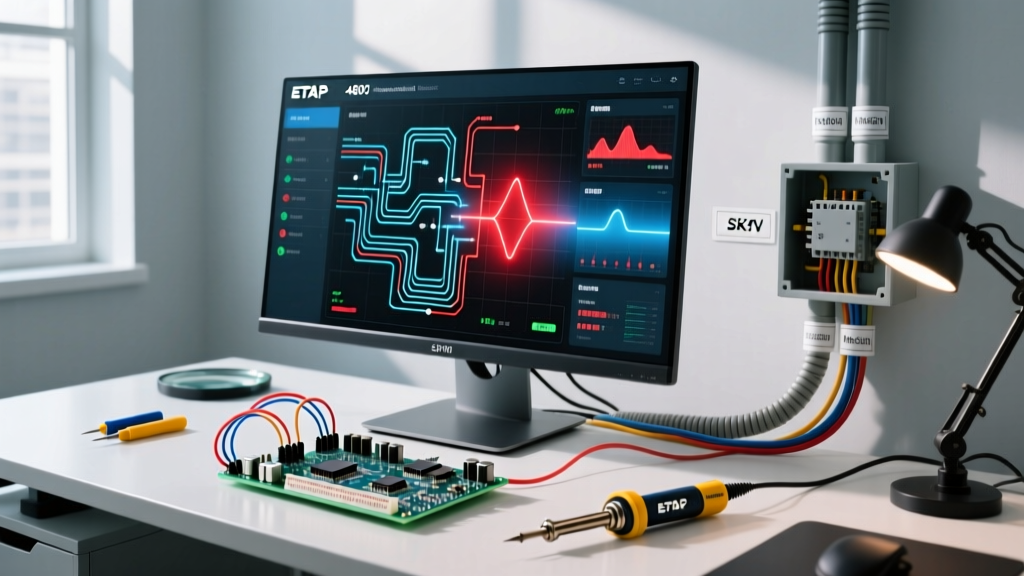
ETAP is the undisputed heavyweight in commercial and industrial power modeling. When designing a 1500kVA pad-mounted transformer feeding a multi-story commercial complex, ETAP allows you to build a comprehensive One-Line Diagram (OLD). Its Short Circuit module calculates the exact symmetrical and asymmetrical fault currents at every bus, ensuring that the specified 65kA AIC (Ampere Interrupting Capacity) main breakers are adequately rated. If the utility upgrades their local substation and the available fault current spikes to 72kA, ETAP will instantly flag your 65kA breakers as a severe safety hazard.
2. SKM Power*Tools for Windows (PTW)
SKM PTW is highly favored by commercial electrical contractors for its CAPTOR module, which is dedicated to plotting Time-Current Curves (TCC). Selective coordination is critical; if a 20A branch breaker faults, you do not want the 400A sub-feeder or the 2000A main service breaker to trip. CAPTOR visually overlays the trip curves of various manufacturers (Square D, Eaton, ABB), allowing you to adjust magnetic trip settings and dial in the exact millisecond delays required to isolate faults locally.
3. Interplay Learning (SkillMill) for Physical Wiring Simulation
While ETAP and SKM handle the math, Interplay Learning provides an interactive 3D electrical wiring simulator designed for physical skill development. Commercial apprentices use this platform to practice wiring Variable Frequency Drives (VFDs), troubleshooting 3-phase motor control circuits, and simulating commercial HVAC controls without the risk of a 480V shock. It bridges the gap between classroom theory and live panel terminations.
Step-by-Step: Simulating a 480Y/277V Commercial Service Entrance
To understand the practical application of these tools, let us walk through the workflow of simulating a new 1200A, 480Y/277V commercial service entrance using a mathematical simulator like SKM or ETAP.
- Define the Utility Source: Input the utility company's provided data. For example, a 13.8kV to 480V delta-wye transformer with a 5.75% impedance and an infinite bus fault contribution resulting in 45,000 Amps of available fault current at the secondary terminals.
- Model the Main Distribution Panel (MDP): Input the busbar rating (1200A), the main breaker frame size (1200A, 65kA AIC), and the specific manufacturer's trip unit model (e.g., Square D MasterPact NT with Micrologic 6.0).
- Map the Downstream Feeders: Model the step-down transformers (e.g., 150kVA 480V to 208Y/120V) and the subsequent lighting and appliance branch panels. Include exact conductor lengths and types (e.g., 350 feet of 3/C #300 kcmil XHHW-2 in EMT) to accurately calculate impedance.
- Run the Short Circuit Analysis: Execute the simulation. The software will calculate the fault current at the furthest 208V panel. If the calculated fault current is 14,500A, but the branch panel breakers are only rated for 10kA AIC, the simulator will highlight this NEC Article 110.9 violation in red.
- Generate Arc Flash Labels: Using the IEEE 1584-2018 empirical model, the simulator calculates the incident energy (measured in cal/cm²) and the arc flash boundary. This data is exported directly to print the mandatory warning labels required by NFPA 70E before the equipment is energized.
Bridging the Gap: NEC Compliance and Simulator Outputs
The National Electrical Code (NFPA 70) strictly mandates that electrical equipment be rated for the available fault current. Specifically, NEC Article 110.24 requires that the maximum available fault current be field-marked on service equipment. An electrical wiring simulator automates this calculation, providing the exact data needed for the inspector's sign-off.
"Selective coordination for emergency and standby systems is no longer a suggestion; it is a strict NEC mandate under Articles 700.32 and 701.32. Relying on rule-of-thumb breaker sizing is a liability. You must use simulation software to plot the TCC and prove that the downstream breaker clears the fault before the upstream emergency transfer switch drops the load."
— Senior Electrical Engineer, Commercial MEP Design Firm
Furthermore, simulators help optimize conductor sizing by running Load Flow analyses. In a large commercial retail space, voltage drop can be a silent killer of HVAC efficiency. By simulating the load flow, an electrician can identify that a 250-foot run of #4 AWG copper is causing a 4.2% voltage drop on a 208V motor circuit, prompting an upsizing to #2 AWG to maintain the NEC recommended 3% maximum for branch circuits.
FAQ: Commercial Electrical Wiring Simulators
Can I use a free online electrical wiring simulator for commercial projects?
No. Free simulators (like basic web-based circuit builders) are designed for DC electronics or simple single-phase AC residential circuits. They lack the database of commercial breaker trip curves, 3-phase fault calculations, and IEEE 1584 arc flash algorithms required for 480V commercial work. Using them for commercial design is a massive liability risk.
How often should I update my simulator's equipment database?
You should update the manufacturer component libraries (Square D, Eaton, Siemens, ABB) at least annually. Manufacturers frequently update trip unit firmware, release new current-limiting fuses, and alter thermal trip characteristics. An outdated database can result in inaccurate selective coordination plots.
Do electrical inspectors accept simulator-generated arc flash labels?
Yes, provided the software is industry-recognized (like ETAP or SKM) and the input data (utility fault contribution, conductor lengths, working distances) is accurate and verifiable. Inspectors will look for the IEEE 1584 standard reference and the date of the study on the printed label.
Final Thoughts on Commercial Simulation
Integrating a professional electrical wiring simulator into your commercial contracting workflow is an investment in safety, compliance, and reputation. While the upfront licensing costs for software like ETAP or SKM PTW may seem steep, they pale in comparison to the cost of replacing a vaporized 1600A main breaker, failing an AHJ inspection, or facing the devastating human and financial toll of an arc flash incident. In 2026, simulating before you terminate is the hallmark of a top-tier commercial electrical professional.