
The Hidden Hazards of Vintage Electrical Systems
Renovating a pre-1970s home often uncovers a tangled, confusing mess behind the drywall. For DIYers and seasoned electricians alike, deciphering the colours of old electrical wiring is a critical first step before any demolition or upgrading begins. Unlike modern NM-B (Romex) cables that strictly adhere to National Electrical Code (NEC) color standards, legacy wiring systems were manufactured during an era of loose standardization, material shortages, and regional variations.
Misidentifying a faded neutral as a hot conductor, or failing to recognize a dangerous multi-wire branch circuit, can lead to catastrophic arc faults or fatal shocks. This material and tool guide breaks down the historical color codes, the specific failure modes of vintage insulation, and the exact diagnostic tools required to map these circuits safely in 2026.
⚠️ 2026 Safety Warning: Under the latest NEC guidelines, any modification or extension to legacy wiring systems (including knob-and-tube or early ungrounded NM cable) typically requires upgrading the entire circuit to include an Equipment Grounding Conductor (EGC) and Arc Fault Circuit Interrupter (AFCI) protection at the panel. Always consult your local Authority Having Jurisdiction (AHJ) before altering vintage circuits.
Historical Breakdown: Wire Insulation Colors by Era
The insulation materials and color palettes used in residential wiring evolved dramatically between 1900 and 1980. Understanding these eras is the key to accurate identification.
1. The Knob-and-Tube Era (1880s–1930s)
Early knob-and-tube (K&T) wiring utilized single-conductor copper wires wrapped in a layer of vulcanized rubber, which was then encased in a friction-taped cotton or asphalt-impregnated cloth braid.
- Original Colors: The cloth braid was typically black (for hot) and white or natural cotton (for neutral).
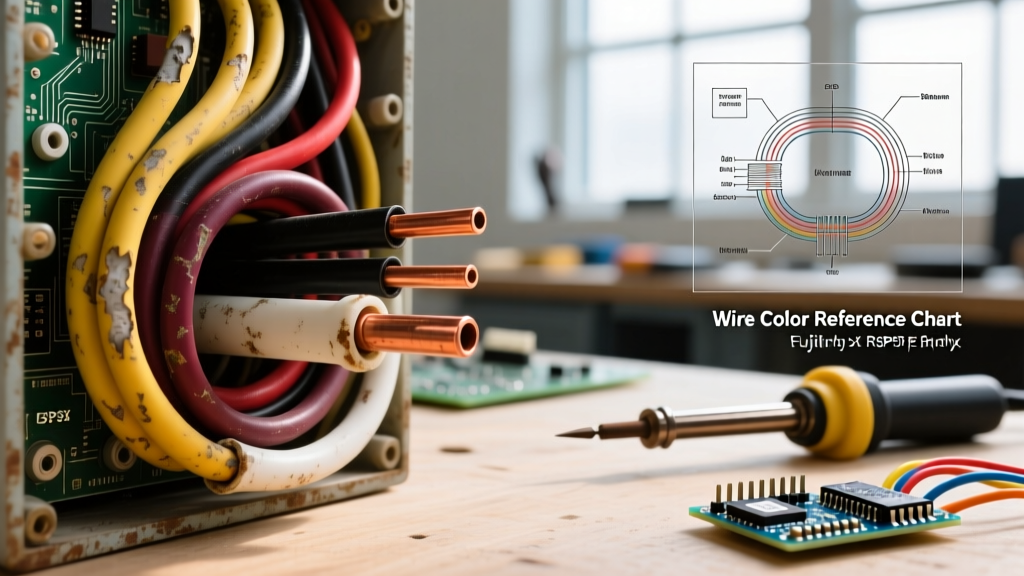
- The 2026 Reality: Decades of heat and UV exposure cause the white cloth to turn a mottled yellowish-brown or grey. The black cloth often fades to a dull charcoal. Furthermore, the copper conductor underneath was frequently tinned (coated in solder) to prevent the sulfur in the rubber from corroding the copper. When you strip back the cloth, the wire will look silver, not copper—a detail that frequently confuses modern DIYers.
2. Early Armored Cable (BX) & Lead-Sheathed (1920s–1950s)
As homes demanded more power, flexible metal armored cable (BX) replaced open K&T. Inside the steel spiral armor were rubber-insulated conductors.
- Color Anomalies: You will often find black, white, and occasionally red conductors. However, the heat generated by early incandescent lighting circuits and the chemical breakdown of the vulcanized rubber causes the insulation to become brittle and turn uniformly dark brown or black, regardless of its original intended color.
- Edge Case: Many early BX cables from the 1930s lack a dedicated bonding strip or ground wire entirely, relying on the steel armor itself as a ground path—a practice that is highly unreliable and no longer code-compliant.
3. Early Non-Metallic (NM) Cable / First-Gen Romex (1950s–1970s)
The transition to PVC and early plastic insulation brought us the first iterations of modern NM cable.
- The 'Grey' Romex: In the 1960s and 70s, NM cable jackets were often grey or stark white. Inside, you will find a black (hot), white (neutral), and sometimes a bare copper ground.
- The Missing Ground: Many homes wired in the early 1960s feature 2-wire NM cable (black and white only) with no bare ground wire. The outer jacket was often a pale grey or off-white, which degrades into a brittle, yellowish plastic over time.
Material & Tool Guide: Testing Legacy Wiring Safely
Standard modern testing methods often fail on vintage wiring. The thick, degraded rubber and cloth braid of K&T and early BX cables act as heavy dielectrics, blocking the capacitive coupling that non-contact voltage testers rely on.
Essential Diagnostic Tools for Vintage Circuits
| Tool Category | Recommended 2026 Model | Avg. Cost | Why It's Required for Old Wiring |
|---|---|---|---|
| Non-Contact Tester | Klein Tools NCVT-3TI | $42.00 | Dual-range (12-1000V) helps penetrate thick, degraded rubber insulation where standard 120V testers fail. |
| Contact Voltage Tester | Fluke T6-1000 PRO | $285.00 | Uses FieldSense technology to measure voltage through the insulation jacket without needing bare metal contact—crucial for brittle cloth wires that might crumble if stripped. |
| Receptacle Tester | Southwire 10210-G (with GFCI) | $22.00 | Essential for identifying 'bootleg grounds' (where a jumper wire connects the neutral to the ground screw on a 3-prong outlet to fake a ground). |
| Pigtail Connectors | Ideal 72B Purple Wire-Nut | $0.35/ea | Specifically rated for joining tinned copper (vintage K&T) to modern bare copper without galvanic corrosion or loose connections. |
Comparison Matrix: Legacy vs. Modern NEC Color Codes
When splicing into old circuits, you must translate historical colors into modern safety standards. The National Fire Protection Association (NFPA) strictly dictates modern color codes to prevent cross-wiring hazards.
| Function | Modern NEC Standard (2026) | Common Legacy Equivalents (Pre-1970) | Required Action / Marking |
|---|---|---|---|
| Hot (Line 1) | Black, Red, Blue | Faded Black, Grey, Yellow, or even White (in switch loops) | Must wrap with black electrical tape or heat-shrink if using white/grey as hot. |
| Neutral | White or Light Grey | White cloth, bare copper (rare/dangerous), Natural Cotton | Never use a white wire as a hot conductor without permanent re-identification. |
| Equipment Ground | Bare Copper or Green | Often missing; sometimes Green cloth or the BX metal armor | Retrofit ground via EGC to panel, or rely on AFCI/GFCI protection per NEC 250.86. |
Critical Edge Cases & Failure Modes
When mapping the colours of old electrical wiring, you will inevitably encounter wiring methods that violate modern logic but were standard practice decades ago.
1. The 'White as Hot' Switch Loop
In homes built between 1920 and 1960, 2-wire cables were run from the ceiling fixture down to the wall switch. The white wire was used to carry the switched hot back up to the light fixture. Because re-identifying wires with tape or paint was rarely enforced by inspectors back then, you will frequently find white wires connected to the brass (hot) screws on switches and black wires on the dark (neutral) screws. Always test with a multimeter before assuming white is neutral.
2. Multi-Wire Branch Circuits (MWBC) on Fuses
Early electricians used a single 3-wire cable (Black, White, Red) to feed two separate 120V circuits that shared a single white neutral. If these are connected to the same leg (phase) in an old fuse box or panel, the shared neutral will carry the sum of both currents (e.g., 15A + 15A = 30A), melting the neutral wire insulation inside the wall while the hot breakers remain un-tripped. This is a leading cause of hidden electrical fires in vintage homes.
3. The 'Crumble' Factor at Junction Boxes
The heat generated at wire nuts and splices accelerates the vulcanization and drying of old rubber insulation. When you unscrew a vintage junction box cover, the insulation often flakes off the copper conductor for the first two inches. If this happens, the wire must be cut back to healthy insulation, which often leaves insufficient length to make a new splice. In these cases, you must use a push-in connector (like the Wago 221-413) combined with a short THHN pigtail to bridge the gap.
Cost Analysis: Pigtailing vs. Full Rewire in 2026
Homeowners often ask if they can simply 'leave the old wire in the walls' and just update the outlets. According to data from the U.S. Department of Energy, aging electrical infrastructure is a primary driver of residential inefficiency and fire risk. Here is what you can expect to spend in the current market:
- Pigtailing / Panel Upgrade Only: If the insulation is intact and tested, an electrician can install AFCI breakers and pigtail modern copper pigtails at every junction box. Cost: $1,800 – $3,500 for a 2,000 sq ft home.
- Full Rewire (Knob-and-Tube / Early BX Removal): Involves cutting drywall access holes, pulling new 12/2 and 14/2 NM-B Romex, and patching. With 2026 copper commodity prices and skilled labor shortages, expect to pay $18.00 to $28.00 per square foot (Total: $36,000 – $56,000 for a 2,000 sq ft home).
Frequently Asked Questions
Q: Can I just wrap old black wire in white tape to use it as a neutral?
A: No. While the NEC allows re-identification of white wires as hot (using black tape), it strictly prohibits re-identifying a dark-colored wire (black, red, grey) as a neutral. Neutrals must be manufactured with white or grey insulation.
Q: Does homeowners insurance cover homes with old cloth wiring?
A: Most major insurance carriers in 2026 will either deny coverage, require a specialized high-risk policy, or mandate a full inspection and partial rewiring (specifically targeting active knob-and-tube) before binding a policy. Always disclose the presence of legacy wiring to your broker.
Q: Why does my old copper wire look silver when I strip it?
A: You are looking at tinned copper. Early manufacturers dipped the copper in molten tin to prevent the sulfur in the rubber insulation from reacting with the copper and creating copper sulfide (a highly resistive compound). It is safe to use, but requires specific wire nuts (like the Ideal Purple 72B) to ensure a gas-tight connection when joining to modern bare copper.