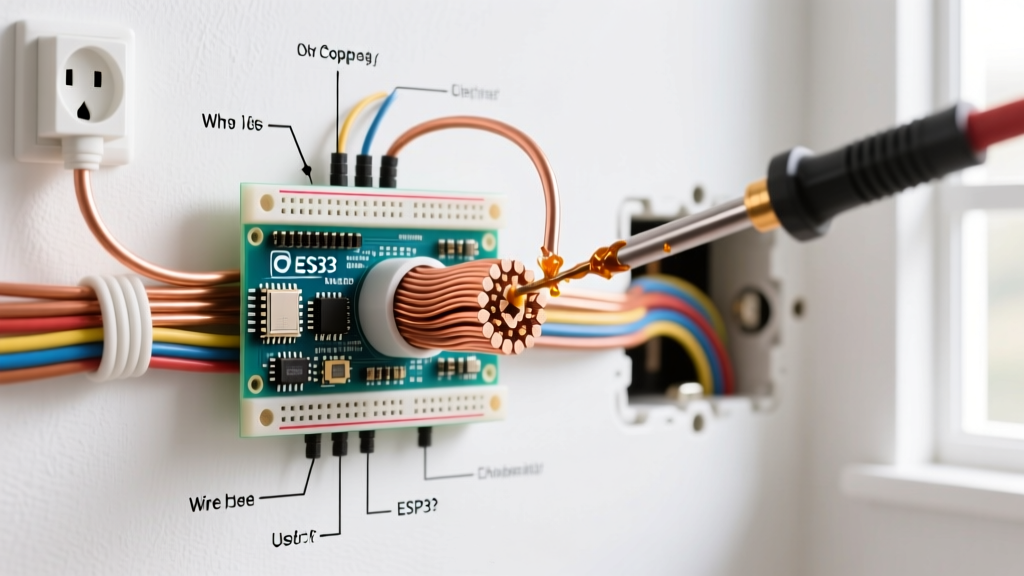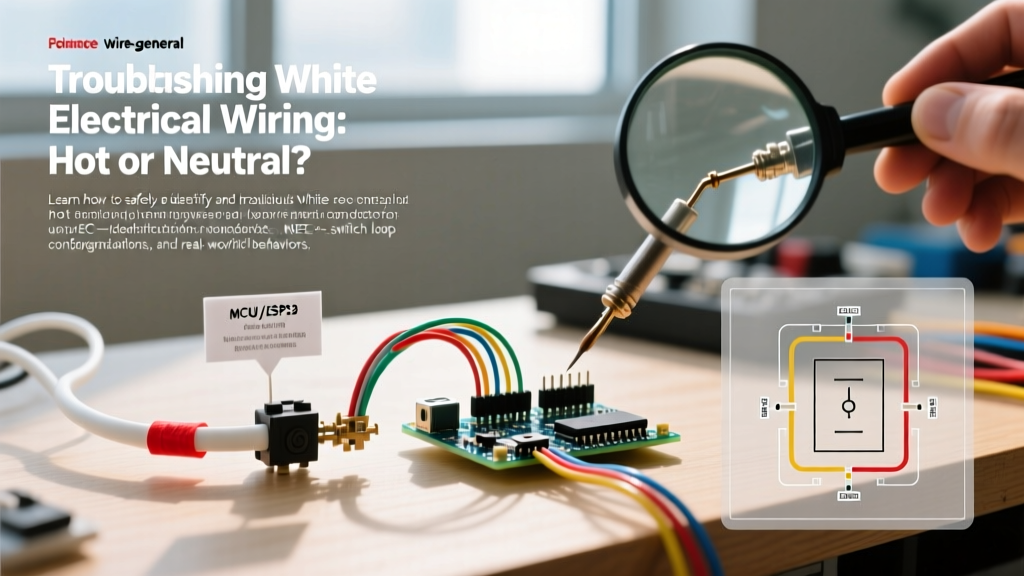

Troubleshooting White Electrical Wiring: Hot or Neutral?
In residential and commercial electrical systems, the color white is universally taught as the 'neutral' wire. However, assuming a white wire is safe to touch is one of the most common and lethal mistakes DIYers and junior electricians make. Under specific National Electrical Code (NEC) allowances, legacy wiring practices, and multi-conductor cable configurations, white electrical wiring can carry a full 120V or 240V lethal load.
This comprehensive troubleshooting guide breaks down exactly when and why a white wire might be hot, the specific NEC codes governing its use, and a step-by-step diagnostic protocol using modern testing equipment like the Fluke 117 True RMS Multimeter and Klein NCVT-4IR non-contact voltage tester.
The NEC Baseline: What White Electrical Wiring Should Mean
According to NFPA 70 (National Electrical Code) Article 200.2, white or gray insulation is strictly reserved for grounded (neutral) conductors. The neutral wire carries the unbalanced current back to the panel and is bonded to the earth ground at the main service disconnect.
However, NEC Article 200.7(C) provides a critical exception: a white wire within a multi-conductor cable (like 12/2 or 14/2 Romex) can be used as an ungrounded (hot) conductor if it is permanently re-identified at each location where the conductor is visible and accessible. This is typically done by wrapping the ends with black or red electrical tape, or using heat-shrink tubing. If a previous electrician or homeowner skipped this step, you are left with a 'hidden hot' white wire.
OSHA Safety Warning: Always treat every white wire as energized until proven otherwise. Per OSHA Electrical Safety Guidelines, verify the absence of voltage with a properly rated CAT III or CAT IV multimeter before making physical contact with any conductor.
4 Scenarios Where a White Wire is Actually HOT
When troubleshooting white electrical wiring, you will typically encounter four specific scenarios where the white conductor is energized.
1. Pre-2011 Switch Loops
Before the 2011 NEC update (Article 404.2), standard switch loops were wired using 14/2 or 12/2 cable. The white wire was used to carry continuous 120V power (the line) down to the switch, while the black wire carried the switched power (the load) back up to the light fixture. Because re-identification was often ignored by hasty installers, millions of homes have white wires acting as continuous 120V hots inside switch boxes.
2. 240V Appliance Circuits
Heavy appliances like baseboard heaters, electric water heaters, and older HVAC condensing units often use 10/2 or 12/2 cable for 240V circuits. In these setups, there is no neutral. The black wire is Leg 1 (120V), and the white wire is Leg 2 (120V), combining to deliver 240V. Touching the white wire here will result in a severe shock.
3. 3-Way and 4-Way Switch Travelers
When wiring 3-way switches (staircases, hallways), electricians use 14/3 or 12/3 cable. This cable contains a black, red, white, and bare ground. The white wire is frequently used as a 'traveler' wire, carrying switched voltage between the two switches. Depending on the toggle positions, the white traveler will intermittently read 120V.
4. Multi-Wire Branch Circuits (MWBC)
In an MWBC, two hot wires (usually black and red) share a single white neutral. While the white wire is a neutral here, it carries the unbalanced load. If the circuit breakers are not properly handle-tied and someone opens the white neutral while the circuit is under load, the 120V appliances on the shared circuit will suddenly be subjected to 240V, causing immediate catastrophic failure and potential fire.
Quick-Reference Matrix: White Wire Roles by Cable Type
| Cable Type | Standard Application | White Wire Role | Re-identification Required? |
|---|---|---|---|
| 14/2 or 12/2 | Standard 120V Receptacles | Neutral (Grounded) | No |
| 14/2 or 12/2 | Pre-2011 Switch Loops | Continuous Hot (Line) | Yes (Often omitted) |
| 14/2 or 12/2 | 240V Baseboard / Water Heater | Hot (Leg 2) | Yes |
| 14/3 or 12/3 | 3-Way Switch Travelers | Traveler (Switched Hot) | Optional per NEC 200.7(C) |
| 14/3 or 12/3 | Split Receptacles / MWBC | Shared Neutral | No |
Step-by-Step Troubleshooting Protocol
To safely diagnose an unknown white wire, follow this sequential testing methodology. You will need a non-contact voltage tester (NCVT) and a True RMS multimeter with a low-impedance (LoZ) setting.
- Initial NCVT Sweep: With the circuit energized, hover your NCVT over the white wire. Note that NCVTs can register 'phantom' or ghost voltages on white wires running parallel to hot black wires in the same Romex sheath. A beep does not guarantee a hard hot connection.
- Eliminate Phantom Voltage (LoZ Test): Set your Fluke 117 multimeter to 'LoZ' (Low Impedance). This setting places a low-impedance load on the circuit, effectively draining ghost voltages. Insert the black probe into the ground bundle and the red probe onto the exposed white wire.
- Interpret the Multimeter Readings:
- 115V - 125V: The white wire is HOT. It is either a re-identified line, a 240V leg, or a traveler.
- 0V - 2V: The white wire is likely a true neutral or a de-energized traveler.
- 40V - 90V: You may be reading a series voltage drop through a connected load (like a lightbulb filament) on an open neutral, or you are on a high-resistance bootleg neutral.
- Neutral-to-Ground Voltage Drop Test: If the white wire reads 0V to ground, switch to standard AC Voltage mode. Measure between the black (hot) wire and the white wire. Then measure between the black (hot) wire and the bare ground. If the white wire is a healthy neutral, both readings should be nearly identical (e.g., 121V). If the white wire reads significantly lower than the ground reading, you have a high-resistance neutral connection or a bootleg neutral.
Common Failure Modes & Edge Cases
The 'Bootleg' Neutral
In older homes or shoddy remodels, an electrician may have lost the white neutral wire inside a wall cavity and improperly bonded the neutral terminal to the ground wire to 'complete' the circuit. This energizes the entire grounding system of that branch. To test for this, turn off the breaker, disconnect the white wire, and use your multimeter's continuity setting (ohms) between the white wire and the bare ground. A reading of 0.1 to 0.5 ohms indicates a dangerous bootleg connection.
Backstabbed Receptacle Failures
If a white wire tests as 'hot' at a downstream receptacle but 'neutral' at the panel, you likely have a broken neutral upstream. When a neutral breaks (often due to a failed push-in 'backstab' connection on a cheap 15A receptacle), the downstream white wire becomes energized through the connected appliance's internal circuitry, seeking a path back to the panel. Always check upstream receptacles and replace backstabbed connections with screw-terminal pigtails.
FAQ: White Electrical Wiring
Can I use a white wire for a ground?
No. NEC Article 250.119 strictly mandates that equipment grounding conductors must be bare, covered in green insulation, or covered in green with yellow stripes. Using a white wire as a ground is a severe code violation and creates a massive shock hazard.
Why is my white wire warm to the touch?
A neutral white wire should never be warm. If it is warm, it indicates either an overloaded circuit, a loose termination creating high resistance (and therefore heat), or harmonic distortion from non-linear loads (like LED drivers or computers) on a shared MWBC neutral. Use an infrared thermometer to check the breaker panel terminations; temperatures exceeding 140°F (60°C) require immediate tightening or replacement.
Does the 2023 NEC change how white wires are used in switch loops?
The 2023 NEC continues to enforce the 2011 mandate requiring a grounded (neutral) conductor at every switch location to accommodate smart switches and timers. Therefore, modern switch loops must use 14/3 or 12/3 cable, reserving the white wire strictly for the neutral, while black, red, or re-identified conductors handle the line and load.
For further reading on code compliance and field troubleshooting, consult the latest updates at Electrical Contractor Magazine (Codes & Standards).