
The Intersection of Water and Voltage: Evaporative Cooler Electrical Wiring Standards
Evaporative coolers, commonly known as swamp coolers, are a staple in arid climates from Arizona to Nevada. However, installing a metal chassis filled with circulating water on top of a residential roof introduces severe electrical hazards if not wired to exact code specifications. Proper evaporative cooler electrical wiring is not just about making the motor spin; it is a strict exercise in adhering to the National Electrical Code (NEC), specifically Articles 210 (Branch Circuits), 250 (Grounding and Bonding), and 430 (Motors).
As of the latest NEC enforcement cycles rolling through 2025 and 2026, local AHJs (Authorities Having Jurisdiction) are cracking down on improper roof wiring, specifically targeting UV-degraded cables, missing GFCI protection, and undersized equipment grounding conductors. This guide breaks down the exact code requirements, circuit math, and failure modes you need to know for a compliant, safe installation.
Expert Insight: According to the U.S. Department of Energy, evaporative coolers can reduce air conditioning costs by up to 75% in dry climates, but their longevity and safety are entirely dependent on proper electrical and plumbing integration. Never treat a swamp cooler like a standard attic fan; the water exposure demands outdoor-rated, wet-location wiring methods.
Branch Circuit Sizing and Motor Load Calculations
Most residential roof-mounted evaporative coolers (such as the MasterCool MCP44 or Champion 4500 CFM models) utilize a 1/3 HP or 1/2 HP, 115-volt single-phase blower motor, alongside a fractional-horsepower water pump. To size the branch circuit correctly, we must look at NEC Article 430.
The 125% Rule for Motor Circuits
NEC Section 430.22 requires that conductors supplying a single motor be sized at no less than 125% of the motor's Full Load Amps (FLA). Let's run the math on a standard 1/2 HP, 115V swamp cooler motor:
- Motor FLA: Approximately 9.8 Amps (per NEC Table 430.248).
- Water Pump FLA: Approximately 1.5 Amps.
- Total Combined Load: ~11.3 Amps.
- 125% Multiplier (NEC 430.24): 11.3A x 1.25 = 14.125 Amps.
While a 15-Amp circuit technically clears the minimum ampacity threshold, best practice and most local codes dictate a dedicated 20-Amp circuit using 12 AWG THWN-2 copper conductors. This accounts for voltage drop over long conduit runs from the main panel to the roof and prevents nuisance tripping during the high-inrush locked-rotor current (LRA) when the blower motor starts.
Overcurrent Protection (Breaker Sizing)
Per NEC 430.52, the branch-circuit short-circuit and ground-fault protective device (the breaker) is sized differently than the wire ampacity. For a standard inverse-time breaker protecting a single-phase motor, you can size up to 250% of the FLA. However, a standard 20A or 30A breaker is universally accepted and provides ample protection without violating the maximum rating.
The Disconnect Requirement: NEC 430.102
You cannot legally hardwire an evaporative cooler directly into a junction box without a local disconnect. NEC 430.102(B) mandates that an individual disconnecting means must be provided for the controller and the motor, and it must be within sight of both. 'Within sight' is defined by the NEC as visible and not more than 50 feet away.
Choosing the Right Disconnect
On a residential roof, you generally have three compliant options for the disconnect switch. Below is a comparison matrix to help you choose the right hardware for your install.
| Disconnect Type | Typical Cost (2026) | NEC Compliance Notes | Best Use Case |
|---|---|---|---|
| Non-Fused AC Disconnect (30A/60A) | $15 - $25 | Must be rated for outdoor use (NEMA 3R). Relies on the main panel breaker for overload protection. | Standard residential roof installs where the branch circuit breaker is easily accessible. |
| Fused Disconnect (Pull-out) | $35 - $55 | Requires appropriately rated time-delay fuses. Provides localized overcurrent protection. | Commercial installs or long wire runs where voltage drop requires localized fault clearing. |
| Cord-and-Plug Connection | $25 - $40 (Receptacle + Plug) | Per NEC 430.109, the plug/receptacle can serve as the disconnect IF rated for HP and GFCI protected. | Retrofit installations where running conduit to a fixed disconnect is structurally difficult. |
GFCI Protection and Roof Receptacle Rules
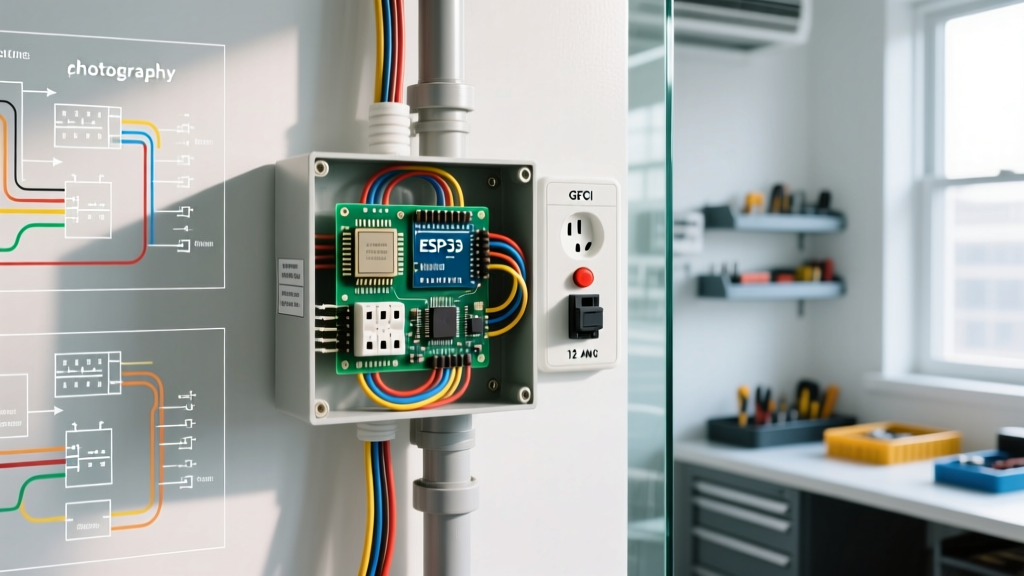
If you opt for the cord-and-plug method, or if you are installing a maintenance receptacle next to the cooler, GFCI (Ground-Fault Circuit Interrupter) protection is non-negotiable. NEC 210.8(A)(3) requires GFCI protection for all 125V through 250V, 15A and 20A receptacles installed outdoors.
Wet Location Receptacle Specifications
A standard outdoor cover will not pass inspection on a flat or pitched roof exposed to blowing rain and cooler splash-back. You must use:
- WR Rating: Weather-Resistant receptacles, marked with 'WR' on the face, featuring UV-stabilized thermoplastic and corrosion-resistant internal contacts.
- TR Rating: Tamper-Resistant shutters, required by NEC 406.12 for all outdoor residential receptacles.
- Extra-Duty Covers: NEC 406.9(B)(1) requires an 'extra-duty' weatherproof cover that remains weather-resistant even when the receptacle is in use with a cord plugged in.
- GFCI Location: To prevent nuisance tripping and avoid climbing onto a wet roof to reset a tripped outlet, install the GFCI device inside the main electrical panel or at the interior wall directly below the roof penetration, wiring the roof receptacle on the LOAD side.
Grounding and Bonding the Metal Chassis
This is where most DIY evaporative cooler electrical wiring projects fail catastrophically. The cooler's metal housing sits in a puddle of recirculating water. If the hot wire chafes against the chassis and the ground path is compromised, the entire metal box becomes energized at 120V—a lethal shock hazard for anyone touching the cooler or the roof flashing.
The Equipment Grounding Conductor (EGC)
NEC Section 250.118 outlines acceptable EGCs. While rigid metal conduit (RMC) or intermediate metal conduit (IMC) can technically serve as the ground path, the corrosive, wet environment of a swamp cooler demands a dedicated copper EGC.
Per NEC Table 250.122, a 20-Amp circuit requires a minimum 12 AWG copper equipment grounding conductor. This bare or green-insulated wire must be pulled through the conduit alongside your hot and neutral conductors and terminated directly to the cooler's designated green grounding screw, ensuring a low-impedance path back to the panel to instantly trip the breaker in the event of a ground fault.
Common Code Violations and Failure Modes
When inspecting older homes or DIY roof jobs, electrical inspectors frequently flag the following violations. Avoid these to ensure your installation passes inspection and operates safely for decades.
1. Using NM-B (Romex) in Wet Locations
Running standard indoor NM-B cable through the attic and out a roof jack directly into the cooler's junction box is a severe violation of NEC 334.12(B). NM-B is not rated for wet or damp locations. The constant humidity and water splash inside the cooler will wick into the paper backing of the Romex, causing insulation breakdown and short circuits. Solution: Transition to THWN-2 conductors inside Liquidtight Flexible Metal Conduit (LFMC) or EMT before exiting the attic.
2. Missing Conduit Expansion Joints
Roofs in the Southwest can reach 160°F in the summer and drop below freezing in the winter. Rigid PVC conduit exposed to direct sunlight will expand and contract significantly. NEC 300.7 requires expansion fittings for PVC runs where the temperature change will cause the conduit to expand or contract by 1/4 inch or more. Failing to install these leads to the conduit snapping or pulling out of the cooler's junction box, exposing live wires.
3. Shared Neutral Multi-Wire Branch Circuits (MWBC)
Some installers attempt to wire the cooler's 120V motor and the 120V water pump on separate phases of an MWBC sharing a single neutral. Because motor starting currents and pump inductive loads create harmonic distortion and unbalanced return currents, this can overheat the shared neutral. Always run a dedicated, single-phase circuit with its own dedicated neutral for the entire evaporative cooler unit.
Frequently Asked Questions (FAQ)
Can I plug my roof-mounted swamp cooler into an existing attic outlet?
No. Attic outlets are generally not on a dedicated circuit, and daisy-chaining a high-draw motor load (up to 10A running, 30A starting) onto an existing lighting or receptacle circuit will cause voltage drops and breaker trips. Furthermore, the cord would have to pass through the roof deck, violating NEC 400.12, which prohibits flexible cords from being used as a substitute for the fixed wiring of a structure.
Do I need a permit to wire an evaporative cooler?
Yes. In almost all municipalities, running a new 120V or 240V branch circuit to the exterior of the home requires an electrical permit and a final inspection by the local AHJ. The National Fire Protection Association (NFPA) strongly advocates for permitted work to ensure life-safety codes regarding grounding and GFCI protection are met.
What wire type is best for the final connection to the cooler?
Liquidtight Flexible Metal Conduit (LFMC) containing individual THWN-2 stranded copper conductors is the industry standard. LFMC provides UV protection, physical damage resistance, and the flexibility needed to absorb the vibration of the blower motor without cracking rigid fittings.