
The True Cost of Junction Box Electrical Wiring: DIY vs. Professional
Splicing conductors outside of an approved enclosure is a severe fire hazard and a direct violation of the National Electrical Code (NEC). When extending a circuit or repairing damaged cable, junction box electrical wiring is the only code-compliant method. However, homeowners frequently debate whether to tackle this as a weekend DIY project or hire a licensed electrician. In 2026, with electrical labor rates averaging $95 to $165 per hour and material costs stabilizing, the financial and safety calculus requires a precise breakdown.
2026 Cost Breakdown: Single Junction Box Installation
| Cost Factor | DIY Approach | Professional Electrician |
|---|---|---|
| Materials (Box, Wire Nuts, Blank Cover) | $8 - $25 | $15 - $35 (Markup applied) |
| Specialty Tools (Wire Strippers, Torque Screwdriver) | $0 - $60 | $0 (Included in service) |
| Labor (1-2 Hours) | $0 (Your time) | $135 - $320 |
| Permit & Inspection Fees | $50 - $120 | $75 - $150 (Usually pulled by pro) |
| Total Estimated Cost | $58 - $205 | $225 - $505 |
While the DIY route saves $150 to $300 upfront, the hidden costs of failing an inspection or causing an electrical fire dwarf these initial savings. According to the Electrical Safety Foundation International (ESFI), electrical distribution and lighting equipment remain a leading cause of home structure fires, often stemming from improper splices and overcrowded enclosures.
Decoding NEC Article 314: The 'Box Fill' Calculation
The most common point of failure in DIY junction box electrical wiring is ignoring box fill calculations. NEC Article 314 dictates exactly how many conductors can safely occupy a specific volume of space to prevent heat buildup and insulation damage during installation.
Step-by-Step Box Fill Math
To determine if your chosen box is legally compliant, you must calculate the cubic inch (cu. in.) requirements based on the largest wire gauge entering the box:
- 14 AWG Wire: 2.0 cu. in. per conductor
- 12 AWG Wire: 2.25 cu. in. per conductor
- 10 AWG Wire: 2.5 cu. in. per conductor
Pro Tip: Equipment grounding conductors (bare copper or green) count as a single conductor based on the largest ground wire present. Cable clamps inside the box also count as one conductor. Pigtails that originate and terminate entirely within the box do not count toward the fill calculation.
Real-World Scenario: You are splicing two 12/2 NM-B cables (Romex) to extend a 20-amp kitchen receptacle circuit. You have 4 current-carrying conductors (2 blacks, 2 whites), plus 1 allowance for all grounds, and 1 allowance for internal clamps. Total conductor count = 6.
6 conductors × 2.25 cu. in. = 13.5 cubic inches minimum.
A standard Carlon B618R-UPC (18 cu. in. PVC) or a Raco 71171 (21 cu. in. 4x4 steel box) will easily pass this inspection. A shallow 12 cu. in. pancake box will fail, risking a melted enclosure under load.
Critical Failure Modes in DIY Junction Boxes
When analyzing field failures, professional electricians and forensic engineers consistently identify three catastrophic DIY errors in junction box electrical wiring:
1. High-Resistance Connections and Thermal Runaway
Using undersized wire nuts or failing to torque lug connections to manufacturer specifications creates a high-resistance joint. Under a continuous 15A or 20A load, this resistance generates localized heat. Over time, the thermal cycling expands and contracts the metal, loosening the splice further. By the time an Arc Fault Circuit Interrupter (AFCI) detects the signature of a parallel arc, the surrounding PVC insulation and wooden framing may already be smoldering.
2. The 'Hidden Box' Violation (NEC 314.29)
NEC 314.29 strictly requires that all junction boxes remain accessible without damaging the building structure. A pervasive DIY mistake is drywalling over a junction box after splicing wires in an attic or behind a wall. If a splice fails 10 years later, an electrician will have to tear open finished walls to locate and repair it. Always use a blank cover plate and ensure it remains visible in attics, basements, or crawlspaces.
3. Missing Knockout Seals
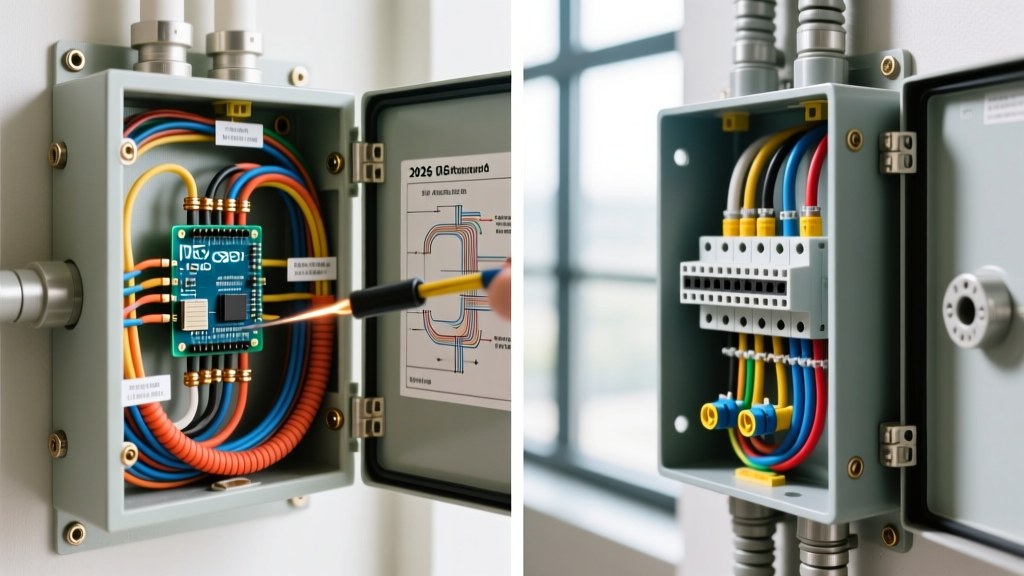
Steel junction boxes feature multiple pre-punched knockouts for cable entry. If you punch out a hole in a Raco 71171 steel box but only use two of the four available entries, the open holes must be sealed with 1/2-inch or 3/4-inch sheet metal knockout seals. Leaving them open compromises the box's ability to contain an internal arc blast and provides an entry point for rodents, which can chew through wire insulation.
Material Selection: PVC vs. Galvanized Steel in 2026
The environment dictates your material choice. For standard interior residential framing, PVC boxes like the Carlon Zip Box Blue series are dominant due to their speed of installation and integrated nail-on brackets. However, PVC is strictly prohibited in certain commercial applications and exposed surface-mount scenarios where physical damage is likely.
For exposed basement ceilings, garages, or commercial conduit runs, galvanized steel (such as the Steel City 71171) is mandatory. Steel provides superior grounding continuity when used with metallic conduit and offers vital arc-containment properties that plastic simply cannot match. Furthermore, the 2023 and 2026 NEC cycles have heavily emphasized the use of listed torque tools; professional electricians now routinely use insulated torque screwdrivers to ensure terminal screws inside metal boxes are tightened to exact inch-pound specifications, eliminating human guesswork.
Decision Matrix: Should You DIY or Hire a Pro?
Use this framework to determine if your specific junction box electrical wiring project is within your skill set:
When to DIY (Proceed with Caution)
- The Scope: You are adding a single, surface-mounted junction box in an exposed basement or attic to extend an existing, easily accessible circuit.
- The Wiring: You are working exclusively with standard NM-B (Romex) cable, 14 or 12 AWG, and the circuit is protected by a standard or AFCI breaker (not a multi-wire branch circuit with shared neutrals).
- The Knowledge: You understand how to calculate box fill, properly strip wire insulation without nicking the copper, and use a non-contact voltage tester to verify zero energy state.
When to Call a Licensed Electrician (Non-Negotiable)
- The Scope: The splice involves a 240V appliance circuit (e.g., HVAC, double-oven), a service entrance cable, or aluminum branch wiring (which requires specialized AlumiConn connectors and antioxidant paste).
- The Environment: The junction box must be installed in a wet location, requiring NEMA 4X weatherproof enclosures and silicone dielectric grease.
- The Access: You need to fish cables through finished walls or fire-blocked studs where maintaining the integrity of the building's firestopping and draft-stopping is critical.
Final Verdict on Junction Box Electrical Wiring
Junction box electrical wiring is not merely about connecting copper; it is about managing thermal dynamics, mechanical stress, and long-term accessibility. While a competent DIYer can safely execute a basic box fill calculation and install a PVC enclosure, the margin for error shrinks drastically when dealing with high-amperage loads or complex multi-wire branch circuits. For complex retrofits, the $200 to $400 investment in a licensed professional guarantees compliance with the National Fire Protection Association (NFPA) standards, ensuring your home's electrical infrastructure remains safe for decades.