
The Hidden Inspection Bottleneck in Smart Home Upgrades
The transition from legacy toggle switches to advanced smart home ecosystems has fundamentally altered residential rough-in and final inspection requirements. While homeowners focus on app integration and voice control, electrical inspectors are laser-focused on thermal dissipation, box fill capacities, and circuit separation. Failing an inspection on smart house electrical wiring rarely happens because the devices themselves are unlisted; it happens because the physical infrastructure housing them violates the National Electrical Code (NEC).
As of the 2026 construction cycle, the integration of Wi-Fi 6/7 mesh nodes, PoE (Power over Ethernet) sensors, and high-inrush smart relays demands a rigorous understanding of NEC Articles 725, 404, and 314. This guide provides contractors and advanced DIYers with the exact specifications, product models, and code mandates required to pass rough-in and final inspections on the first attempt.
The Neutral Wire Mandate: NEC 404.2(C)
One of the most common reasons for inspection failure in smart home retrofits and new builds is the absence of a neutral wire at the switch box. Modern smart switches—such as the Lutron Caseta PD-6ANS or the Leviton Decora Smart DW15S—require a continuous 120V neutral connection to power their internal Wi-Fi, Zigbee, or Z-Wave radios, even when the load is turned off.
Code Enforcement and Exceptions
NEC 404.2(C) explicitly mandates that new construction switch boxes controlling lighting loads must include a neutral conductor. Inspectors will flag any new-build gang box that only receives a 14/2 or 12/2 switch loop without a neutral.
- New Construction: You must pull a 14/3 (or 12/3) cable to every standard switch location to provide line, load, neutral, and ground.
- Retrofit Exception: If you are upgrading an older home where pulling a neutral is structurally prohibitive, NEC allows the use of smart switches that do not require a neutral, provided they do not leak current through the equipment grounding conductor. In these scenarios, inspectors will approve devices like the Lutron Caseta PD-6ANS (which uses a low-leakage bypass) or the Shelly Plus 1PM installed at the fixture canopy rather than the switch box.
Box Fill Calculations & Thermal Derating (NEC 314.16)
Smart switches are physically massive compared to standard decora switches. A standard smart switch can protrude 1.5 to 1.75 inches into the wall cavity and contains internal relays, heat sinks, and radio antennas. Cramming these into a standard 14-cubic-inch shallow box is a guaranteed inspection failure due to NEC 314.16 box fill violations and severe thermal derating risks.
Smart Switch Box Fill Comparison Matrix
| Box Model / Type | Cubic Inch Capacity | Max 14 AWG Wires Allowed | Smart Switch Compatibility | Approx. Cost (2026) |
|---|---|---|---|---|
| Standard Plastic Nail-On (Shallow) | 14.0 cu in | 7 wires | Fails Inspection (Overfill/Heat) | $1.10 |
| Carlon B618R (Deep Single Gang) | 22.5 cu in | 11 wires | Passes (Ideal for Wi-Fi/Z-Wave) | $3.50 |
| Arlington BE1 (Non-Metallic) | 24.0 cu in | 12 wires | Passes (Accommodates 12 AWG) | $4.25 |
| Raco 1875 (Deep Metal 4-Square) | 34.3 cu in | 17 wires | Passes (Multi-gang smart relays) | $6.80 |
Expert Calculation Tip: When calculating box fill for a smart switch, the device itself counts as two conductor allowances based on the largest wire connected to it (NEC 314.16(B)(1)). If you are using 12 AWG wire (2.25 cu in per wire), a single smart switch consumes 4.5 cubic inches of space before you even account for the incoming line, load, neutral, ground, and cable clamps. Always spec Carlon B618R or deeper boxes for smart house electrical wiring rough-ins.
Low Voltage & Line Voltage Separation (Article 725)
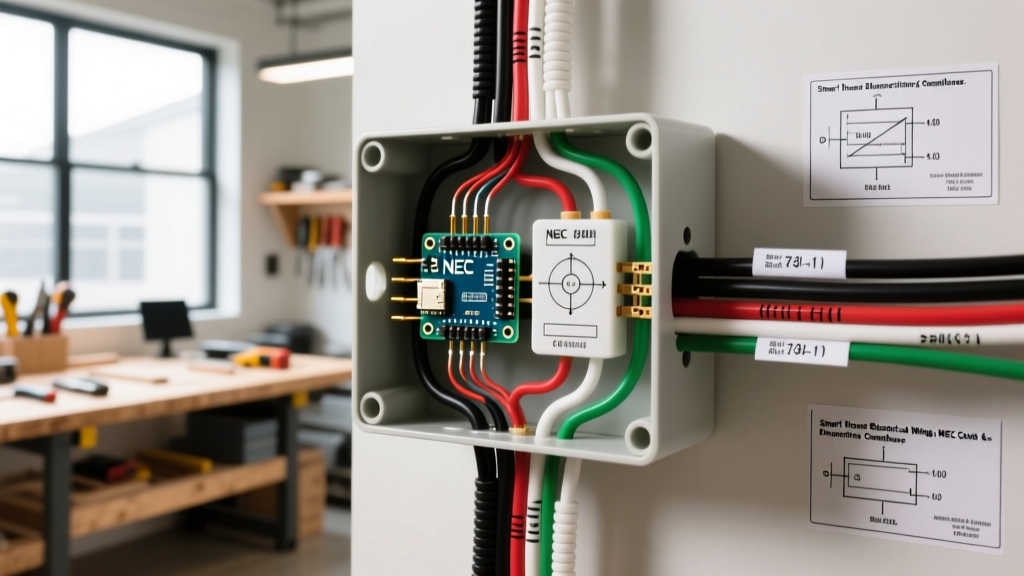
Smart homes rely heavily on low-voltage communication cables (CAT6A for PoE access points, KNX bus cables, or proprietary alarm wiring). A critical inspection failure occurs when contractors run these Class 2 or Class 3 circuits in the same gang box or conduit as 120V/240V line voltage without a physical barrier.
NEC 725.136 Separation Requirements
According to the International Association of Electrical Inspectors (IAEI), mixing power-limited circuits with power circuits induces electromagnetic interference (EMI) and creates a severe shock hazard if insulation fails.
Inspector Insight: If you must terminate a CAT6 PoE line and a 120V smart receptacle in the same dual-gang box, you must use a listed physical divider, such as the Arlington DVKIT. Without this barrier, the rough-in will be red-tagged immediately.
For conduit runs, maintain a minimum 2-inch separation between parallel runs of line voltage and low-voltage smart home cabling, or use grounded metallic conduit for the line voltage to act as a shield.
AFCI and GFCI Nuisance Tripping with Smart Relays
Modern smart homes utilize LED drivers and high-frequency switching power supplies inside smart relays (like the Shelly Pro 4PM). These components generate harmonic distortion and high inrush currents upon startup. When installed on circuits protected by combination-type AFCI (Arc-Fault Circuit Interrupter) breakers, this inrush can mimic an arc fault, causing nuisance tripping.
Mitigation Strategies for Compliance
- Soft-Start Drivers: Specify LED transformers with built-in soft-start circuitry to limit inrush current to under 20A.
- Breaker Selection: While you cannot bypass NEC 210.12 AFCI requirements for bedroom and living area lighting circuits, using advanced AFCI breakers with superior digital signal processing (DSP) algorithms—such as the Square D HOM220GFIC or newer Eaton AFCL series—reduces false positives.
- Panel Documentation: Clearly label the panel directory. Inspectors appreciate when smart home dedicated circuits (e.g., "Smart Hub / PoE Switch / Network Rack") are explicitly mapped, as these often require specific GFCI/AFCI exemptions depending on local amendments.
Pre-Inspection Checklist for Smart Wiring
Before calling for your rough-in or final inspection, verify your smart house electrical wiring against this compliance checklist. For further code clarification, refer to Mike Holt Enterprises, a premier authority on NEC applications.
- [ ] Neutral Verification: Every new-construction switch box contains a dedicated neutral pigtail.
- [ ] Box Volume: All smart switch locations utilize minimum 22.5 cu in deep boxes (e.g., Carlon B618R).
- [ ] Voltage Separation: Physical dividers are installed in any mixed-voltage gang boxes.
- [ ] PoE Grounding: Network rack patch panels and PoE injectors are properly bonded to the electrical grounding electrode system.
- [ ] Thermal Clearance: Insulation baffles are installed around recessed smart lighting cans (IC-rated or non-IC rated with proper clearance).
- [ ] Dimmer Derating: Multi-gang smart dimmers have their heat-sink fins removed only if the manufacturer's derating chart permits, and the total wattage is reduced accordingly.
Final Thoughts on Code-Compliant Smart Infrastructure
Smart house electrical wiring is not simply about connecting a blue wire to a neutral bundle. It requires a holistic understanding of spatial geometry, thermal dynamics, and electromagnetic separation. By proactively addressing NEC box fill mandates, enforcing strict line/low-voltage boundaries, and specifying deep junction boxes during the rough-in phase, you eliminate the primary friction points that cause inspection delays. Building to the 2026 NEC standard ensures that the smart home infrastructure remains safe, scalable, and fully compliant for decades to come.