When transitioning from residential to commercial electrical installations, the complexity, scale, and code requirements shift dramatically. Selecting the right electrical wiring materials for commercial projects is not merely about amperage and voltage; it involves navigating stringent National Electrical Code (NEC) mandates, physical environmental hazards, and long-term maintenance considerations. In commercial spaces—ranging from retail storefronts to multi-story office complexes and industrial warehouses—the days of relying on non-metallic sheathed cable (NM-B) are largely over.
This comprehensive guide breaks down the critical electrical wiring materials required for commercial builds in 2026, detailing conductor types, raceway systems, cable assemblies, and the specific failure modes that electricians and project managers must avoid.
Primary Conductors: THHN vs. XHHW-2
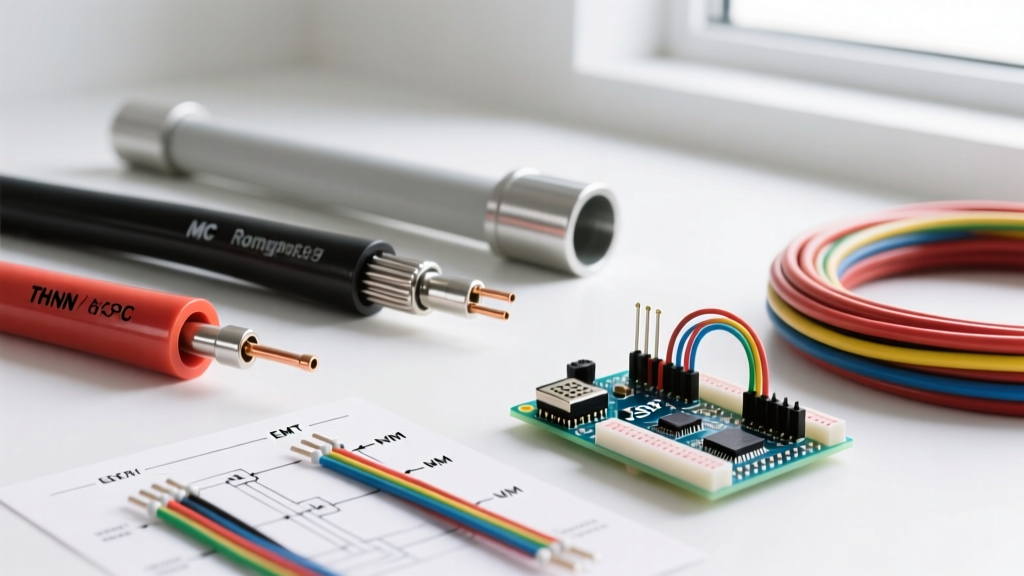
The backbone of any commercial electrical system is the conductor. While residential wiring heavily utilizes NM-B (commonly known by the brand name Romex), commercial environments require individual conductors pulled through raceways or bundled in metal-clad assemblies. The two dominant choices are THHN/THWN-2 and XHHW-2.
THHN/THWN-2 (Thermoplastic High Heat-resistant Nylon-coated)
THHN is the industry workhorse. It features a PVC insulation layer with a nylon outer jacket, providing excellent resistance to oil, gas, and solvents. However, the nylon jacket makes the wire slightly stiffer, which can increase pulling tension in long conduit runs. In 2026, a 500-foot spool of 10 AWG copper THHN typically ranges from $110 to $140, depending on copper commodity fluctuations.
XHHW-2 (Cross-Linked Polyethylene High Heat Water-resistant)
XHHW-2 uses XLPE (cross-linked polyethylene) insulation. Because XLPE is inherently tougher than PVC, it requires a thinner insulation wall to achieve the same dielectric strength. This thinner profile means you can fit more XHHW-2 conductors into the same size conduit compared to THHN, potentially allowing you to downsize your conduit and save on material costs.
Conductor Comparison Matrix
Feature
THHN/THWN-2
XHHW-2
Insulation Material
PVC with Nylon Jacket
Cross-Linked Polyethylene (XLPE)
Max Temperature
90°C (Dry & Wet)
90°C (Dry & Wet)
Insulation Thickness
Thicker (requires more conduit space)
Thinner (allows higher conduit fill)
Pulling Characteristics
Stiffer; nylon can bind without lubricant
Slicker; easier to pull in long runs
Short-Circuit Rating
Standard
Superior (XLPE withstands higher thermal stress)
Estimated Cost (10 AWG)
~$0.22 - $0.28 per foot
Copper Development Association recommends XHHW-2 for runs exceeding 200 feet due to its lower friction coefficient and reduced risk of insulation scoring during the pull.
Raceways and Conduit Systems
Unlike residential homes where wires are stapled to studs, commercial electrical wiring materials must be enclosed in approved raceways to protect against physical damage, fire spread, and electromagnetic interference (EMI). The NEC outlines specific wiring methods in Article 300, with three primary metallic and non-metallic options dominating the market.
1. EMT (Electrical Metallic Tubing)
EMT is the most common raceway in commercial interiors (offices, retail, schools). It is lightweight, thin-walled, and typically comes in 10-foot sticks. Trade sizes range from 1/2' to 4'. While 1/2' is permitted by code, most commercial specifications mandate a minimum of 3/4' EMT to prevent jamming during wire pulls and to provide better mechanical crush resistance. A 10-foot stick of 3/4' galvanized steel EMT costs between $6.50 and $8.50 in bulk.
Best For: Exposed ceilings, interior drywall partitions, and above suspended drop ceilings.
Failure Mode: Crushing from forklift impacts or heavy ladders in warehouse environments. EMT must not be used where subject to severe physical damage.
2. RMC (Rigid Metal Conduit) & IMC
When EMT is not robust enough, RMC or IMC (Intermediate Metal Conduit) is required. IMC is slightly thinner than RMC but offers nearly identical crush resistance. Both are threaded and require heavy-duty bending tools, such as the Greenlee 881 hydraulic bender.
Best For: Industrial facilities, exterior building facades, and areas subject to severe physical damage (NEC Article 300.5).
Failure Mode: Internal rusting if standard steel RMC is used in wet locations without proper PVC coating or corrosion inhibitors.
3. PVC Schedule 80
While PVC Schedule 40 is common for underground utility feeds, Schedule 80 PVC is the required non-metallic choice for commercial above-ground installations where physical damage is a concern but metallic conduit is undesirable (e.g., highly corrosive chemical plants or food processing facilities).
Prefabricated Cable Assemblies: MC vs. AC
For commercial branch circuits, pulling individual THHN wires through EMT can be labor-intensive. Prefabricated cable assemblies offer a faster alternative, but choosing between Metal-Clad (MC) and Armored Cable (AC) is a critical decision that impacts code compliance and safety.
The Grounding Distinction
The primary difference lies in the equipment grounding conductor (EGC). MC Cable contains a dedicated green insulated or bare copper grounding wire alongside the current-carrying conductors. AC Cable (often referred to by the legacy trademark 'BX') does not have a dedicated ground wire; instead, it relies on the metal armor and an internal aluminum bonding strip to provide the ground path.
Under modern NEC guidelines and strict commercial engineering specifications, MC Cable is overwhelmingly preferred and often mandated. The impedance of the armor in AC cable can sometimes be too high to clear a fault quickly on longer runs, whereas the dedicated copper EGC in MC cable guarantees a low-impedance fault path.
Pro-Tip for Commercial Fit-Outs: When ordering MC cable for commercial office tenant improvements, specify 'MC-AP' (Armor Plus) from manufacturers like Southwire or AFC Cable. MC-AP features a full-sized, insulated green ground wire that is in continuous contact with the armor, allowing the armor itself to be listed as an additional ground path, effectively exceeding standard NEC requirements and reducing EMI in sensitive IT environments.
2026 Procurement and Code Compliance Updates
Managing the supply chain for electrical wiring materials requires staying ahead of both market pricing and code cycles. As the industry adapts to the NFPA 70 (National Electrical Code) updates, several material selection rules have tightened.
Arc-Fault and Ground-Fault Material Impacts
Recent NEC cycles have expanded AFCI (Arc-Fault Circuit Interrupter) and GFCI requirements into commercial spaces, particularly in dormitories, hotel guest rooms, and specific retail areas. This impacts material selection in two ways:
Neutral Pigtailing: Commercial panels must be ordered with adequate neutral bar space, as dual-function AFCI/GFCI breakers require a direct neutral connection.
Shared Neutrals Banned: Multi-wire branch circuits (MWBCs) sharing a neutral are increasingly problematic with AFCI protection. Electricians must pull dedicated neutral wires for almost all commercial 120V branch circuits, increasing the total copper volume and conduit fill requirements by up to 33%.
Fire-Rated Cabling in Plenums
Any electrical wiring materials installed in the environmental air space of a suspended ceiling (a plenum) must be rated for the environment. Standard PVC-insulated wires emit toxic halogen gases when burned. Therefore, Plenum-rated MC cable or conductors with low-smoke, zero-halogen (LSZH) jackets must be used. Always verify the UL listing on the cable jacket before installing above drop ceilings to avoid catastrophic inspection failures.
Frequently Asked Questions (FAQ)
Can I use NM-B (Romex) in a commercial building?
Generally, no. NEC Article 334.12 prohibits the use of NM-B cable in commercial spaces that exceed three floors above grade, in areas subject to physical damage, or within dropped ceilings used for environmental air handling. Some limited exceptions exist for Type I and II non-combustible construction, but most commercial engineers specify MC cable or EMT/THHN exclusively to avoid liability.
What is the maximum conduit fill for commercial wire pulls?
According to NEC Chapter 9, Table 1, if in 'commercial-electrical-projects'>OSHA's electrical safety guidelines emphasize that proper support spacing prevents long-term mechanical stress on terminations, which is a leading cause of thermal failure in commercial panels.
How do I prevent insulation scoring when pulling THHN?
Always use a dedicated conduit reaming tool (such as the Klein Tools 53711) to remove the internal burr left by pipe cutters. Furthermore, apply a UL-listed wire pulling compound (like Ideal 45-001) for any run with more than two 90-degree bends or pulls exceeding 100 feet. Never use dish soap or non-approved lubricants, as they can degrade the PVC insulation over time.