
While electricians and DIYers universally use the term 'Romex' to describe non-metallic sheathed cable, it is actually a registered trademark of Southwire. In the field, it refers specifically to NM-B (Non-Metallic, Type B) cable, the standard for interior residential branch circuit wiring. As we navigate the 2026 electrical landscape, with the 2023 National Electrical Code (NEC) fully adopted across most jurisdictions and early 2026 NEC drafts circulating, understanding the precise code requirements for NM-B is critical. Improper installation of electrical wiring Romex remains a leading cause of residential electrical fires and inspection failures.
This guide breaks down the exact NEC articles, sizing matrices, and physical installation rules you must follow to ensure your NM-B installations are safe, efficient, and code-compliant.
The Anatomy of NM-B and the 60°C Temperature Rule
Before pulling wire, you must understand what is inside the jacket. A standard Romex cable contains three main components: individual THHN/THWN-2 conductors insulated with PVC and nylon, a bare copper grounding conductor, and a paper separator wrapped around the conductors. The paper acts as a friction reducer during pulling and a moisture wick, while the outer PVC jacket is rated for 90°C.
Code Callout (NEC 334.80): Despite the 90°C rating of the inner THHN conductors, the ampacity of NM-B cable must be determined using the 60°C column of NEC Table 310.16. This is because the overall cable assembly and historical terminal ratings are limited to 60°C. You can use the 90°C column only for derating purposes, but the final overcurrent protection must align with the 60°C ampacity.
Color-Coded Sizing and Ampacity Matrix
Manufacturers color-code the outer jacket of electrical wiring Romex to allow inspectors and electricians to instantly verify the wire gauge and corresponding overcurrent protection. Using the wrong breaker for a specific gauge is a severe fire hazard.
| Jacket Color | Wire Gauge (AWG) | Max Ampacity (60°C) | Standard Breaker Size | Common Applications |
|---|---|---|---|---|
| White | 14 AWG | 15 Amps | 15A | General lighting, bedroom receptacles |
| Yellow | 12 AWG | 20 Amps | 20A | Kitchen small appliance, bathroom, garage |
| Orange | 10 AWG | 30 Amps | 30A | Electric water heaters, window AC units |
| Black | 8 AWG / 6 AWG | 40A / 55A | 40A / 50A | Electric ranges, dryers, EV chargers |
Securing and Supporting: NEC 334.30
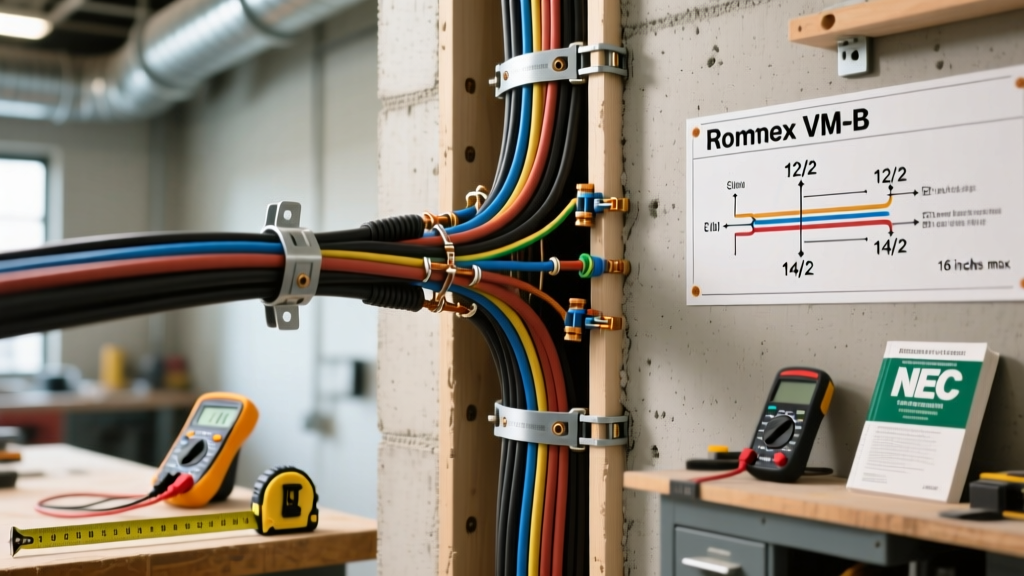
One of the most common inspection failures involves improper stapling. NEC 334.30 dictates exactly how NM-B cable must be secured to framing members.
- Intervals: Cable must be secured at least every 4.5 feet (54 inches).
- Box Proximity: Cable must be stapled within 12 inches of every electrical box, cabinet, or fitting. (Exception: boxes that are internal to the wall and the cable is fished, or single-gang non-clamp boxes where the cable is secured within 8 inches).
- Staple Sizing: Do not use generic staples. Use staples specifically listed for NM-B cable. For 14/2 and 12/2, a 1/2-inch crown staple (e.g., Gardner Bender GS-19) is standard. For 10/2 or multiple cables, use a 5/8-inch or 3/4-inch staple (e.g., GS-22 or GS-24) to avoid crushing the dielectric jacket.
Pro Tip: In 2026, plastic insulated staples are highly recommended over bare metal. They prevent accidental nail-downs into the copper conductor and reduce the risk of the metal staple cutting into the PVC jacket over time due to thermal expansion and contraction.
Boring Holes and Nail Plate Protection (NEC 300.4)
When routing electrical wiring Romex through wooden studs and joists, the physical placement of the bored hole is strictly regulated to prevent drywall installers from driving screws directly into your live conductors.
The 1.25-Inch Setback Rule
Per NEC 300.4(A)(1), any hole bored through a framing member must be at least 1.25 inches from the nearest edge of the wood. If a standard 2x4 stud (which is actually 1.5 inches wide) is bored perfectly in the center, you have exactly 1.25 inches of clearance on a 3/4-inch hole. If your hole is off-center, or if you are notching the edge of a joist, you violate this rule.
Steel Nail Plates
If you cannot maintain the 1.25-inch setback (NEC 300.4(A)(2)), you must install a 1/16-inch thick steel nail plate over the face of the stud to protect the cable. These plates cost roughly $0.50 to $1.00 each in bulk and save you from a failed inspection or a catastrophic short circuit when the drywall crew arrives.
The Derating Trap: Bundling and Firestopping
This is where many seasoned DIYers and even some journeymen make critical errors. NEC 310.15(C)(1) requires ampacity derating when you bundle more than three current-carrying conductors together.
If you run four separate 12/2 NM-B cables (which equals 8 current-carrying conductors, as grounds do not count) through a single bored hole in a top plate, and then seal that hole with firestop foam or caulk (which prevents heat dissipation), you must apply a derating factor. For 7 to 9 conductors, the derating factor is 70%.
The Math: 12 AWG THHN is rated 30A at 90°C. 30A x 0.70 = 21 Amps. Because 21 Amps is still above the 20A breaker limit, you are technically safe in this specific scenario. However, if you bundle ten 12/2 cables (20 current-carrying conductors), the derating factor drops to 40%. 30A x 0.40 = 12 Amps. You can no longer use a 20A breaker; you must downgrade to a 15A breaker or, more realistically, separate the cables into different bored holes. Always consult Table 310.15(C)(1) when running multiple feeds through a single penetration.
Prohibited Locations for NM-B Cable
Electrical wiring Romex is designed for dry, interior, protected environments. Per NEC 334.12, you cannot use NM-B in the following scenarios:
- Exposed in Dropped Ceilings: You cannot lay Romex across the grid of a commercial or residential suspended ceiling. It must be run in conduit or you must use MC (Metal Clad) cable.
- Damp or Wet Locations: NM-B cannot be used outdoors, in concrete foundations, or buried underground. The paper separator will wick moisture, leading to corrosion and insulation failure. Use UF-B (Underground Feeder) or THWN-2 in PVC conduit instead.
- Commercial Buildings Over 3 Stories: Type III, IV, and V construction buildings exceeding three stories generally prohibit exposed NM-B due to fire-spread concerns; MC cable or EMT conduit is required.
Termination and the Torque Mandate (NEC 110.14(D))
Stripping and terminating Romex requires care. Never use a standard utility knife to slit the jacket, as nicking the inner THHN insulation or the copper conductor creates a high-resistance hotspot. Use a dedicated cable ripper like the Jonard Tools RT-225 or the Klein Tools 11055 wire stripper with a Romex-slitting jaw.
Furthermore, NEC 110.14(D) mandates that all terminations must be torqued to the manufacturer's specifications. As of the 2023/2026 code cycles, inspectors are actively enforcing this with torque screwdrivers. For standard 15A and 20A Leviton or Eaton spec-grade receptacles, the required torque is typically 14 in-lbs. For 30A double-pole breakers, it often ranges between 35 to 45 in-lbs. Guessing the tightness leads to loose connections, arcing, and melted terminals.
Authoritative References
For the most current code adoptions and manufacturer specifications, always consult the primary sources:
- National Fire Protection Association (NFPA) - NEC Codes and Standards
- Southwire - Nonmetallic Sheathed Cable (NM-B) Specifications
- U.S. Consumer Product Safety Commission (CPSC) - Electrical Safety Center
By adhering strictly to these NEC guidelines, utilizing the correct support hardware, and respecting the thermal limits of NM-B cable, you ensure that your electrical wiring Romex installations will pass inspection and provide decades of safe, reliable service.