
The Role of the Pigtail in Electrical Wiring Inspections
When an electrical inspector walks onto a rough-in or final inspection site, the quality of your splices is one of the first things they scrutinize. Using a pigtail in electrical wiring is a fundamental technique for joining multiple conductors to a single terminal or extending a wire run. However, improper pigtailing is a leading cause of red-tagged inspections, arc faults, and catastrophic neutral failures. As jurisdictions adopt the 2023 and upcoming 2026 NFPA 70: National Electrical Code (NEC) cycles, inspectors are cracking down on box fill violations, loose wire-nut connections, and improper multi-wire branch circuit (MWBC) splicing.
This guide provides the exact specifications, NEC article references, and field-tested workflows required to ensure your pigtailing methods pass inspection on the first visit.
Inspector's Warning: Never daisy-chain the neutral conductor on a Multi-Wire Branch Circuit (MWBC) through a receptacle. If the receptacle is removed or the terminal fails, the shared neutral breaks, causing 240V to series through downstream 120V appliances, resulting in immediate equipment destruction and fire risk. Always pigtail MWBC neutrals.
Critical NEC Codes Governing Pigtails
To pass an electrical inspection, your splicing methods must align with specific NEC articles. Memorizing these will help you anticipate an inspector's focus areas.
NEC 300.13(B): Continuity of Grounded Conductors
This is the most critical code regarding pigtails. NEC 300.13(B) mandates that the grounded (neutral) conductor of a multi-wire branch circuit must be spliced (pigtailed) in the box. The neutral cannot rely on the receptacle's internal strap or terminal screw to maintain continuity to downstream devices. While this code specifically targets MWBCs, many high-end builders and strict municipal inspectors now require pigtailing all neutrals, even on standard 2-wire circuits, to prevent downstream outages if a single receptacle fails.
NEC 314.16(B): Box Fill Calculations
Adding pigtails increases the physical mass inside a junction or device box. Inspectors will calculate box fill to ensure the enclosure is not overcrowded, which causes heat buildup and damaged wire insulation.
- The Pigtail Exemption: Per NEC 314.16(B)(1), pigtails that originate and terminate within the same box do not count toward the box fill volume.
- The Connector Penalty: Per NEC 314.16(B)(3), the wire connector (Wire-Nut, lever-nut, or crimp) counts as one conductor fill based on the largest wire size entering the connector. For #12 AWG wire, that connector consumes 2.25 cubic inches of your box's total volume.
NEC 110.14(B): Splicing Devices
All connectors used for pigtailing must be listed and identified for the specific combination of wire sizes and materials (copper-to-copper or copper-to-aluminum). Using an undersized wire nut or mixing solid and stranded wire in a connector not rated for the combination is an immediate fail.
Top 3 Pigtail Violations That Trigger Red Tags
Based on field reports from the International Association of Electrical Inspectors (IAEI), these are the most common pigtailing failures observed during rough-in inspections:
-
The 'Bootleg' Ground Pigtail
The Violation: Creating a pigtail from the neutral bus or neutral wire to serve as an equipment grounding conductor (EGC) on a 2-prong to 3-prong receptacle upgrade.
The Fix: Grounding pigtails must originate from a verified EGC, the metal box (if properly grounded via EMT or armored cable), or a dedicated grounding rod. Never cross-tie neutral and ground downstream of the main service disconnect. -
Insulation Caught in the Connector
The Violation: Stripping the wire too short, resulting in the wire nut or lever-nut clamping down on the PVC insulation rather than the bare copper. This creates a high-resistance connection that will fail an infrared thermography scan or cause intermittent arcing.
The Fix: Use precision wire strippers. For standard twist-on connectors, strip exactly 3/4 inch (19mm). For Wago 221 lever-nuts, strip exactly 11mm (7/16 inch). -
Overcrowded 'Rat's Nest' Pigtails
The Violation: Using excessively long pigtails (over 6 inches) in a standard single-gang device box (typically 18 to 22 cubic inches). The excess wire prevents the device from seating flush and crushes the conductors against the drywall.
The Fix: Keep device box pigtails between 4 and 5 inches long. Use deep junction boxes (minimum 22.5 cu in) if complex splicing is required.
Connector Selection Matrix: Compliance & Reliability
Choosing the right connector is vital for both code compliance and long-term reliability. Below is a comparison of industry-standard connectors used for pigtailing in 2026.
| Connector Type | Specific Model | Max Wire Capacity | Strip Length Req. | Inspection Pros & Cons |
|---|---|---|---|---|
| Standard Twist-On | Ideal 72B (Blue) | 3x #12 AWG | 3/4 inch | Pro: Cheap, fast for skilled pros. Con: Prone to user error if not pre-twisted. |
| Lever-Nut (Push-In) | Wago 221-413 | 3x #12 AWG | 11mm (7/16 inch) | Pro: Visual inspection window, zero torque variance. Con: Higher cost per splice, takes up more box volume. |
| Push-In (In-Sure) | Ideal 33 (Tan) | 3x #12 AWG Solid | 1/2 inch | Pro: Extremely compact for tight boxes. Con: Only for solid wire; stranded requires ferrules. |
| Crimp Sleeve | Standard Copper Crimp | Varies by die | 1/2 inch | Pro: Permanent, vibration-proof. Con: Requires specialized ratcheting crimp tool. |
Field Workflow: Stripping, Twisting, and Torquing
To guarantee your pigtail in electrical wiring passes the physical pull-test performed by inspectors, follow this exact workflow:
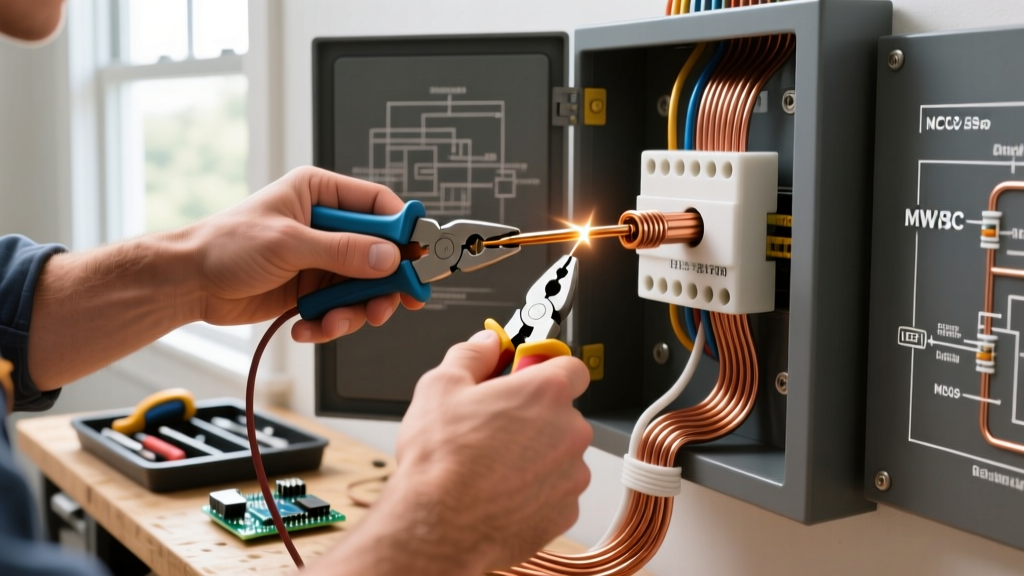
- Step 1: Precision Stripping. Use a Klein Tools 11063W (for #14-#10 AWG) to strip the insulation. Avoid nicking the copper conductor, which creates a weak point that will snap during the inspector's pull-test.
- Step 2: Alignment. Hold the bare copper ends perfectly parallel. Do not pre-twist solid copper wires if you are using modern, high-quality wire nuts like the Ideal 72B or Gardner Bender GS-6. The internal steel coil is designed to bite into parallel wires and twist them simultaneously.
- Step 3: The Twist. Push the connector onto the wires and twist clockwise. Stop twisting the moment you feel the wires begin to twist outside the connector at the base of the insulation. This indicates the internal spring has fully seated and the copper is tightly bound.
- Step 4: The Pull Test. Grip each individual wire and pull firmly in opposite directions. UL 486A standards require connectors to withstand significant axial force; a firm human tug (approx. 15-20 lbs) is the field standard.
- Step 5: Terminal Torque. When terminating the other end of your pigtail to a receptacle or breaker, use a torque screwdriver (e.g., Klein Tools 61-076). Standard 15A and 20A receptacles require 12 to 14 in-lbs of torque. Hand-tightening often leads to loose connections that arc over time.
Inspector's FAQ: Edge Cases and Clarifications
Do I need to pigtail the equipment grounding conductor (EGC)?
Yes. Per NEC 250.148, equipment grounding conductors must be spliced together in the box, and a pigtail must be run to the device's green grounding screw. The only exception is if you are using a listed device with a self-grounding strap installed in a properly grounded metal box, but pigtailing the EGC is the universal best practice for compliance.
Can I use a pigtail to adapt aluminum wire to a copper receptacle?
Standard copper-only wire nuts will fail inspection if used to splice aluminum to copper. You must use a connector specifically listed for CO/ALR (Copper-Aluminum Revised) applications, or use a specialized crimp system like the Copalum or Alumiconn connector. Furthermore, the receptacle itself must be rated CO/ALR.
Is electrical tape required over wire nuts?
No. In fact, many senior inspectors dislike taped wire nuts because the tape can hide a poorly made splice, trap heat, and degrade into a sticky mess over time. A properly twisted, UL-listed wire nut does not require tape. The only exception is when wrapping the base of a connector in wet locations or specific industrial applications dictated by site engineers.