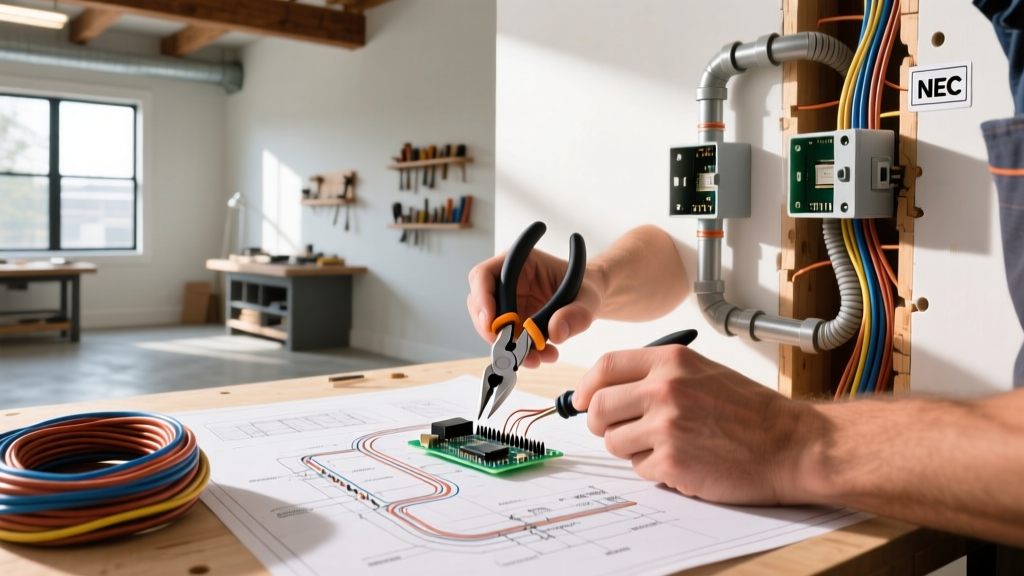

The Unforgiving Environment: Why Outdoor Electrical Wiring Demands Strict Code Adherence
Unlike interior residential wiring, outdoor electrical wiring is subjected to a relentless barrage of environmental stressors: ultraviolet (UV) radiation, extreme temperature fluctuations, moisture ingress, soil acidity, and physical impact from landscaping equipment. Because of these harsh conditions, the National Electrical Code (NEC), published by the National Fire Protection Association (NFPA), enforces stringent, highly specific requirements for exterior installations. As of the current 2026 enforcement cycles, local inspectors are cracking down on improper burial depths, missing GFCI protections, and incorrect wet-location enclosures. This guide breaks down the critical NEC articles governing exterior wiring, providing the exact specifications you need to pass inspection and ensure long-term safety.
The Core Framework: NEC Articles Governing Outdoor Installations
When planning an exterior circuit, you are primarily navigating three foundational NEC articles:
- Article 225 (Outside Branch Circuits and Feeders): Dictates the rules for wiring that originates inside the building and terminates outside, covering clearance, support, and outdoor panelboards.
- Article 300 (General Requirements for Wiring Methods and Materials): Specifically, Section 300.5 details the exact burial depths, overcurrent protection, and backfill requirements for underground services and branch circuits.
- Article 406 (Receptacles, Cord Connectors, and Attachment Plugs): Section 406.9 mandates the use of weatherproof enclosures and 'in-use' covers for outdoor receptacles.
Underground Burial Depths & Conduit Specifications
One of the most frequently cited code violations in outdoor electrical wiring is improper trench depth. NEC Table 300.5 provides minimum cover requirements (the distance from the top of the underground conduit or cable to the surface of the ground). Below is a critical reference matrix for standard residential and light commercial applications (0 to 600 Volts).
| Wiring Method | Minimum Burial Depth | Specific Conditions & Notes |
|---|---|---|
| Rigid Metal Conduit (RMC) or Intermediate Metal Conduit (IMC) | 6 inches | Must be galvanized steel; approved for direct burial without concrete encasement. |
| PVC Schedule 80 | Required where wiring emerges from the ground and is subject to physical damage (e.g., driveways, landscaping edges). | |
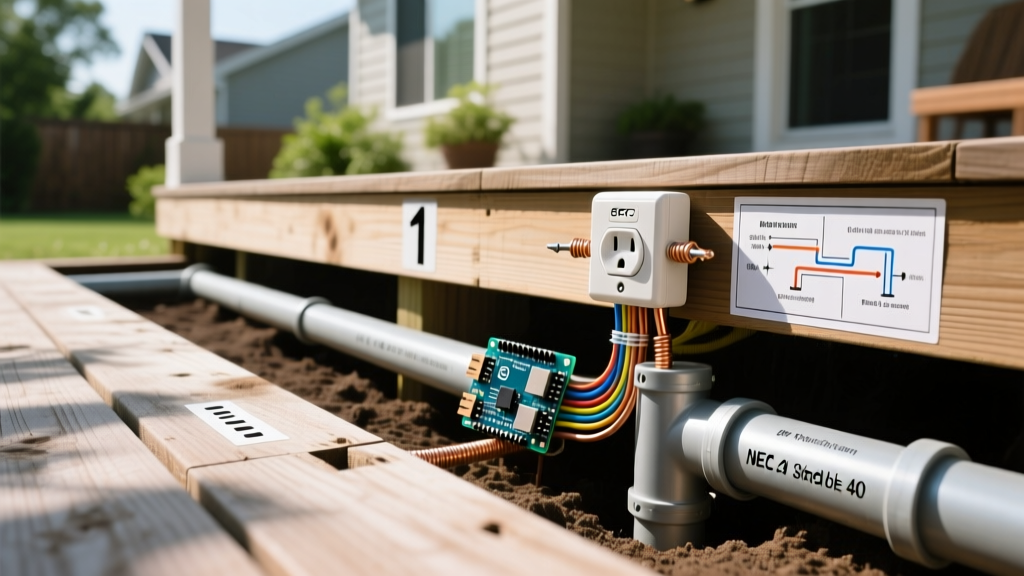
| PVC Schedule 40 | Standard for most residential underground branch circuits under lawns and flowerbeds. | |
| Direct Burial UF-B Cable (Standard) | Requires 24 inches of cover unless protected by a 2-inch concrete pad or GFCI protection. | |
| Direct Burial UF-B Cable (GFCI Protected) | Only applicable for residential branch circuits rated 120V or less, 20A or less, with GFCI protection at the source. |
Pro-Tip for Trenching: NEC 300.5(D) requires a warning ribbon to be placed in the trench at least 12 inches above the underground installation for any circuit operating over 600V, but it is considered an industry best practice to include a bright yellow 'Caution: Electrical Line Buried Below' ribbon at 12 inches for standard 120V/240V residential runs to prevent future excavation damage.
PVC Expansion and Contraction: The Hidden Code Trap
When running long distances of PVC conduit outdoors, temperature swings can cause the pipe to expand and contract significantly, potentially pulling joints apart or buckling the run.
NEC 300.7(A) Requirement: Raceways exposed to widely different temperatures must be equipped with expansion fittings. PVC expands at a rate of approximately 4.16 inches per 100 feet for every 100°F change in temperature. If you are running a 100-foot surface-mounted PVC conduit on an exterior wall in a climate where temperatures swing from 20°F in winter to 110°F in summer (a 90°F delta), the pipe will expand and contract by nearly 3.75 inches. You must install PVC expansion couplings (like the Carlon E943 series) to absorb this movement.
Wet vs. Damp Locations: Fixture and Enclosure Ratings
The NEC draws a hard line between 'damp' and 'wet' locations, and confusing the two is a primary reason for failed outdoor lighting inspections. According to the Occupational Safety and Health Administration (OSHA) and NEC Article 100 definitions:
- Damp Locations: Areas protected from weather and not subject to saturation with water, but subject to moderate degrees of moisture (e.g., under roof overhangs, covered porches, interior soffits). Fixtures here must be rated for damp locations (NEMA 2 or IP44).
- Wet Locations: Installations underground, in concrete slabs in direct contact with the earth, or subject to saturation with water or other liquids (e.g., exposed exterior walls, uncovered decks, landscape lighting, fountains). Fixtures and junction boxes must be rated for wet locations (NEMA 3R, 4, 4X, or IP65+).
Furthermore, any junction box installed in a wet location must be equipped with a gasketed cover and threaded conduit hubs to prevent water from wicking into the box via capillary action.
GFCI Protection and Receptacle Placement Rules
Ground-Fault Circuit Interrupter (GFCI) protection is non-negotiable for outdoor electrical wiring. Under NEC 210.8(A)(3) and 210.8(F), all 125-volt through 250-volt receptacles rated 150 volts or less to ground, 50 amperes or less, and those rated 150 volts to ground or more, 60 amperes or less, installed outdoors must have GFCI protection. This includes:
- Standard 15A and 20A receptacles on exterior walls.
- Receptacles installed on decks, balconies, and porches.
- Dedicated outdoor HVAC disconnect receptacles.
- Receptacles located in detached garages or sheds with dirt floors (considered wet/damp environments).
The 'In-Use' Cover Mandate
NEC 406.9(B)(1) requires that all 15A and 20A outdoor receptacles in wet locations be enclosed in an 'extra-duty' weatherproof enclosure. These covers (often called bubble covers) must remain weatherproof even when a plug is inserted and the cord is hanging down. Standard flat, flip-up metal covers that only protect the receptacle when nothing is plugged in are a direct code violation in wet locations.
Wire Insulation Types: Selecting the Right Conductor
Pulling interior wire through exterior conduit is a common and dangerous mistake. The insulation rating must match the environment inside the conduit. Underground conduit is universally classified as a wet location because condensation will inevitably form inside the pipe.
- THHN: Rated for dry locations only. Do not use outdoors.
- THWN-2: The 'W' stands for wet. Rated for 90°C in both wet and dry locations. This is the standard, most cost-effective choice for pulling through outdoor PVC or RMC.
- XHHW-2: Cross-linked polyethylene insulation. Offers superior moisture resistance and a tighter bending radius than THWN-2. Highly recommended for long conduit pulls or direct burial applications where permitted.
- UF-B (Underground Feeder): A solid, gray-jacketed cable designed for direct burial without conduit. It must transition into a conduit (usually Schedule 80 PVC) when emerging from the ground to protect it from physical damage up to at least 8 feet above grade.
Common Code Violations and How to Avoid Them
Based on recent Department of Energy safety audits and local inspector reports, avoid these frequent pitfalls:
- Failing to secure conduit properly: PVC conduit outdoors must be secured within 3 feet of every box and at intervals not exceeding 3 feet (for 1/2" to 1" pipe). Sagging conduit traps water and fails inspection.
- Using interior-rated caulk on exterior penetrations: Where conduit enters the home's siding or masonry, you must use a UV-stable, exterior-rated silicone or polyurethane sealant to maintain the building envelope and prevent moisture intrusion into the interior wall cavity.
- Improper splice enclosures: Landscape lighting transformers and wire nuts buried directly in the dirt or hidden inside unsealed PVC caps are severe fire and shock hazards. All splices must remain accessible and be housed in listed, gasketed wet-location junction boxes.
- Mixing low-voltage and line-voltage in the same trench: Unless separated by a solid brick or concrete barrier, line-voltage (120V) and low-voltage (12V/24V) landscape wiring must maintain a minimum separation distance (typically 12 inches) to prevent inductive interference and catastrophic faults if a shovel strikes the trench.
Frequently Asked Questions
Can I use Romex (NM-B) inside outdoor conduit?
No. NM-B (Romex) is strictly rated for dry, interior locations. Even if it is pulled inside a perfectly sealed, weatherproof outdoor PVC conduit, the NEC classifies the interior of that conduit as a wet location due to inevitable condensation. You must strip the NM-B jacket and use individual THWN-2 conductors, or transition to UF-B cable.
Do outdoor hardwired light fixtures require a junction box?
Yes, unless the fixture itself is listed and identified for direct conduit connection (often seen in commercial wet-location LED wall packs). Standard residential exterior sconces require a wet-location rated round or octagonal junction box behind them, complete with a rubber gasket between the fixture canopy and the siding or masonry surface.
What is the maximum number of bends allowed in an outdoor conduit run?
NEC 300.18 limits the total number of bends in any continuous conduit run to 360 degrees (four 90-degree bends) without a pull box or junction box. This rule applies equally to indoor and outdoor runs to prevent damage to wire insulation during the pulling process.