
Whether you are a first-year electrical apprentice, a seasoned journeyman looking to troubleshoot complex smart-home faults, or a dedicated DIYer preparing for a major remodel, making mistakes with live 120V/240V AC power is not an option. According to the National Fire Protection Association (NFPA), electrical malfunctions remain a leading cause of residential fires, often stemming from improper terminations, overloaded circuits, or misunderstood multi-way switch loops.
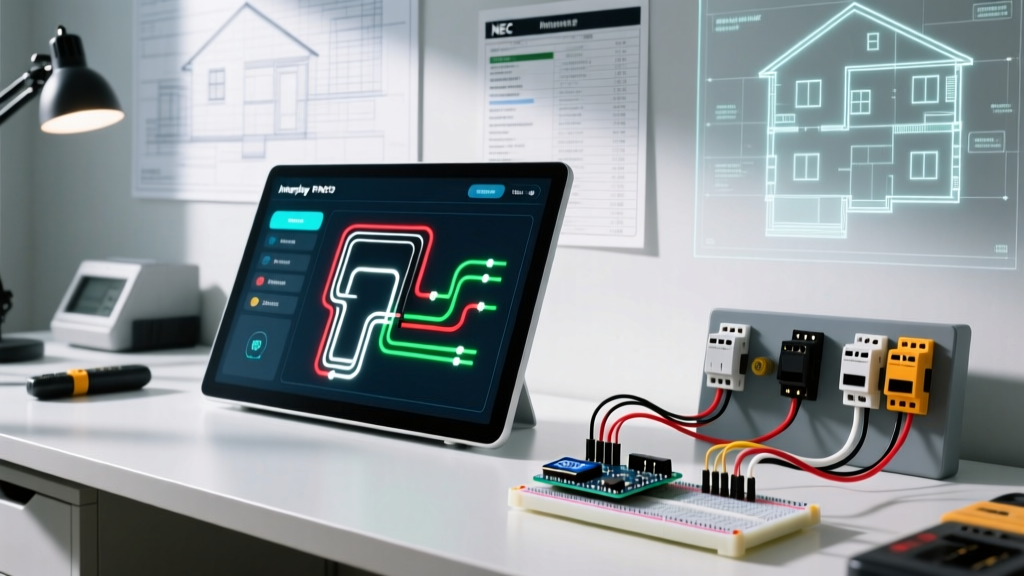
Enter the residential electrical wiring simulator. In 2026, virtual wiring environments have evolved from basic 2D schematic drawers into fully interactive, physics-based 3D sandboxes. These tools allow users to practice panel terminations, calculate box fill volumes, and troubleshoot ground faults without the risk of arc flashes or ruined copper. This guide breaks down the top simulation platforms available today, evaluating their accuracy, National Electrical Code (NEC) compliance, and real-world utility.
The Case for Virtual Wiring Practice
Safety First: The Occupational Safety and Health Administration (OSHA) emphasizes that electrical hazards, including shock and arc flash, require rigorous training before field exposure. Simulators bridge the gap between textbook theory and live-panel exposure.
A high-quality residential electrical wiring simulator provides three critical advantages:
- Zero-Consequence Troubleshooting: Intentionally create dead shorts or reverse polarity scenarios to see how virtual breakers trip and GFCI receptacles react.
- NEC Code Visualization: Physically see why a 4-gang box violates NEC Article 314.16 box-fill calculations when crammed with 12 AWG THHN and four smart dimmers.
- Multimeter Mastery: Practice using virtual True-RMS multimeters and non-contact voltage testers (NCVT) to verify de-energized states before 'touching' virtual bus bars.
2026 Tool Guide: Top Residential Electrical Wiring Simulator Platforms
1. Interplay Learning (SkillMill) — The Trade Professional's Standard
Interplay Learning is the heavyweight champion for trade schools and HVAC/Electrical apprenticeships. Their 3D electrical simulations are designed specifically for residential and light commercial troubleshooting. Rather than just drawing lines, you are placed in a 3D rendered living room or basement, tasked with diagnosing why a specific branch circuit is failing.
- Standout Feature: Full 3D multimeter integration. You must select the correct dial setting (e.g., AC Voltage, Continuity, Ohms) and place the virtual probes on the correct terminals to get accurate readings based on simulated circuit physics.
- NEC Integration: Scenarios frequently reference specific NEC articles, forcing the user to identify code violations like missing junction box covers or improper neutral-to-ground bonding in subpanels.
- Pricing (2026): Individual subscriptions hover around $29/month, while enterprise/school licenses are custom-quoted. A 7-day free trial is usually available.
2. Electrician Simulator (PC/Console) — The Gamified Sandbox
Available on Steam and major consoles, Electrician Simulator bridges the gap between entertainment and genuine residential wiring education. While it is marketed as a simulation game, its 'Sandbox Mode' and 'Job Mode' feature surprisingly accurate residential wiring mechanics, including 3-way switch loops, 240V dryer receptacles, and smart home integrations.
- Standout Feature: The physical wire routing mechanic. You must physically strip wires, attach them to screw terminals or push-in connectors, and manage cable staples. It visually penalizes you for leaving exposed copper outside the terminal (a common cause of residential arc faults).
- Edge Case Handling: The game accurately simulates the behavior of AFCI/GFCI combination breakers when a virtual nail is driven through a simulated drywall partition, piercing a cable.
- Pricing: Base game is approximately $19.99, with DLCs adding advanced commercial and solar scenarios.
3. PhET Circuit Construction Kit: AC/DC — The Academic Physics Engine
Developed by the University of Colorado Boulder, the PhET Circuit Construction Kit is a free, browser-based simulator. While it leans heavily toward electronics and physics, its AC/DC module is unparalleled for understanding the invisible physics of residential alternating current.
- Standout Feature: Visual electron flow and voltage graphs. You can watch the AC sine wave propagate through a virtual circuit, making it the absolute best tool for understanding phase angles, RMS voltage, and why 240V split-phase systems work the way they do in US residential panels.
- Limitations: It does not simulate physical residential components like Decora switches, Romex cable, or physical panel bus bars. It uses idealized batteries, resistors, and AC sources.
- Pricing: 100% Free and open-source.
Head-to-Head Comparison Matrix
| Simulator Platform | Best Use Case | 2026 Pricing | NEC Code Focus | Physical Wiring Mechanics |
|---|---|---|---|---|
| Interplay Learning | Apprentices, Trade Schools, Troubleshooting | ~$29/mo (Individual) | High (Direct citations) | Low (Focus on diagnostics) |
| Electrician Simulator | DIYers, Spatial Planning, Component Familiarity | $19.99 (One-time) | Medium (Implicit rules) | High (Stripping, routing) |
| PhET AC/DC Kit | Understanding AC Physics, Sine Waves, Loads | Free | None (Pure physics) | None (Schematic only) |
Step-by-Step: Simulating a NEC-Compliant 3-Way Switch Circuit
One of the most common stumbling blocks for residential wiring students is the 3-way switch loop. Using a robust 3D residential electrical wiring simulator, follow this workflow to master the topology before touching real 14/3 or 12/3 NM-B cable.
- Identify the Power Source: In the simulator, run your virtual 120V feed (Line) into the first switch box. Pro Tip: Calculate your box fill. A standard 3-way switch counts as two conductor allowances per NEC 314.16(B)(1).
- Run the Travelers: Connect the two brass traveler terminals on Switch A to the two brass traveler terminals on Switch B using the red and black wires of your virtual 3-conductor cable.
- Connect the Load: Run the white wire (re-identified with black virtual electrical tape per NEC 200.7) from the common terminal of Switch B to the hot terminal of the light fixture.
- Complete the Neutral: Run the white neutral wire directly from the source panel to the light fixture, bypassing the switches entirely (unless simulating smart switches with neutral requirements).
- Bond the Grounds: Use the simulator's wire nut tool to pigtail the bare copper grounds to the green grounding screws on both metal switch boxes and the switches themselves.
- Energize and Test: Turn on the virtual main breaker. Toggle Switch A and Switch B independently to verify the logic gate operates correctly.
The 'Feel' Factor: What Simulators Cannot Teach
While a residential electrical wiring simulator is an incredible cognitive tool, it completely lacks haptic feedback. As you transition from the screen to the job site, be acutely aware of these physical realities that software cannot replicate:
- Termination Torque: NEC 110.14(D) requires that terminations be tightened to the manufacturer's specified torque. Simulators don't teach you the physical 'click' of a Milwaukee M12 Torque Screwdriver set to 15 in-lbs on a Square D QO breaker.
- Wire Stripping Tension: Stripping 12 AWG solid copper without nicking the conductor requires precise gauge selection and pressure on tools like the Klein 11063W. A nicked wire creates a physical weak point that will snap inside a tight junction box—a failure mode no simulator currently models.
- Cable Bending Radius: Pushing stiff 10/3 NM-B cable into a crowded 4-gang old-work box requires physical leverage and patience. Simulators allow wires to clip through each other or bend at impossible 90-degree angles right at the terminal.
Frequently Asked Questions
Can I use a simulator to pass my state electrical journeyman exam?
Simulators are excellent for understanding circuit logic and troubleshooting, which helps with the practical portions of your training. However, the journeyman exam is heavily focused on NEC codebook navigation and specific article memorization. You must pair simulator practice with rigorous codebook study and practice exams.
Are there VR-compatible residential wiring simulators?
Yes. Interplay Learning supports VR headsets (like the Meta Quest 3) for many of their 3D troubleshooting modules. This provides incredible spatial awareness for navigating tight virtual crawlspaces and examining panel clearances, which is highly beneficial for visual learners.
Do these simulators support 2026 smart home wiring standards?
Modern simulators, particularly updated versions of Electrician Simulator and specialized smart-home modules in Interplay, now include low-voltage PoE (Power over Ethernet) lighting, 0-10V dimming circuits, and smart breaker panel configurations, reflecting the current shift in residential construction.