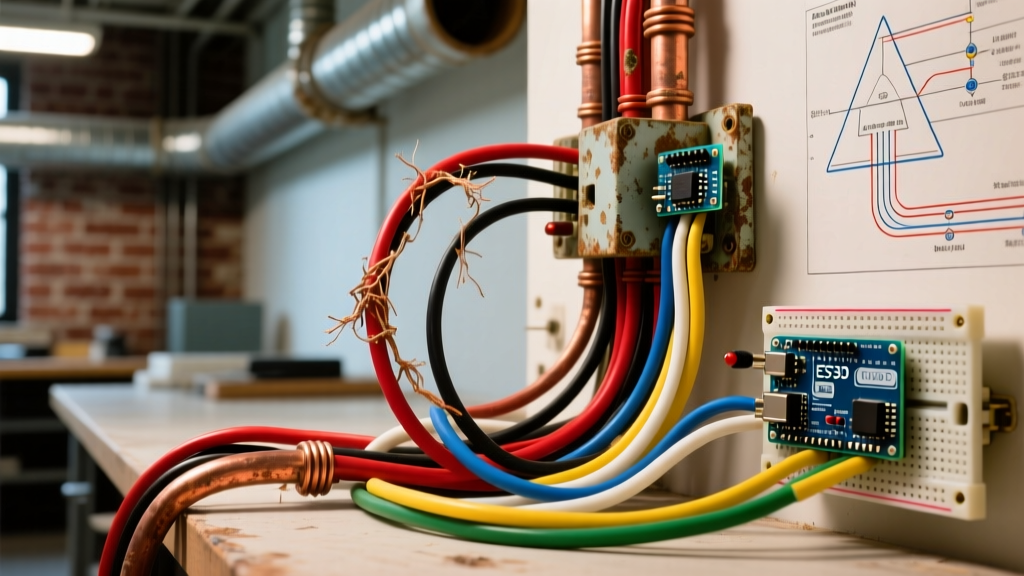

The Hidden Hazards of Legacy Commercial Wiring
When undertaking commercial building retrofits, facility managers and master electricians frequently encounter a hazardous labyrinth of legacy conductors. Identifying old electrical wiring colours is not merely an exercise in historical trivia; it is a critical safety protocol that prevents catastrophic equipment failure, arc flash incidents, and severe electrical shock. Commercial environments—ranging from mid-century manufacturing plants to 1980s retail centers—often feature 3-phase power systems and industrial control panels wired under outdated editions of the National Electrical Code (NEC) or international standards like BS 7671.
Misinterpreting legacy phase colors can lead to connecting 120V commercial lighting to a 277V leg, or worse, misidentifying a high-leg delta system and sending 208V into a 120V control coil. This comprehensive guide breaks down the evolution of commercial wiring colors, providing actionable frameworks for safely mapping and upgrading legacy electrical infrastructure.
Decoding Old Electrical Wiring Colours in US 3-Phase Systems
In North America, the NEC has undergone several significant revisions regarding phase identification. For commercial electricians working on 208Y/120V or 480Y/277V systems, assuming modern color codes apply to a building constructed before 1975 is a dangerous gamble. Prior to the 1971 NEC cycle, the grounded (neutral) conductor was not universally mandated to be white or natural gray. You may encounter legacy neutrals that are bare, green, or white with colored tracers.
Furthermore, the 2008 NEC (Article 210.5(C)) introduced standardized coloring for 480Y/277V systems to prevent cross-voltage accidents. Before this, 480V systems often utilized the same Black, Red, and Blue scheme as 208V systems, leading to fatal mistakes when electricians assumed a Red wire was 120V to ground instead of 277V.
| System Voltage | Legacy Colors (Pre-2008) | Modern NEC Colors (Post-2008) | Neutral / Ground |
|---|---|---|---|
| 208Y/120V | Black, Red, Blue | Black, Red, Blue | White / Gray / Green |
| 480Y/277V | Black, Red, Blue (High Risk) | Brown, Orange, Yellow | Gray / Green |
| 240V Delta (High-Leg) | Black, Red, Blue (Blue = High Leg) | Black, Red, Orange (Orange = High Leg) | White (Center Tap) / Green |
The High-Leg Delta Trap: A Commercial Electrician’s Nightmare
The most perilous legacy configuration in US commercial wiring is the 240V 3-Phase 4-Wire Delta system, commonly known as the 'High-Leg', 'Red-Leg', or 'Wild-Leg' Delta. This system utilizes a center-tapped transformer to provide 120V for single-phase lighting and receptacles, while delivering 240V for heavy commercial HVAC and motor loads.
In this configuration, Phases A and C yield 120V to the neutral bar. However, Phase B (the high leg) yields approximately 208V to neutral. If an electrician misidentifies the old electrical wiring colours and connects a standard 120V commercial contactor coil or LED driver to the high leg, the component will instantly overvolt and fail, potentially causing a fire.
Field Warning: Historically, the high leg was often colored Blue in older installations, while Phases A and C were Black and Red. The 2008 NEC revision strictly mandated that the high leg must be identified by the color Orange. During a retrofit, never trust the insulation color of a high-leg delta system without verifying voltage to ground with a True-RMS multimeter.
Industrial Control Panels and NFPA 79 Legacy Colours
Beyond branch circuits, commercial facilities rely heavily on industrial control panels for HVAC, elevators, and manufacturing conveyors. The NFPA 79 standard governs these panels, and older installations feature vastly different control wiring colours compared to modern setups. Understanding these legacy control colors is vital when troubleshooting commercial machinery.
- Red (Legacy AC Control): In older panels, red was universally used for ungrounded AC control circuits (typically 120VAC derived from a step-down transformer). Modern NFPA 79 still permits red for AC control, but black is now heavily utilized for ungrounded power.
- White (Legacy Grounded Control): Used for the grounded side of the AC control circuit. If a white wire in an old commercial panel is switched by a contactor, it may be re-identified with black tape at the termination points, a common mid-century shortcut.
- Yellow (Interlocks & DC): Historically, yellow was used for interlock circuits that bypassed the main disconnect. In some legacy DC control systems (like older elevator relays), yellow indicated ungrounded DC power.
- Blue (Legacy DC Control): Often used for ungrounded DC control circuits (e.g., 24VDC PLC outputs). However, in branch wiring, blue was a phase conductor, highlighting the danger of assuming wire color functions without tracing the circuit to its source.
UK and IEC Harmonization: The 2004 BS 7671 Shift
For commercial projects in the UK, Europe, and regions following IEC standards, the spelling 'colours' often points to the massive harmonization shift that occurred in 2004. Before April 2004, UK 3-phase commercial wiring utilized Red, Yellow, and Blue for phases, with Black for neutral. This caused severe confusion when UK contractors worked on European equipment wired to IEC standards (Brown, Black, Grey).
The IET Wiring Regulations (BS 7671) Amendment 2:2004 mandated a transition to the harmonized European colors. Commercial buildings wired between 1970 and 2004 will feature the old regime, and mixed installations are incredibly common in retrofitted UK commercial spaces.
| Function | Old UK Colours (Pre-2004) | Harmonized IEC Colours (Post-2004) |
|---|---|---|
| Phase 1 (L1) | Red | Brown |
| Phase 2 (L2) | Yellow | Black |
| Phase 3 (L3) | Blue | Grey |
| Neutral (N) | Black | Blue |
| Earth (PE) | Green (or Bare) | Green/Yellow Stripe |
Step-by-Step Protocol for Mapping Legacy Commercial Panels
To safely navigate unmapped legacy panels, commercial electricians must follow a rigorous verification and re-identification protocol. According to OSHA electrical safety guidelines, working on exposed energized parts requires strict adherence to Lockout/Tagout (LOTO) or NFPA 70E arc flash boundaries. A full commercial panel mapping typically costs between $1,500 and $3,500 for a 42-circuit legacy board, but it prevents tens of thousands in damaged equipment.
Step 1: Arc Flash PPE and Boundary Setup
Before opening any legacy commercial panel, calculate the incident energy. Older panels often lack modern current-limiting breakers, resulting in high arc flash hazards. Don Category 2 PPE (minimum 8 cal/cm² rating), including a face shield, balaclava, and voltage-rated gloves with leather protectors.
Step 2: Voltage Verification and Phasing
Use a True-RMS multimeter with a low-impedance (LoZ) mode, such as the Fluke 378 FC or Fluke 117. LoZ mode prevents 'ghost voltage' readings caused by capacitive coupling in old commercial cable trays. Measure Phase-to-Neutral and Phase-to-Ground on every single circuit. Do not rely on non-contact voltage testers (NCVTs) for phase identification, as they cannot distinguish between a 120V leg and a 208V high-leg.
Step 3: Re-Identification and Labeling
Once the actual voltages are mapped, re-identify the conductors at both the panel termination and the load end. Use high-quality phase tape, such as 3M Scotch 35 Series vinyl electrical tape, which resists UV degradation and heat up to 105°C. For 480V systems, apply Brown, Orange, and Yellow tape. For high-leg delta systems, wrap the B-phase conductor entirely in Orange tape for the first 6 inches from the termination to ensure future electricians immediately recognize the hazard.
Step 4: Update the Panel Directory
Legacy panel directories are notoriously inaccurate, often featuring faded pencil marks or outdated tenant names. Utilize a thermal printer (like the Panduit MP600) to generate durable, heat-shrink wire markers and adhesive panel labels. Update the directory to reflect the new color coding and exact load descriptions as mandated by NEC Article 408.4.
Final Thoughts on Commercial Retrofits
Navigating old electrical wiring colours requires a healthy dose of skepticism and a reliance on empirical testing over visual assumptions. Whether you are dealing with a US high-leg delta system or a pre-2004 UK 3-phase board, the legacy insulation colors are merely historical suggestions, not electrical facts. By adhering to modern NFPA 70 National Electrical Code standards, utilizing LoZ True-RMS testing, and rigorously re-identifying conductors, commercial electricians can safely bridge the gap between mid-century infrastructure and modern electrical demands.