
Navigating the 2026 Copper Market for Home Wiring
Choosing the correct electric wire gauge for home wiring is not just a matter of passing inspection; it is the fundamental baseline for your home's electrical safety, efficiency, and overall project budget. As we move through 2026, the global copper market has seen moderate stabilization following the volatile spikes of the early 2020s, but material costs remain a significant line item for any residential remodel or new construction project. According to the National Fire Protection Association (NFPA), adhering to the latest National Electrical Code (NEC) ampacity tables is mandatory to prevent thermal overloads and mitigate fire risks.
This cost estimation guide breaks down the exact pricing, application scenarios, and hidden cost factors associated with selecting the proper wire gauge. Whether you are wiring a single bathroom remodel or roughing in a 3,000-square-foot new build, understanding the financial and technical implications of American Wire Gauge (AWG) sizing will keep your project on time and under budget.
Master Gauge & Cost Matrix: NM-B (Romex) Cable
Non-Metallic Sheathed Cable (NM-B), commonly referred to by the popular brand name Romex, is the standard for interior dry-location residential wiring. Below is the 2026 estimated pricing for standard Southwire SIMpull NM-B rolls, reflecting current big-box retailer and electrical supply house averages.
| Wire Gauge (AWG) | Max Ampacity (60°C/75°C) | Primary Residential Application | 2026 Cost per 250ft Roll | Cost Per Linear Foot |
|---|---|---|---|---|
| 14/2 NM-B | 15 Amps | Lighting circuits, low-draw fans | $115.00 - $125.00 | $0.46 - $0.50 |
| 12/2 NM-B | 20 Amps | Standard receptacles, kitchens, baths | $138.00 - $148.00 | $0.55 - $0.59 |
| 10/2 NM-B | 30 Amps | Electric water heaters, window ACs | $195.00 - $215.00 | $0.78 - $0.86 |
| 8/2 NM-B | 40 Amps | Electric ranges, baseboard heaters | $285.00 - $310.00 | $1.14 - $1.24 |
| 6/2 NM-B | 55 Amps | EV Level 2 chargers, subpanels | $390.00 - $420.00 | $1.56 - $1.68 |
Note: Pricing fluctuates based on regional supply chain dynamics and bulk purchasing agreements. Always add a 10% waste factor to your linear foot calculations for cuts, junction box loops, and panel dressing.
Detailed Breakdown by Circuit Type and Code Requirements
14 AWG: The Lighting Standard
While 14 AWG is perfectly legal for 15-amp circuits under NEC Article 240, many professional electricians in 2026 are abandoning it entirely in favor of 12 AWG. Why? The cost difference is roughly $23 per 250ft roll (about $0.09 per foot). By standardizing on 12 AWG for the entire home, contractors eliminate the risk of accidentally pairing a 14 AWG wire with a 20-amp breaker—a severe fire hazard that will fail inspection. Use 14 AWG only if you are strictly budget-constrained on a massive lighting-only circuit run.
12 AWG: The Modern Receptacle Workhorse
For general-purpose receptacles, kitchen small-appliance circuits, and bathroom GFCI circuits, 12 AWG is the undisputed standard. It accommodates 20-amp breakers, allowing for higher continuous loads. Furthermore, 12 AWG wire features a thicker copper cross-section, which inherently reduces voltage drop on long runs from the main panel to the far corners of the house.
10 AWG to 2 AWG: Heavy Appliances and EV Infrastructure
When wiring dedicated 240-volt appliances, the gauge requirements scale up rapidly. A standard 4,500-watt electric water heater requires a 30-amp double-pole breaker and 10/2 NM-B cable. However, the rise of Level 2 Electric Vehicle (EV) home charging stations has dramatically increased the demand for 6 AWG and 4 AWG wiring. A 48-amp continuous EV charger requires a 60-amp breaker, mandating the use of 4 AWG copper THHN in conduit or 4/2 NM-B cable, which can cost upwards of $2.50 per foot.
The Hidden Cost: Voltage Drop and Upsizing
Expert Insight: The NEC recommends a maximum 3% voltage drop on branch circuits for optimal efficiency. If you are running a 12 AWG circuit 120 feet from the panel to a detached workshop drawing 16 amps, you will experience a voltage drop exceeding 4%. The solution? Upsize to 10 AWG or even 8 AWG. Failing to account for voltage drop can lead to motor burnout in power tools and premature failure of HVAC compressors.
Upsizing your wire gauge to combat voltage drop introduces secondary costs that amateur estimators frequently miss:
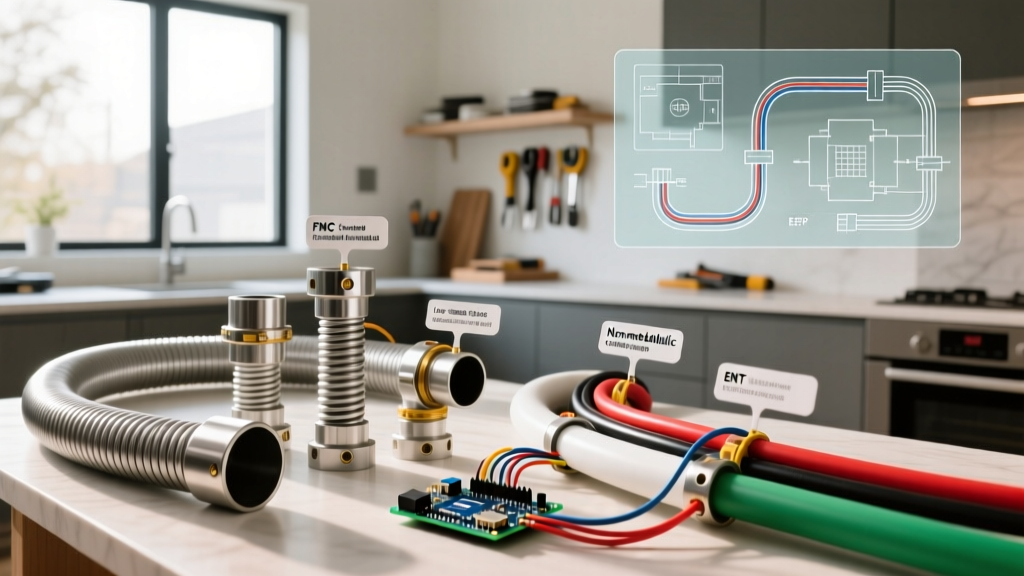
- Larger Conduit: Upsizing from 12 AWG to 8 AWG THHN may require moving from 1/2-inch EMT conduit to 3/4-inch, increasing material and bending labor costs.
- Pigtail Adapters: Most standard 15A and 20A receptacles cannot physically accommodate 10 AWG or 8 AWG solid copper wire on their terminal screws. You must budget for wire nuts, Wago connectors, and 12 AWG pigtails inside deep junction boxes.
- Box Fill Calculations: Larger gauge wires take up more cubic inch volume. You will need to upgrade from standard 18-cubic-inch nail-on boxes to 22-cubic-inch deep boxes to remain compliant with NEC Chapter 9, Table 1 box fill limits.
Copper vs. Aluminum: Heavy Feeder Cost Savings
When estimating costs for main service panels or large subpanels (100A to 200A), the price of copper becomes prohibitive. For heavy feeders, electrical contractors universally pivot to Aluminum Service Entrance (SER) cable. According to safety guidelines monitored by the Occupational Safety and Health Administration (OSHA), modern AA-8000 series aluminum alloy wire is exceptionally safe when terminated with proper anti-oxidant paste and torqued to manufacturer specifications.
2026 Feeder Cost Comparison (200-Amp Service):
- 4/0 AWG Copper SER: ~$48.00 per foot. Total for 50ft run: $2,400
- 4/0 AWG Aluminum SER: ~$16.50 per foot. Total for 50ft run: $825
By utilizing aluminum for the main feeder and reserving copper strictly for interior branch circuits, you can shave thousands of dollars off a new construction electrical rough-in without compromising safety or code compliance.
Conduit Derating: The THHN Trap
If your project requires pulling individual THHN/THWN conductors through conduit rather than using NM-B cable, you must account for NEC Article 310.15(B)(3)(a) adjustment factors. When you bundle multiple current-carrying conductors in a single raceway, they generate mutual heat, reducing their ability to dissipate thermal energy.
- Count the Conductors: If you have two 120V circuits in one conduit, you have 4 current-carrying conductors (the grounds do not count).
- Apply the Derating Factor: 4 to 6 conductors require an 80% derating factor. 7 to 9 conductors require 70%.
- Calculate the New Ampacity: A 12 AWG THHN wire has a base ampacity of 30A (in the 90°C column). If derated to 80%, its new capacity is 24A. This is still safe for a 20A breaker. However, if you pull 8 conductors (70% derating), the capacity drops to 21A. If that circuit serves a continuous load (defined as running for 3 hours or more), the NEC requires the load to be limited to 80% of the breaker rating (16A). You are now dangerously close to the thermal limit and should upsize to 10 AWG THHN.
Step-by-Step Project Estimation Framework
To build a bulletproof material estimate for your 2026 wiring project, follow this sequential framework:
- Map the Circuit Schedule: List every circuit, its breaker size, and the required AWG based on NEC Article 210.
Measure Linear Distances: Use a laser measure or digital floor plans to calculate the exact path from the panel to the furthest device on the home-run.- Add the Slack Factor: Add 12 inches for every device box, 24 inches for the panel dressing, and 10% for routing obstacles.
- Check for Voltage Drop: Run the 3% voltage drop formula for any run exceeding 75 feet. Upsize the gauge where necessary.
- Price the Rolls vs. Cut-to-Length: Compare the cost of 250ft spools against the per-foot price at your local supply house. If you need 210 feet of 12/2, buying a 250ft roll is almost always cheaper than buying cut-to-length.
Frequently Asked Questions
Can I mix 14 AWG and 12 AWG on the same 15-amp circuit?
Yes, the NEC allows a larger wire (12 AWG) to be used on a smaller breaker (15A). However, you must never use 14 AWG on a 20-amp circuit. Mixing gauges can confuse future electricians, so it is highly recommended to maintain uniform wire sizes per circuit.
Why is 12 AWG wire so much harder to strip and bend?
The increased copper mass of 12 AWG makes it stiffer, especially in crowded multi-gang switch boxes. In 2026, most professionals use automatic wire strippers and deep-back boxes to mitigate the physical strain and box-fill violations associated with thicker gauges.
Does the ground wire count toward the AWG size?
No. When you purchase 12/2 NM-B, the '12' refers to the two current-carrying conductors (hot and neutral). The bare copper ground wire is typically 14 AWG on a 12/2 cable, which is perfectly compliant with NEC Table 250.122 for equipment grounding conductors on a 20-amp circuit.