
Planning Your Extension: Load Calculations First
Before purchasing a single spool of wire or boring a hole through a stud, successful electrical wiring for extensions demands a rigorous load calculation. According to the National Fire Protection Association (NFPA), NEC Article 220 dictates the requirements for branch-circuit, feeder, and service load calculations. When extending an existing home, you cannot simply tap into the nearest junction box; you must verify that the existing panel and the specific breaker have the residual capacity to handle the new addition's square footage and planned appliances.
For a standard 150-square-foot bedroom addition, the NEC requires a minimum of 3 volt-amperes (VA) per square foot for general lighting, plus dedicated 20-amp small-appliance branch circuits if the extension includes a kitchenette or wet bar. Failing to calculate this upfront results in nuisance tripping and dangerous thermal overloads in the panel bus bars.
Core Materials: Selecting the Right Cable and Conduit
The backbone of any addition is the cabling. In 2026, copper prices remain volatile, making accurate material estimation critical to prevent budget overruns. For most residential interior extensions, Non-Metallic Sheathed Cable (NM-B) is the standard. However, if your extension passes through an unfinished basement, crawlspace, or exterior masonry, you must transition to individual THHN conductors pulled through EMT (Electrical Metallic Tubing) or Schedule 80 PVC conduit to meet physical protection requirements outlined in NEC Article 334.15.
Wire Gauge and Application Matrix for Extensions
| Wire Type & Gauge | Max Amperage | Primary Use Case in Extensions | Est. 2026 Cost (250ft Spool) |
|---|---|---|---|
| 14/2 NM-B (Romex) | 15 Amps | General lighting, low-draw bedroom receptacles | $95 - $110 |
| 12/2 NM-B (Romex) | 20 Amps | Bathroom GFCI circuits, kitchenette extensions, heavy tool garages | $125 - $145 |
| 10/3 NM-B | 30 Amps | Water heater or dryer extensions (requires 240V) | $180 - $210 |
| 6 AWG THHN (Stranded) | 55-65 Amps | Subpanel feeder for large multi-room additions (pulled in conduit) | $1.15 - $1.35 / ft |
Pro-Tip: Always opt for Southwire SIMpull NM-B cable. The proprietary jacket lubricant drastically reduces friction when pulling wire through bored studs over long distances, saving hours of labor on large extensions.
Junction Boxes and Device Enclosures
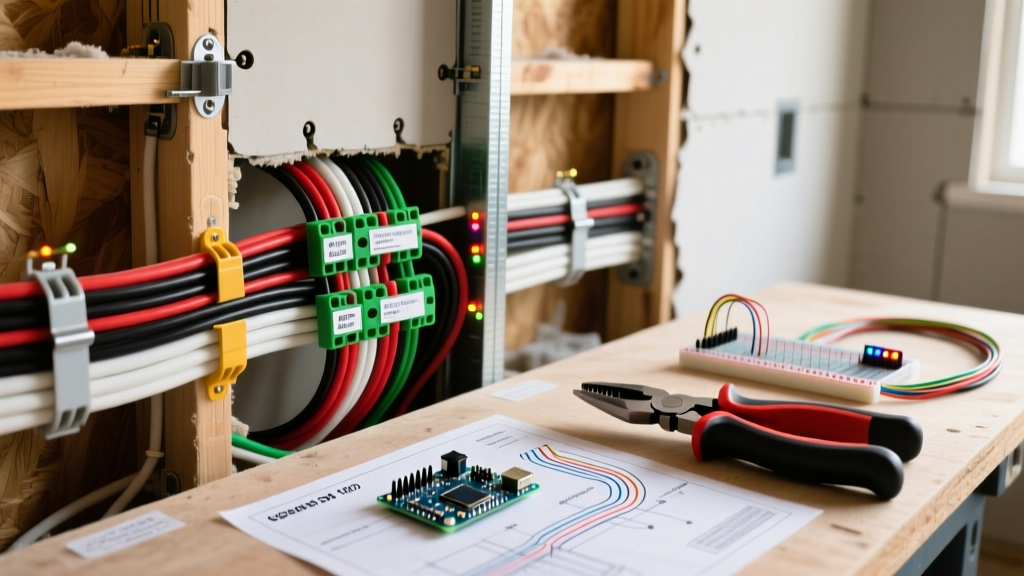
Box fill violations are the most common reason inspectors fail extension rough-ins. NEC Article 314.16 strictly governs box volume calculations. Every 12 AWG wire entering or leaving the box counts as 2.25 cubic inches. A standard single-gang nail-on box (like the Carlon B618R-UPC) offers 18 cubic inches of space, which maxes out at exactly eight 12 AWG conductors (including pigtails and device yokes).
- New Work (Exposed Studs): Use Carlon B618R-UPC (18 cu in, $1.15/ea) for standard receptacles, and Carlon B625R-UPC (25 cu in, $1.85/ea) for smart switches or GFCI/AFCI devices which have notoriously deep bodies.
- Retrofit/Tie-in Points: When tapping into existing drywall to feed the extension, use the Arlington BE311BR non-metallic old-work box ($3.50/ea). Its adjustable bracket secures firmly to 5/8-inch drywall without requiring a stud.
The Professional Tool Arsenal for Extension Wiring
Running wire from the main panel to a distant addition requires specialized tools to navigate fire blocks, top plates, and insulated exterior walls. Relying on standard drill bits will stall your progress and damage structural framing.
1. Framing and Boring Tools
To route NM-B through double top plates and fire blocks, you need a high-torque right-angle drill or a dedicated speed borer. The Greenlee 7238SB 7/8-inch Speed Borer ($48) features a self-feed screw tip that pulls itself through dense Douglas Fir or LVL beams without binding. Pair this with the Milwaukee M18 FUEL 1/2-inch Right Angle Drill ($329) for tight joist bays where a standard hammer drill cannot fit.
2. Wire Pulling and Fishing
When extending circuits down finished walls or across insulated ceilings, fish tapes are mandatory. For drops exceeding 15 feet, upgrade from a standard steel tape to the Milwaukee 48-22-5711 15ft Red Fish Glow Rod Set ($45). The fiberglass rods feature an integrated LED tip, allowing you to visually track the rod's path through dark wall cavities filled with blown-in cellulose or fiberglass batts.
3. Stripping and Termination
Clean terminations prevent arc faults. The Klein Tools 11055 Wire Stripper ($28) is calibrated specifically for 10-18 AWG solid and stranded wire, ensuring you never nick the copper conductor—a common precursor to wire snapping under torque.
Bridging Old and New: Transition Materials
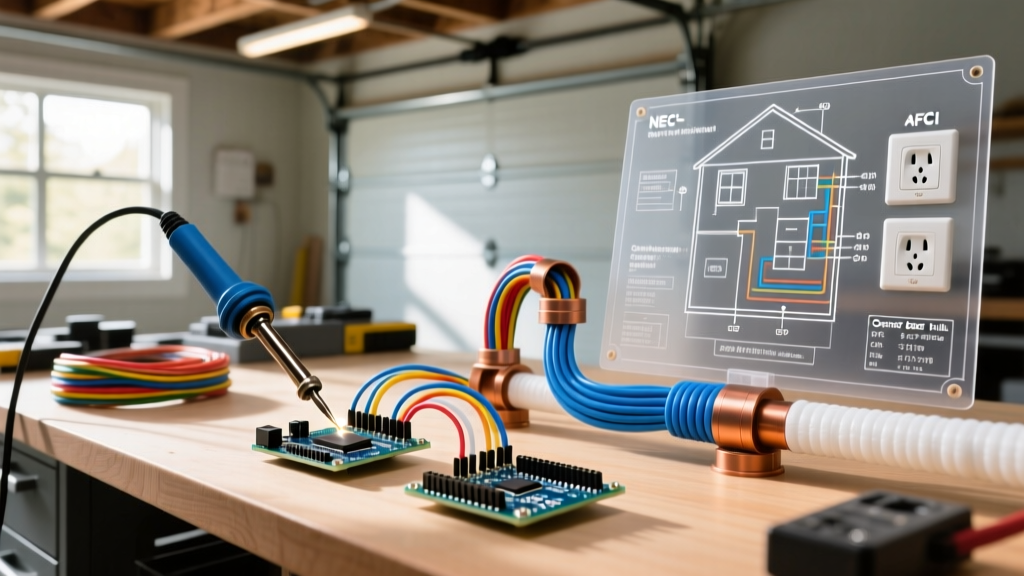
The most complex phase of electrical wiring for extensions is the tie-in. If you are extending a 120V branch circuit from an existing bedroom to a new addition, you must ensure the entire circuit is protected by an Arc-Fault Circuit Interrupter (AFCI) breaker, per NEC Article 210.12. If the existing panel uses older standard breakers, you must upgrade the breaker to a combination-type AFCI (e.g., Eaton BR220AFCI, $45) before extending the wire.
When splicing wires inside a retrofit junction box to feed the new extension, abandon standard wire nuts for WAGO 221 Series Lever-Nuts. The 221-413 (3-conductor) lever-nut ($0.65/ea) provides a gas-tight, vibration-proof connection that accommodates both 12 AWG and 14 AWG solid copper, and features a built-in test port for multimeter probes to verify voltage before closing the drywall.
Common Failure Modes in Extension Wiring
Even experienced DIYers make critical errors when extending circuits over long distances. Avoid these specific failure modes:
Voltage Drop Over Distance: The NEC recommends a maximum 3% voltage drop on branch circuits. If you are running a 120V, 20-amp circuit 120 feet from the panel to a detached garage extension using 12 AWG wire, the voltage drop will be approximately 4.1% (4.9V). This will cause power tools to overheat and smart home hubs to reboot randomly. Solution: Upsize to 10 AWG THHN pulled in 3/4-inch EMT conduit for any extension run exceeding 90 feet.
Another frequent failure is neutral overcrowding. In a multi-wire branch circuit (MWBC) feeding a kitchen extension, sharing a single neutral wire between two hot legs requires the breakers to be tied together with a handle tie (NEC 210.4). If an electrician replaces one breaker without the tie, or separates the panels, the neutral can carry the sum of both hot legs, melting the insulation and causing a fire.
Frequently Asked Questions
Can I run electrical wiring for extensions through HVAC ductwork?
Absolutely not. NEC Article 300.21 and 300.22 strictly prohibit running NM-B or standard THHN wiring inside ducts, plenums, or other spaces used for environmental air. The toxic smoke generated by wire insulation during a fire would be distributed throughout the entire home. You must use specialized plenum-rated (CMP) cable or route the wiring around the ductwork.
Do I need a permit to extend an existing circuit?
Yes. According to industry standards tracked by Electrical Contractor Magazine and local building authorities, any alteration, extension, or addition to a permanent wiring system requires a municipal permit and a rough-in/final inspection. Unpermitted extensions can void your homeowner's insurance in the event of an electrical fire.
How do I protect exterior extension wiring?
For exterior walls or wet locations, all receptacles must be GFCI protected and fitted with extra-duty while-in-use covers (e.g., TayMac MM540C). Furthermore, any wiring penetrating the exterior envelope must be sealed with fire-rated expanding foam or silicone caulk to maintain the home's thermal and moisture barriers.