
The Hidden Dangers of Legacy Wiring in Pre-2000s Homes
When planning a major home renovation, uncovering the existing electrical infrastructure is often the most unpredictable phase of the project. Modern contractors and DIY enthusiasts are accustomed to standardized cable insulation colors. However, when you open up the walls of a mid-century or older property, you are immediately confronted with a historical patchwork of outdated standards, faded materials, and regional code anomalies. Misidentifying old colours for electrical wiring is not just a code violation waiting to happen; it is a severe arc-flash and electrocution hazard.
In 2026, with the surge in heritage home restorations and mid-century modern flips, renovation planners must possess a forensic understanding of legacy wiring. A wire that appears brown might actually be a degraded white neutral, and a green wire in a 1950s switch loop might be carrying 120V or 230V of lethal current. This guide provides a comprehensive, region-specific breakdown of historical wiring colors, actionable integration strategies, and the exact diagnostic tools required to safely bridge the gap between legacy circuits and modern electrical codes.
Decoding Old Colours for Electrical Wiring: Regional Timelines
Electrical color codes have never been globally uniform, and even within single countries, transition periods have created dangerous overlaps. Understanding the era in which your property was wired is the first step in accurate identification.
The UK & European Harmonization Shift (Pre-2004 vs. Post-2006)
The most dramatic shift in modern electrical history occurred in the UK and Europe when the IET Wiring Regulations (BS 7671) harmonized with European CENELEC standards. Properties built or renovated between 2004 and 2006 are at the highest risk for mixed circuits, as installers were permitted to use both old and new colors during the transition. According to Electrical Safety First, failing to properly identify and label these mixed circuits is a leading cause of renovation-related electrical fires.
| Function | Old Colour (Pre-2004) | New Colour (Post-2006) | Rename Risk in Renovations |
|---|---|---|---|
| Single Phase Live | Red | Brown | High: Old black neutrals can be mistaken for new brown lives if faded. |
| Single Phase Neutral | Black | Blue | Critical: Old black (neutral) connected to new brown (live) creates a dead short. |
| Earth / Ground | Green | Green & Yellow | Moderate: Bare copper sleeves were common in older installations. |
| 3-Phase Live 1, 2, 3 | Red, Yellow, Blue | Brown, Black, Grey | High: 3-phase industrial remodels require exhaustive phase-mapping. |
North American Anomalies: Faded Cloth and "Hot" Greens
In the US and Canada, the NFPA 70 (National Electrical Code) has maintained a relatively stable black (hot), white (neutral), and bare/green (ground) standard for single-phase residential wiring since the 1930s. However, renovators face two massive edge cases:
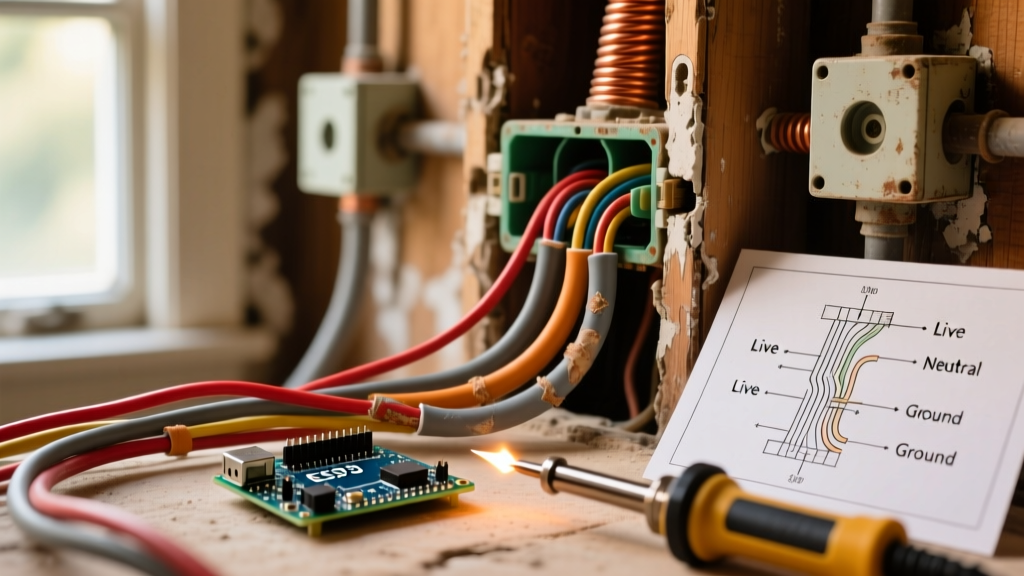
- Cloth and Rubber Degradation: In pre-1950s Knob and Tube (K&T) or early NM cable, the white neutral wire was often coated in rubber or cotton cloth. Decades of attic heat and UV exposure turn this white insulation dark yellow or brown. Renovators frequently mistake these degraded neutrals for hot wires, or worse, assume a bare, crumbling wire is a ground when no ground existed.
- The 1950s "Hot Green" Switch Leg: Before the 1962 NEC mandated equipment grounding conductors in all NM cable, 3-wire cables (Black, White, Green) were commonly used for 3-way switch loops. The green wire was used as a hot "switch leg" returning power to a light fixture. If a previous handyman replaced a fixture without re-identifying the green wire with black tape, a modern renovator will assume it is a ground and bond it to a metal junction box, instantly energizing the entire fixture enclosure.
Australian and New Zealand 3-Phase Transitions
For renovators in the ANZ region, the AS/NZS 3000 standard underwent a major harmonization shift in 2018 to align with international IEC standards. As noted by Energy Safe Victoria, older commercial and large residential properties utilizing 3-phase power will still feature the legacy Red, White, and Blue active conductors, which must now be mapped to the new Brown, Black, and Grey standards. Mixing these up during a panel upgrade will result in catastrophic phase-imbalance and motor burnout in HVAC systems.
Renovation Planning: Integrating Legacy and Modern Circuits
When your renovation plan dictates keeping certain legacy circuits (e.g., in a heritage-listed property where full rewiring is prohibited), you must safely marry old wiring to modern 2026 standards. Standard wire nuts (twist-on connectors) are highly discouraged for this task.
Expert Warning: Legacy copper wire, particularly from the 1940s to 1960s, becomes highly oxidized and brittle. The mechanical torque required to twist a modern 12 AWG solid copper wire together with a brittle 60-year-old 14 AWG wire using a standard wire nut will often shear the legacy conductor flush with the insulation, creating a hidden high-resistance fault inside the wall cavity.
The WAGO and AlumiConn Integration Protocol
Instead of twisting, utilize push-wire or lever-nut technology. For copper-to-copper connections, the WAGO 221-413 lever-nut (rated for 32A) is the 2026 industry standard. The spring-clamp mechanism applies consistent, temperature-compensated pressure without requiring the wires to be twisted together, preserving the structural integrity of brittle legacy conductors.
If your renovation uncovers legacy aluminum branch wiring (common in North American homes built between 1965 and 1973), you cannot use standard WAGO connectors to splice to modern copper. You must use AlumiConn Aluminum-to-Copper lug connectors.
- Strip the legacy aluminum wire exactly 5/16" (do not score the metal).
- Insert into the AlumiConn lug and tighten the set screw using a calibrated torque screwdriver (e.g., Klein Tools 32215) set precisely to 15 in-lbs.
- Insert the modern copper wire into the adjacent port and torque to 15 in-lbs.
- The internal silicone sealant prevents galvanic corrosion and oxide buildup.
Cost Analysis: Spot-Repair vs. Full Renovation Rewire (2026 Data)
Budgeting for electrical remediation requires realistic 2026 labor and material projections. Below is a comparative matrix for a standard 2,000 sq ft (approx. 185 sq m) residential renovation.
| Scope of Work | Average Cost (USD) | Average Cost (GBP) | Timeline | Renovation Impact |
|---|---|---|---|---|
| Diagnostic & Labeling Only | $800 - $1,500 | £600 - £1,200 | 1 - 2 Days | Low (Non-invasive tracing) |
| Spot-Repair & Panel Update | $3,500 - $6,000 | £2,800 - £4,500 | 3 - 5 Days | Medium (Drywall patching required) |
| Full Heritage Rewire (Cu) | $14,000 - $22,000 | £11,000 - £18,000 | 2 - 3 Weeks | High (Major demolition/rebuild) |
Essential Diagnostic Tools for the 2026 Renovator
Visual identification of old colours for electrical wiring is never sufficient. You must verify the electrical state of the conductor before making contact. Equip your renovation team with the following:
- Fluke 117 True-RMS Multimeter: Features VoltAlert non-contact voltage detection and a low-impedance (LoZ) mode to eliminate ghost voltage readings common in old, unshielded knob-and-tube runs.
- Klein Tools NCVT-4IR: A dual-range non-contact voltage tester with an integrated infrared thermometer. The IR sensor is crucial for scanning legacy junction boxes under load; a hot spot exceeding 45°C (113°F) indicates a high-resistance, failing legacy splice hidden behind the plaster.
- Cable Tracer (e.g., Fluke IntelliTone Pro 200): Essential for mapping ungrounded legacy circuits back to the main distribution board when wire colors are entirely faded or painted over.
Frequently Asked Questions (FAQ)
Can I just sleeve an old red wire with brown tubing to meet modern code?
Yes, in regions following BS 7671 (UK/EU), sleeving legacy wires with modern colored heat-shrink or PVC tubing at the termination points is an accepted practice, provided the entire circuit is clearly labeled at the consumer unit. However, this is only permitted for fixed wiring in good condition; if the insulation is brittle or cracking, full replacement is legally required.
What if I find a bare copper wire in a 1930s home?
Do not assume it is a ground. In early 20th-century installations, bare copper was sometimes used as a neutral or even a hot conductor in specific conduit setups. Always test with a True-RMS multimeter referenced to a known earth ground before handling.