
Why Wire Color Codes Matter in Renovation Planning
When you strip back the drywall in a mid-century home or open up the ceiling of a 1970s ranch, the electrical system you uncover is a historical timeline of the property. For homeowners and contractors planning a renovation, understanding the color code for electrical wiring is not just a matter of code compliance—it is a critical safety imperative. Misidentifying a conductor in an older home can lead to catastrophic short circuits, equipment failure, or fatal electrical shocks.
The National Electrical Code (NEC), maintained by the National Fire Protection Association (NFPA), strictly dictates how modern wiring must be color-coded to ensure uniformity and safety. However, renovations often involve interfacing new 2026-compliant materials with legacy systems that predate modern standards. This guide breaks down the exact color codes you will encounter, how to handle the transition between old and new, and the specific tools you need to verify circuits before making a single cut.
The Modern NEC Standard: NM-B Cable Jacket Colors
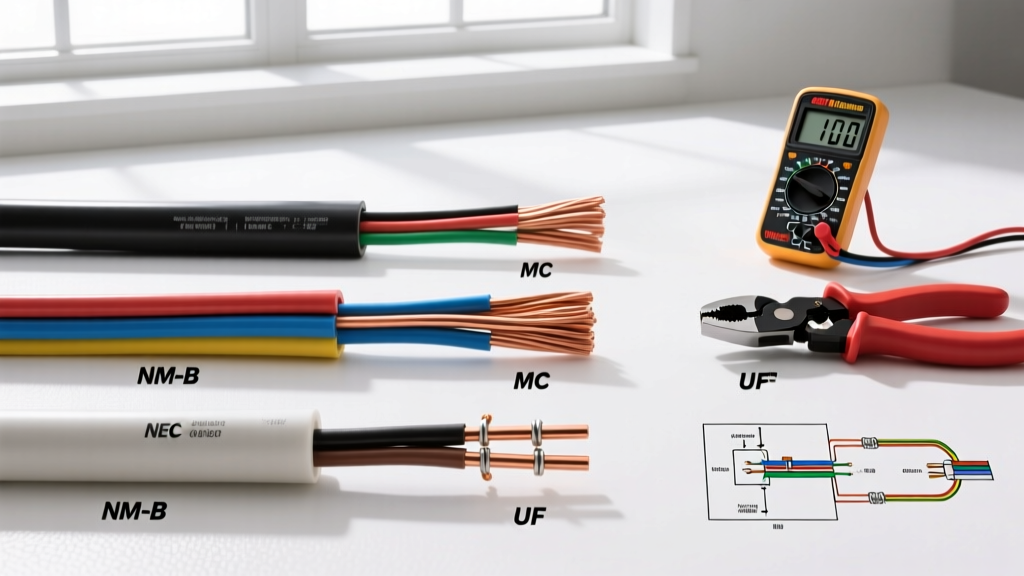
For most residential renovations involving interior walls, you will be working with Non-Metallic Sheathed Cable (NM-B), commonly referred to by the brand name Romex. The outer jacket color of NM-B cable is not random; it is a standardized visual indicator of the wire gauge (AWG) and the maximum amperage the circuit can safely handle. When purchasing materials like Southwire SIMpull or Cerro Wire for your remodel, use this chart to ensure you are pulling the correct cable for your new circuits.
| Jacket Color | Wire Gauge (AWG) | Max Amperage | Common Renovation Applications |
|---|---|---|---|
| White | 14 AWG | 15 Amps | General lighting, bedroom receptacles, smoke detectors |
| Yellow | 12 AWG | 20 Amps | Kitchen countertop receptacles, bathroom GFCI, dining rooms |
| Orange | 10 AWG | 30 Amps | Electric water heaters, window AC units, dryers (120V components) |
| Black | 8 AWG or 6 AWG | 40-55 Amps | Electric ranges, HVAC air handlers, EV charger subpanels |
Note: In 2026, the average retail cost for a 250-foot spool of 12/2 Yellow NM-B is approximately $165 to $185 (about $0.65 to $0.74 per linear foot), reflecting recent copper market stabilization.
Inside the Jacket: Individual Conductor Colors
Once you strip the outer NM-B jacket, the individual conductors follow a strict, universal color code mandated by NEC Article 200 and 210:
- Black (or Red/Blue): The 'Hot' or ungrounded conductor. This carries the 120V current from the panel to the device. Red is typically used for the second hot leg in 240V circuits or for travelers in 3-way switch setups.
- White (or Gray): The 'Neutral' or grounded conductor. This completes the circuit by carrying current back to the panel. Warning: Gray is sometimes used in commercial conduit, but white is standard for residential NM-B.
- Bare Copper (or Green): The 'Ground' or equipment grounding conductor. This provides a safe path for fault current to trip the breaker. It should never carry current under normal operation.
The Renovation Trap: Switch Loops and Re-Identification
One of the most common hazards encountered during kitchen or bathroom remodels is the 'switch loop.' In older homes, electricians often ran a 2-wite cable (black and white) from a light fixture down to a wall switch. The white wire was used to carry the hot current down to the switch, and the black wire carried the switched hot back up to the light.
NEC Code Alert: Under NEC 200.7(C)(2), using a white wire as a hot conductor is permitted in a switch loop, but it must be permanently re-identified at both terminations using black tape or black heat-shrink tubing. If you open a junction box during your remodel and see a white wire connected to a black wire with no tape, do not assume it is a neutral. Test it with a multimeter.
Legacy Wiring: What to Expect in Pre-1980 Homes
If your renovation involves a home built before 1980, the color code for electrical wiring may be inconsistent, faded, or entirely absent. The U.S. Consumer Product Safety Commission (CPSC) strongly recommends having older wiring systems evaluated, as degraded insulation is a leading cause of residential electrical fires.
Cloth-Sheathed Wiring (1920s–1950s)
Early cloth wiring often featured a black hot wire and a white neutral wire, but the white cloth frequently yellowed or stained to look identical to the black wire over decades. Furthermore, the rubberized insulation beneath the cloth becomes brittle and crumbles when disturbed. Actionable Advice: If you are renovating a home with cloth wiring, do not attempt to splice it. The vibration from pulling new wires can cause the old insulation to shatter, exposing live copper. Budget for a full circuit replacement.
Knob-and-Tube (Pre-1930s)
Knob-and-tube (K&T) wiring did not have a standardized color code. Wires were often coated in black asphalt-impregnated cotton or loom. Because K&T lacks a grounding conductor and is typically rated for only 10 amps by modern standards, the NEC prohibits adding new insulation over it or extending it. Any renovation that opens walls containing K&T requires a complete abatement and rewiring of those circuits.
Early Aluminum Wiring (1960s–1970s)
During the copper shortage of the late 60s, aluminum NM-B was used. The jacket colors were similar to modern copper (white for 14AWG, yellow for 12AWG), but the conductors inside are silver instead of copper. Aluminum expands and contracts at a different rate than copper, leading to loose connections at receptacles. If you uncover aluminum wiring during a demo, plan to install COPALUM crimps or replace the circuits entirely.
Exposed Conduit and THHN/THWN Wire Colors
For basement finish-outs, garage workshops, or commercial-style renovations requiring exposed EMT (Electrical Metallic Tubing) conduit, you will pull individual THHN/THWN conductors. The color code here expands to accommodate three-phase power and multi-wire branch circuits (MWBC):
- Phase 1 (Hot): Black
- Phase 2 (Hot): Red
- Phase 3 (Hot): Blue
- Neutral: White or Gray
- Ground: Green, Green with Yellow Stripe, or Bare
Pro-Tip for MWBCs: If you are wiring a new kitchen island requiring two 20A circuits on a single 12/3 NM-B or in a conduit MWBC, you must use a black wire and a red wire for the two hot legs. They must be tied to a double-pole 20A breaker with a handle tie to ensure both legs trip simultaneously, preventing a shared neutral overload.
Essential Testing Tools for Renovation Verification
Never trust the color code of a wire in an existing home without verification. Previous DIYers or unlicensed handymen may have miswired circuits. Before touching any conductor, use these industry-standard tools:
- Non-Contact Voltage Tester (NCVT): The Klein Tools NCVT-4 (approx. $38) is a dual-range tester that detects both standard 120V and low-voltage 12-48VAC. Use this to verify a circuit is dead before removing cover plates.
- Voltage & Continuity Tester: The Fluke T6-1000 Electrical Tester (approx. $250) allows you to measure voltage and current without contacting bare metal probes, utilizing FieldSense technology. This is invaluable for checking if a white wire in a switch loop is actually carrying 120V.
- Receptacle Tester: A standard 3-prong GFCI tester (like the Gardner Bender GRT-3000, $15) will instantly reveal if a previous owner swapped the hot and neutral wires at a receptacle, a common issue when white and black wires are pushed into the wrong terminals.
Renovation Rewiring Budget and Planning Checklist
Integrating new, code-compliant wiring into an older home requires careful budgeting. According to Occupational Safety and Health Administration (OSHA) guidelines and general contractor estimates, here is what you should plan for in a 2026 renovation:
- Material Costs: Budget $0.75 to $1.10 per linear foot for 12/2 NM-B, including wire, wire nuts (Ideal 341 In-Sure push-in connectors are recommended for renovations, approx. $0.35 each), and new 20A Tamper Resistant (TR) receptacles.
- Labor Costs: Professional rewiring in an existing home (which involves fishing wires through closed walls and patching drywall) typically costs between $8.00 and $14.00 per linear foot, heavily dependent on local labor rates and wall construction (lath and plaster vs. drywall).
- Panel Upgrades: If your renovation adds significant load (e.g., a new HVAC system, induction cooktop, or EV charger), you may need to upgrade from a 100A to a 200A panel. Expect to pay $2,200 to $3,800 for a panel upgrade, which includes the new load center, main breaker, and utility coordination.
Frequently Asked Questions
Can I use red electrical tape to mark a white wire as hot?
Yes, but black, red, or any color other than white, gray, or green is acceptable for re-identifying a hot conductor. However, black is the industry standard and reduces confusion for future electricians. Never use white or gray tape to re-identify a hot wire.
What if I find a green wire wrapped in black tape?
Stop immediately. A green or bare wire is strictly reserved for grounding. If a previous worker used a ground wire as a hot or neutral conductor and taped it, the circuit is dangerously miswired and violates NEC 250.119. The entire cable run must be replaced.
Does the color code apply to low-voltage thermostat or doorbell wiring?
No. The NEC color codes detailed above apply to line-voltage (120V/240V) power circuits. Low-voltage wiring (Class 2) uses its own conventions, such as the standard Red/White/Yellow/Green/Blue 18/5 thermostat cable, which operates at 24VAC and is not subject to the same conduit and jacket color rules.