
The High-Stakes Reality of Spa Electrical Compliance
When water and high-voltage electricity intersect, the margin for error drops to absolute zero. Installing the electrical wiring for hot tub environments requires strict adherence to the National Electrical Code (NEC), specifically Article 680. For electrical inspectors, spa installations are among the most heavily scrutinized projects due to the severe risk of electrocution and the complexity of equipotential bonding grids. Whether you are a licensed contractor preparing for a rough-in inspection or a homeowner verifying your electrician's work, understanding the precise compliance metrics is non-negotiable.
This guide breaks down the exact specifications, material requirements, and common failure modes associated with modern hot tub wiring, ensuring your installation passes inspection on the first attempt.
NEC Article 680: The Core Framework
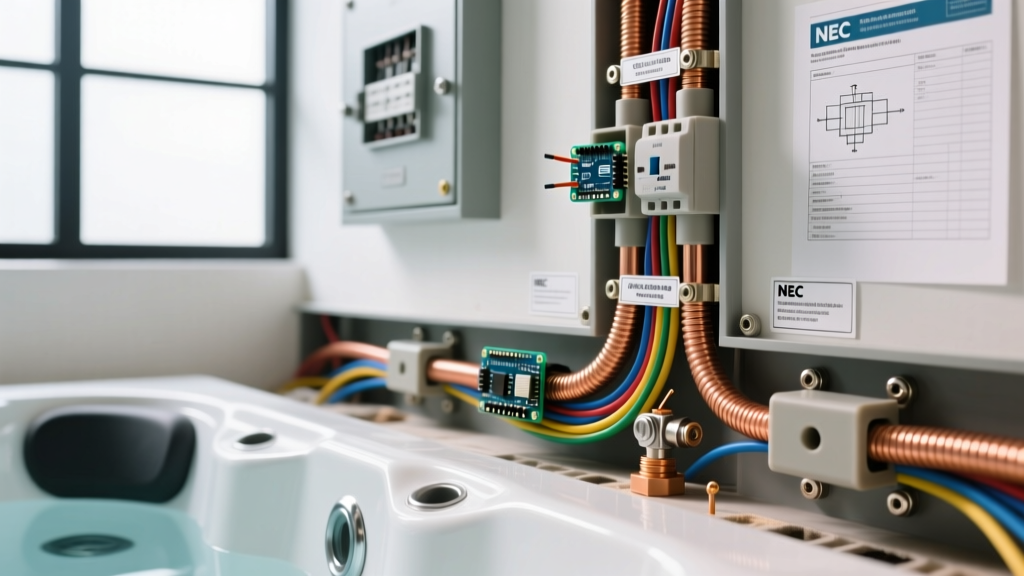
The National Fire Protection Association (NFPA) outlines the definitive rules for pools, spas, and fountains in NEC Article 680. Part IV of this article deals exclusively with spas and hot tubs. The code's primary objective is to eliminate voltage gradients in the water and surrounding wet areas. This is achieved through three main pillars: rapid fault interruption (GFCI), physical isolation (disconnects and conduit), and voltage equalization (bonding).
The 5-Point Inspector's Checklist
Inspectors do not just look at the panel; they trace the entire circuit from the breaker to the tub's control box. Here are the five critical checkpoints that dictate a pass or fail.
1. GFCI Protection and Panel Integration
Every electrical wiring for hot tub setup operating at 120V or 240V must be protected by a Class A Ground Fault Circuit Interrupter (GFCI). A Class A device trips when the ground-fault current reaches 4 to 6 milliamperes, a threshold specifically chosen to prevent lethal ventricular fibrillation. The Electrical Safety Foundation International (ESFI) emphasizes that standard breakers are entirely insufficient for wet environments.
- Breaker Selection: For a standard 50-amp, 240V spa, you must use a 2-pole GFCI breaker (e.g., Square D QO250GFI or Eaton BR250GFI). These typically cost between $115 and $160.
- Pigtail Termination: A common failure mode is miswiring the GFCI pigtail. The white pigtail must connect directly to the panel's neutral bus bar, not the equipment ground bar. Furthermore, the load-side neutral from the spa must connect to the breaker's neutral terminal, bypassing the panel's neutral bus entirely.
2. The Emergency Disconnect Switch
NEC 680.12 mandates a maintenance disconnecting means for the spa. This switch must be located within sight of the hot tub and at least 5 feet away from the water's edge.
Inspector Edge Case: Placing the disconnect 4.5 feet away to save conduit is an automatic red tag. The 5-foot rule ensures a person reaching for the switch is not standing in or touching the water. However, it must not be placed so far away that it is no longer "within sight" and readily accessible.
3. Equipotential Bonding vs. Equipment Grounding
The most misunderstood aspect of hot tub wiring is the difference between grounding and bonding. Grounding provides a path for fault current to trip the breaker. Bonding connects all conductive metal parts together so that no voltage difference can exist between them.
- The Bonding Grid: You must use an 8 AWG solid bare copper wire to bond all metal parts within 3 feet of the hot tub. This includes the tub's metal frame, the pump motor housing, the heater casing, metal piping, and any nearby metal railings or fences.
- Termination: The bonding wire must be attached to the spa's dedicated bonding lug using a listed copper-to-copper connector. It does not go back to the main electrical panel; it simply loops through all local metal components to equalize potential.
4. Conductor Routing and Conduit Rules
Outdoor wet locations prohibit the use of standard non-metallic (NM-B / Romex) cable. You must pull individual THWN-2 conductors through a raceway.
- Conduit Type: Schedule 80 PVC is required where the conduit is subject to physical damage (e.g., near the ground or walkways). Schedule 40 is acceptable only where elevated and protected.
- Conductor Count: A 240V spa with a 120V auxiliary (like a light or ozonator) requires four wires: two hots (Red, Black), one neutral (White), and one equipment ground (Green). All must be THWN-2 rated for wet environments.
5. Conduit Expansion and Weep Holes
Outdoor PVC conduit is subject to extreme thermal expansion. Inspectors will look for PVC expansion fittings on long runs (typically required every 25-30 feet depending on local temperature deltas). Additionally, where conduit enters the spa's control box or an outdoor junction box, it must be fitted with a duct seal or listed fitting to prevent moisture from migrating into the electrical enclosure.
Material Specifications & 2026 Cost Matrix
Budgeting for a compliant installation requires accounting for specialized wet-location materials. Below is a breakdown of standard material costs for a 50-amp, 60-foot run from the main panel to the hot tub.
| Component | Specification / Model | Est. Cost (2026) |
|---|---|---|
| 50A 2-Pole GFCI Breaker | Square D QO250GFI / Eaton BR250GFI | $115 - $160 |
| Conductors (50A) | 6 AWG THWN-2 Copper (4 wires) | $1.80 / ft |
| Bonding Wire | 8 AWG Solid Bare Copper | $1.20 / ft |
| Conduit | 1-inch Schedule 80 PVC | $4.50 / 10ft stick |
| Disconnect Enclosure | NEMA 3R Outdoor Rated (Non-Fused) | $45 - $75 |
| Expansion Fittings | PVC Expansion Joint (1-inch) | $18 - $25 each |
Note: Labor rates vary wildly by region, but expect licensed electrical labor for a compliant 50-amp spa circuit to range from $800 to $1,500, excluding the cost of the spa itself and any trenching required.
Common Failure Modes & Edge Cases
Even experienced electricians occasionally run afoul of Article 680. Avoid these frequent red-tag scenarios:
- Using UF-B Cable in Conduit: Underground Feeder (UF-B) cable is not rated for pulling through conduit in wet locations. The jacket traps moisture and degrades. Inspectors require individual THWN-2 wires.
- Bonding the Ground Rod: The equipotential bonding grid must not be connected to a separate ground rod. It must only bond the metal components together. Driving a separate rod near the spa creates a dangerous ground loop.
- Undersized Disconnect Wiring: If you install a 50A disconnect switch, the wire feeding through it must remain 6 AWG. Downgrading to 8 AWG between the disconnect and the spa control box is a violation unless the spa manufacturer's specific listing allows it.
Frequently Asked Questions
Can I use an existing 30-amp dryer outlet for my hot tub?
No. Most modern hot tubs require a dedicated 40-amp to 60-amp circuit. Furthermore, dryer outlets (NEMA 14-30) lack the required outdoor GFCI protection and emergency disconnect mandated by NEC 680. Sharing or repurposing circuits for wet locations is a severe code violation.
Does the equipotential bonding wire need to be insulated?
No. NEC 680.26 specifically requires the bonding conductor to be a solid 8 AWG bare copper wire. Insulation is not permitted for the exterior bonding grid, as it must be directly clamped to metal surfaces without the barrier of insulation.
What if my hot tub is 120V plug-and-play?
Plug-and-play spas (drawing less than 15 amps) must still be plugged into a GFCI-protected outdoor receptacle. The receptacle must be at least 5 feet from the water's edge, and the cord must not be buried or run through walls. For any hardwired 120V or 240V setup, the full Article 680 inspection checklist applies.