
The True Cost of Electrical Wiring to a Detached Garage in 2026
Running power to a detached structure is one of the most high-impact home improvement projects you can undertake, enabling everything from heavy-duty power tools to Level 2 electric vehicle (EV) charging. However, the cost of electrical wiring to garage structures varies wildly based on trenching distances, subpanel sizing, and material choices. In 2026, with fluctuating copper markets and updated National Electrical Code (NEC) adoptions, homeowners need precise data to budget accurately.
On average, expect to pay between $1,800 and $4,500 for a professional installation. A basic 60-amp direct burial setup sits at the lower end, while a 100-amp or 125-amp PVC conduit system designed for EV charging and climate control will push toward the higher end. This guide breaks down the exact material costs, labor rates, and code requirements you need to know before breaking ground.
2026 Cost Breakdown: Subpanel Size & Installation Method
The two primary variables dictating your final invoice are the amperage of the subpanel and the underground wiring method. Below is a detailed cost matrix based on a standard 50-foot trench run from the main service panel to a detached garage.
| Subpanel Size | Wiring Method | Material Cost | Labor & Trenching | Total Estimated Cost |
|---|---|---|---|---|
| 60-Amp | UF-B Direct Burial | $450 - $650 | $1,100 - $1,500 | $1,550 - $2,150 |
| 60-Amp | PVC Conduit + THWN-2 | $600 - $850 | $1,300 - $1,800 | $1,900 - $2,650 |
| 100-Amp | PVC Conduit + Aluminum | $750 - $1,000 | $1,500 - $2,200 | $2,250 - $3,200 |
| 100-Amp | PVC Conduit + Copper | $1,400 - $1,900 | $1,500 - $2,200 | $2,900 - $4,100 |
| 125-Amp | PVC Conduit + Aluminum | $900 - $1,300 | $1,800 - $2,600 | $2,700 - $3,900 |
*Note: Labor rates vary significantly by region. Urban centers with high prevailing wages may see labor costs 20-30% higher than the national averages listed above.
Material Deep Dive: Direct Burial vs. Conduit Systems
Choosing the right feeder cable is critical for longevity and future-proofing. The debate between direct burial and conduit systems is a common sticking point for DIYers and general contractors alike.
UF-B Cable (Direct Burial)
Underground Feeder (UF-B) cable is a self-contained, moisture-resistant cable that can be buried directly in the earth without a conduit.
- Pros: Lower material cost, faster installation (no pipe gluing or wire pulling), and requires a narrower trench.
- Cons: Vulnerable to accidental shovel strikes, impossible to upgrade without digging a new trench, and requires a deeper burial depth (24 inches minimum per NEC Article 300.5).
- Best For: Basic 60A lighting and standard receptacle setups where no future heavy loads are anticipated.
Schedule 80 PVC Conduit with THWN-2 Wire
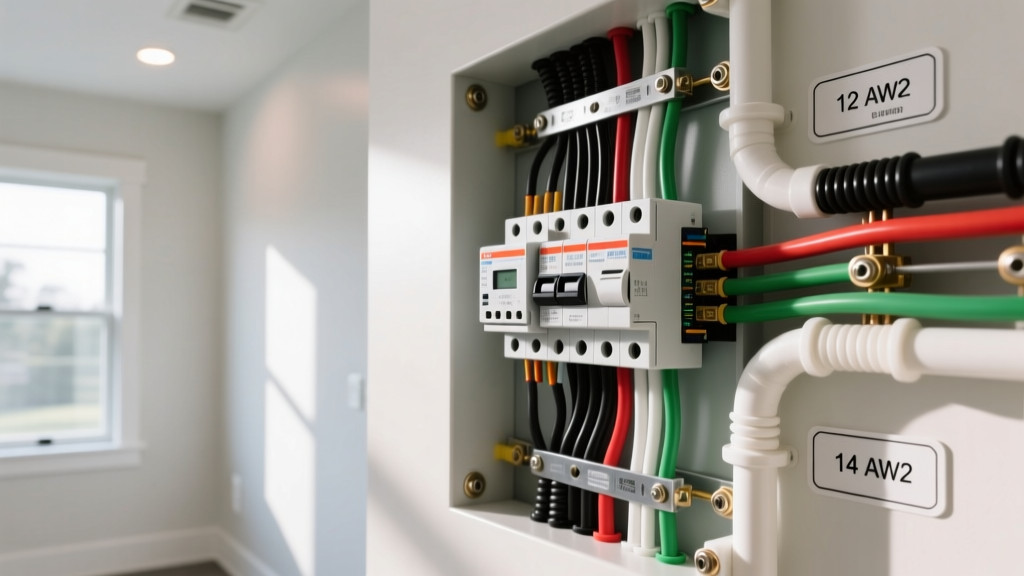
Running individual THWN-2 (or XHHW-2) conductors inside rigid Schedule 80 PVC conduit is the professional standard for modern garage feeds.
- Pros: Ultimate protection against physical damage, allows for future wire upgrades (e.g., pulling thicker wire for an EV charger without re-trenching), and requires a shallower trench (18 inches minimum).
- Cons: Higher upfront material and labor costs, requires careful bending radius calculations, and condensation can build up inside the pipe if not properly sealed.
- Best For: 100A+ subpanels, EV charging setups, and areas with heavy landscaping or future excavation plans.
Expert Insight: In 2026, the price gap between copper and aluminum feeder wire remains significant. For a 100-amp feeder, using 1/0 AWG Aluminum XHHW-2 wire will save you roughly $400 to $600 in materials compared to 3 AWG Copper THWN-2, with virtually no performance loss for a 50-foot run. Ensure your subpanel lugs are rated for aluminum (ALR) to prevent oxidation issues.
The EV Charger Factor: Why 100A is the New Standard
If you are planning electrical wiring to garage spaces in 2026, you must account for Electric Vehicle adoption. According to the U.S. Department of Energy, Level 2 home charging is the most efficient way to maintain battery health and reduce charging times.
A standard Level 2 EV charger (such as the ChargePoint Home Flex or Tesla Wall Connector) can draw up to 48 Amps continuously. Under NEC Article 210.20, continuous loads (those operating for 3 hours or more) must be derated to 80% of the breaker's capacity. Therefore, a 48A charger requires a dedicated 60-Amp breaker.
If you install a 60-Amp subpanel, the EV charger alone will consume the entire capacity of the panel, leaving zero headroom for garage lighting, receptacles, a mini-split HVAC system, or a welder. Upgrading to a 100-Amp or 125-Amp subpanel adds only $500 to $900 to the total project cost but provides the necessary headroom for simultaneous tool use and vehicle charging.
Trenching and Site Preparation Costs
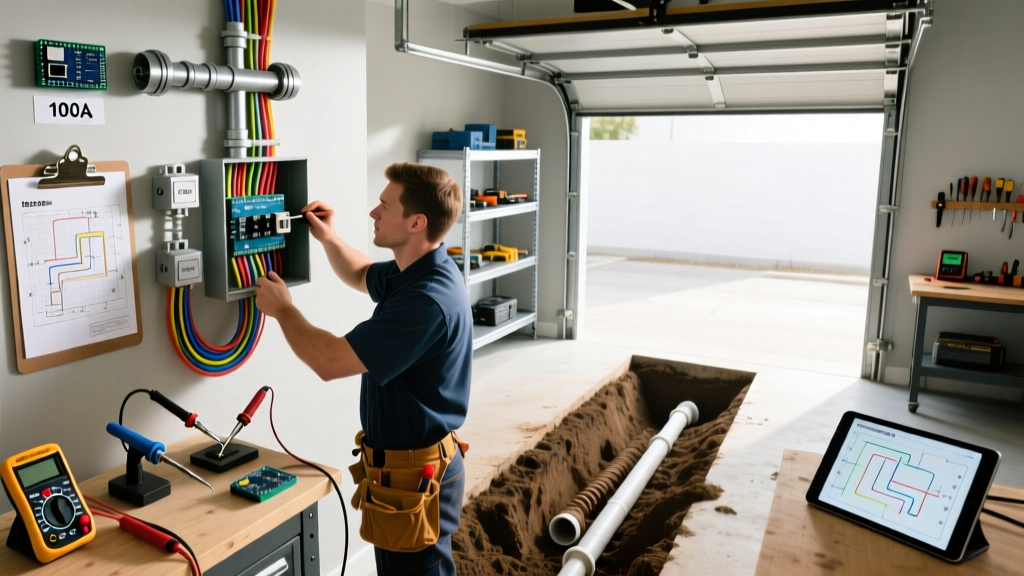
The physical act of digging the trench is often the most labor-intensive portion of the project. Trenching costs are calculated per linear foot and depend heavily on soil composition and local labor rates.
- Soft Soil / Loam: $8 to $12 per linear foot.
- Clay / Rocky Soil: $15 to $25+ per linear foot.
- Concrete / Asphalt Cutting: $25 to $40 per linear foot (requires wet sawing and patching).
DIY Trenching Warning: While renting a walk-behind trencher ($150-$250/day) can save money, you must call 811 before digging to have underground utilities marked. Hitting a main gas or fiber-optic line can result in tens of thousands of dollars in liability and severe safety hazards.
Critical NEC Code Requirements for Detached Structures
Compliance with the National Electrical Code is non-negotiable. The National Fire Protection Association (NFPA) outlines strict rules for detached structures to prevent fire and shock hazards. Key requirements for your 2026 installation include:
- Grounding Electrode System (NEC 250.32): A detached garage with a subpanel requires its own grounding system. This typically involves driving two 5/8-inch copper-clad steel ground rods at least 8 feet deep and spaced 6 feet apart, connected to the subpanel's ground bar with 6 AWG bare copper wire. If the garage has a new concrete slab, a Ufer ground (concrete-encased electrode) is superior and often preferred by inspectors.
- Separation of Neutral and Ground (NEC 250.142): Unlike your main service panel, the neutral and ground bars in a detached garage subpanel must remain isolated. A bonding screw or strap must be removed. Failing to do this creates a parallel neutral path, energizing the grounding system and creating a severe shock hazard.
- GFCI and AFCI Protection (NEC 210.8 & 210.12): All 125-volt, single-phase, 15- and 20-ampere receptacles in a garage must be GFCI protected. Furthermore, most modern jurisdictions require Arc-Fault Circuit Interrupter (AFCI) protection for garage branch circuits to mitigate fire risks from damaged cords.
- Main Disconnecting Means: The subpanel in the detached structure must have a main disconnect switch capable of shutting off all power to the building in a single motion.
Frequently Asked Questions
Can I run electrical wiring to my garage myself?
While DIYers can handle the trenching and conduit assembly, the final terminations at the main service panel and subpanel should be performed by a licensed electrician. Working inside a live 200-Amp main panel carries a high risk of arc flash and fatal electrocution. Furthermore, most municipalities require a licensed professional to pull the electrical permit and schedule the rough-in and final inspections.
Do I need a permit to run power to a detached garage?
Yes. Adding a new subpanel and running underground feeders is considered a major electrical alteration. Permits typically cost between $75 and $250 depending on your local jurisdiction. Skipping the permit can void your home insurance in the event of an electrical fire and cause significant delays during a future home sale.
How do I calculate the exact wire size for my 100-foot run?
For runs exceeding 50 feet, voltage drop becomes a critical factor. The NEC recommends keeping voltage drop below 3% for branch circuits and 5% for the entire feeder and branch combined. For a 100-foot run to a 100-Amp subpanel, standard 1/0 AWG Aluminum may experience a voltage drop exceeding 3%. In this scenario, you should upsize to 2/0 AWG or 3/0 AWG Aluminum THWN-2 to ensure your EV charger and heavy tools receive adequate voltage under load. Always use an online voltage drop calculator verified against NEC Chapter 9, Table 8 resistance values.
For more detailed cost benchmarks and regional labor variations, resources like HomeGuide's electrical cost database provide excellent localized estimates to help you negotiate with local contractors.