
Understanding Electricity Wiring Pipe: More Than Just a Sleeve
When electricians, inspectors, and DIYers refer to an electricity wiring pipe, they are using a layman’s term for electrical conduit. Far from being a simple protective sleeve, conduit is a highly regulated raceway system designed to protect conductors from physical damage, moisture, and chemical corrosion, while also providing a pathway for future wire upgrades. Under the National Electrical Code (NEC), the selection, installation, and fill capacity of your electricity wiring pipe are strictly governed to prevent overheating, insulation degradation, and catastrophic electrical fires.
In this code and standards explainer, we will dissect the most common conduit types, break down the mathematics of conduit fill, and highlight the specific NEC articles you must follow to ensure a safe, inspection-ready installation.
The Big Four: NEC-Approved Electricity Wiring Pipe Types
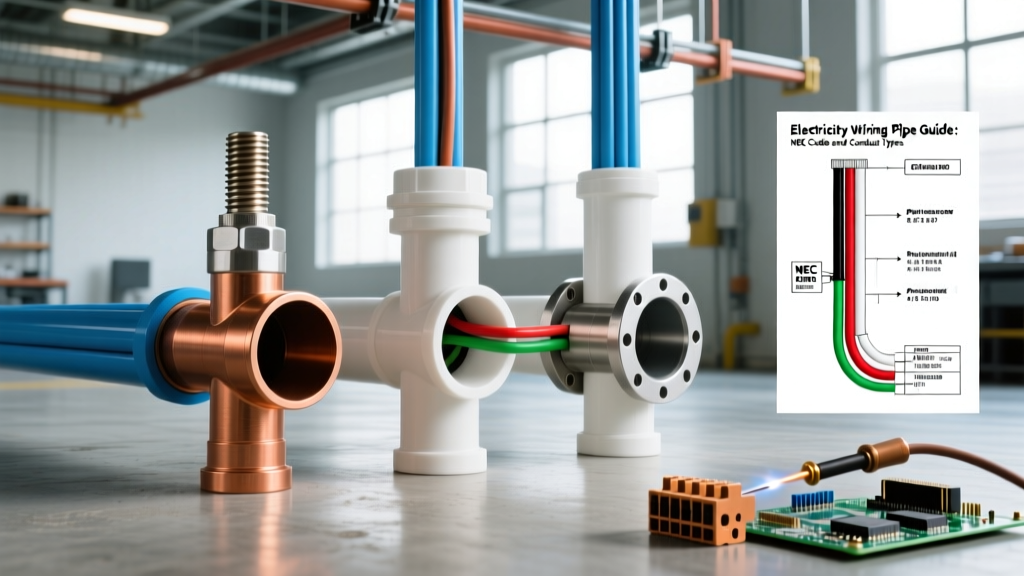
Choosing the correct pipe depends on your environment (wet, dry, embedded in concrete, or exposed to physical damage). Here is how the NEC categorizes the primary raceway systems used in residential and commercial wiring.
1. Electrical Metallic Tubing (EMT) – NEC Article 358
EMT is the most common electricity wiring pipe for exposed interior commercial and residential runs. It is lightweight, thin-walled, and typically made of galvanized steel or aluminum. Because of its thin walls, EMT cannot be threaded; it requires set-screw or compression fittings.
- Best For: Exposed indoor runs, unfinished basements, garages, and commercial drop ceilings.
- Code Restriction: NEC 358.12 prohibits EMT from being used where subject to severe physical damage or in cinder-concrete buried in cinder fill without special corrosion protection.
2. Rigid Polyvinyl Chloride (PVC) – NEC Article 352
Schedule 40 and Schedule 80 PVC pipes are nonmetallic, corrosion-resistant, and highly affordable. Schedule 40 is standard for underground and embedded-in-concrete use, while Schedule 80 is mandated where the pipe is exposed to physical damage (e.g., ascending a wall from an underground trench).
- Best For: Underground service laterals, concrete slab embedments, and highly corrosive environments.
- Code Restriction: PVC cannot be used for support of luminaires or where exposed to physical damage unless Schedule 80 is utilized.
3. Rigid Metal Conduit (RMC) – NEC Article 344
RMC is the heavyweight champion of electricity wiring pipes. It features thick, threaded steel walls capable of withstanding extreme physical impact and blast zones. It is significantly more expensive and labor-intensive to install than EMT.
- Best For: Heavy industrial facilities, hazardous (classified) locations, and exterior runs subject to vehicular impact.
4. Electrical Nonmetallic Tubing (ENT) – NEC Article 362
Often called "smurf tube" due to its bright blue color, ENT is a flexible, corrugated plastic tubing. It is primarily used in residential construction, routed through concrete blocks or frame walls before drywall is installed.
- Best For: Concealed residential runs, low-voltage, and retrofit scenarios where rigid pipe cannot be easily fished.
Conduit Comparison Matrix (2026 Market Data)
| Conduit Type | NEC Article | Wet Location Approved? | Avg. Cost (10ft, 3/4") | Primary Application |
|---|---|---|---|---|
| EMT (Steel) | Art. 358 | Yes (with rain-tight fittings) | $11.50 - $14.00 | Exposed indoor / Commercial |
| PVC Sch 40 | Art. 352 | Yes | $4.50 - $6.00 | Underground / Concrete embed |
| PVC Sch 80 | Art. 352 | Yes | $9.00 - $12.00 | Exposed exterior / Physical damage |
| RMC (Steel) | Art. 344 | Yes | $38.00 - $45.00 | Industrial / Hazardous locations |
| ENT (Flex) | Art. 362 | No (Dry locations only) | $7.00 - $9.00 | Concealed residential walls |
Conduit Fill Capacity: The Mathematics of Wire Pulling
One of the most frequently cited code violations involves overstuffing an electricity wiring pipe. The NEC mandates strict fill limits to ensure heat dissipation and to prevent insulation damage during wire pulling. These rules are found in NEC Chapter 9, Table 1.
⚠️ The 40% Rule: When pulling three or more current-carrying conductors through a conduit, the combined cross-sectional area of the wires (including insulation) cannot exceed 40% of the conduit’s internal cross-sectional area.
Understanding the Jam Ratio
Beyond standard fill percentage, expert electricians calculate the Jam Ratio when pulling three conductors through a bend. If three wires sit side-by-side in a straight pipe, they pull easily. However, at a 90-degree sweep, the wires can wedge against each other and the conduit wall, locking up completely.
The formula is: J = 1.05 x (Conduit Inside Diameter / Conductor Outside Diameter)
- If J is between 2.8 and 3.2, the wires are at a high risk of jamming at the bend.
- Solution: Upsize the electricity wiring pipe by one trade size, or use a larger radius sweep bend to alleviate sidewall pressure.
Support and Securing: How Often Must You Strap?
An electricity wiring pipe must be securely fastened to the building structure to prevent sagging, stress on box terminations, and accidental dislodging. NEC Article 300.11 requires raceways to be securely fastened in place. The specific distances vary by material and trade size.
EMT Support Distances (NEC 358.30)
- Must be secured at least every 10 feet.
- Must be secured within 3 feet of every outlet box, junction box, device box, cabinet, conduit body, or other EMT termination.
PVC Support Distances (NEC 352.30)
PVC requires much closer support intervals due to its flexibility and thermal expansion characteristics:
- 1/2" to 1" Trade Size: Secure every 3 feet.
- 1-1/4" to 2" Trade Size: Secure every 5 feet.
- 2-1/2" to 3" Trade Size: Secure every 6 feet.
- 3-1/2" to 6" Trade Size: Secure every 7 feet.
The Hidden Trap: PVC Expansion and Contraction
A critical edge case that routinely causes failed inspections and shattered pipes is ignoring thermal expansion in PVC electricity wiring pipes. PVC expands and contracts significantly with temperature fluctuations—approximately 3.38 inches per 100 feet for every 100°F change in temperature.
According to NEC 352.44, expansion fittings are mandatory if the expected length change is 1/4 inch (6 mm) or greater. If you are running a 50-foot exterior PVC conduit on a wall in a climate where temperatures swing from 20°F in winter to 100°F in summer (an 80°F delta), the pipe will expand and contract by roughly 1.35 inches. Without an expansion joint, the pipe will buckle, tear out of its straps, or snap at the glued fittings.
Grounding and Bonding Rules
The material of your electricity wiring pipe directly impacts your grounding strategy.
- Metallic Raceways (EMT, RMC, IMC): When installed with listed, tight fittings, the metal pipe itself serves as the Equipment Grounding Conductor (EGC) per NEC 250.118. You do not strictly need to pull a separate green or bare copper ground wire inside the pipe, though many commercial specs require it for redundancy.
- Nonmetallic Raceways (PVC, ENT): Because plastic cannot conduct fault current, you must pull a dedicated EGC (bare copper or green insulated) inside the conduit alongside your current-carrying conductors to ensure a low-impedance fault path back to the panel.
Common Code Violations to Avoid
Based on field inspections and OSHA wiring method standards, avoid these frequent electricity wiring pipe mistakes:
- Using Standard EMT in Direct Burial: EMT will corrode rapidly if buried directly in soil. You must use PVC, RMC, or IMC for direct burial applications.
- Missing Bushings on RMC/IMC: The threaded ends of rigid metal conduit are sharp. NEC 373.6(C) requires an insulated bushing to prevent the metal edge from slicing into wire insulation during pulling.
- Exceeding 360 Degrees of Bends: NEC Chapter 9 dictates that there shall not be more than the equivalent of four quarter bends (360 degrees total) in any single run of conduit between pull points or boxes. This prevents excessive pulling tension.
- PVC Glue (Solvent Weld) Errors: Failing to prime and fully seat PVC conduit results in moisture ingress and internal ridges that strip wire insulation during pulls.
Final Thoughts on Raceway Compliance
Selecting the correct electricity wiring pipe is about balancing environmental protection, physical durability, and thermal management. Whether you are routing Schedule 40 PVC under a driveway or bending EMT for an exposed basement workshop, strict adherence to NFPA 70 (National Electrical Code) fill tables and support spacing is non-negotiable. Always calculate your conduit fill before purchasing materials, and account for thermal expansion on all exterior nonmetallic runs to ensure a system that passes inspection and stands the test of time.