
The Foundation of North American Branch Circuits
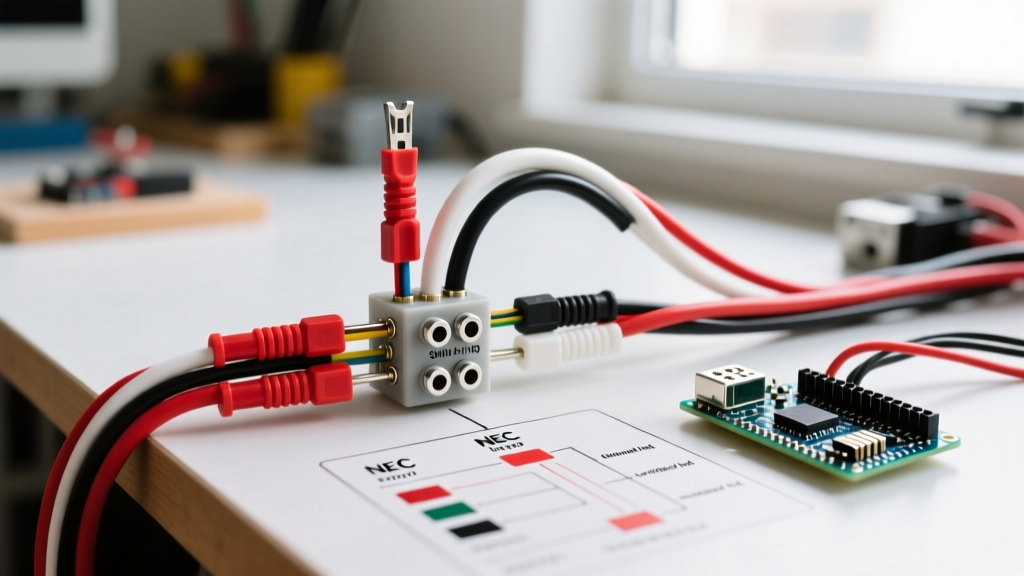
When you strip back the PVC jacket of a standard NM-B (Non-Metallic Sheathed) cable, you are typically greeted by the classic residential wiring triad: black, white, and red conductors, alongside a bare copper ground. While most DIYers and apprentice electricians learn early on that 'black is hot and white is neutral,' the National Electrical Code (NEC) dictates a far more rigorous and nuanced framework for how these colors must be utilized, identified, and protected. Understanding the strict code requirements for electrical wiring red white black configurations is critical for passing inspections, ensuring system longevity, and preventing catastrophic electrical fires.
In this code and standards explainer, we break down the exact NEC articles governing these three primary conductors, explore the physics of Multi-Wire Branch Circuits (MWBC), and detail the severe failure modes that occur when color codes are ignored or misapplied.
Decoding the Core Triad: NEC Definitions and Applications
The NEC does not simply use colors for convenience; it uses them to establish the legal and physical role of each conductor within a circuit. According to National Fire Protection Association (NFPA) standards outlined in NEC Article 100 and Article 200, the roles are strictly defined.
1. The Black Conductor: Ungrounded (Hot)
Black is the standard color for the primary ungrounded conductor. It carries the full 120V alternating current from the breaker panel to the load (outlet, switch, or appliance). Under NEC 210.5(C), the ungrounded conductors of a branch circuit must be identified by phase or line. In a standard 120V, 15A or 20A single-pole circuit, black is universally recognized as the continuous hot feed.
2. The White Conductor: Grounded (Neutral)
White (or gray) is legally reserved for the grounded conductor, commonly called the neutral. Its primary job is to provide the return path for the current back to the service panel's neutral bus bar, completing the 120V circuit. NEC Article 200 strictly mandates the use and identification of grounded conductors. The white wire is bonded to the earth ground at the main service disconnect, which is why touching a properly functioning neutral wire under normal load conditions typically does not result in a shock—though it should never be treated as safe to touch while energized.
3. The Red Conductor: Secondary Ungrounded (Switched/Traveler)
Red is the secondary ungrounded conductor. In a 3-wire cable (like 14/3 or 12/3 NM-B), the red wire is utilized for specific advanced circuit topologies. Its most common applications include:
- Switch Loops and 3-Way Switches: Acting as a 'traveler' wire between two 3-way switches, or carrying the switched-hot feed down to a light fixture.
- Multi-Wire Branch Circuits (MWBC): Acting as the second hot leg on a different phase to share a single neutral.
- 240V Appliances: Providing the second 120V leg for baseboard heaters or window AC units that require 240V but do not require a neutral.
Multi-Wire Branch Circuits (MWBC): The Red and Black Partnership
The most technically demanding application of electrical wiring red white black setups is the Multi-Wire Branch Circuit (MWBC). An MWBC uses two ungrounded conductors (black and red) and one shared grounded conductor (white) to supply two separate 120V circuits while utilizing only a single 3-wire cable.
The Physics of the Shared Neutral
For an MWBC to be safe and code-compliant, the black and red wires must be connected to opposite phases (Line 1 and Line 2) of the split-phase 120/240V residential service. Because the two 120V legs are 180 degrees out of phase, the return currents on the shared white neutral cancel each other out. If the black leg draws 15A and the red leg draws 15A, the white neutral carries exactly 0A (the vector difference).
Critical Failure Mode: Same-Phase Connection
If an electrician incorrectly lands both the black and red conductors on breakers fed by the same phase (e.g., both on Line 1), the white neutral no longer carries the vector difference. Instead, it carries the arithmetic sum. If both circuits draw 15A, the 14 AWG white neutral carries 30A. Since a 14 AWG copper wire is only rated for 15A, the neutral insulation will melt, leading to a catastrophic arc fault or fire inside the wall cavity, all while the 15A breakers remain completely untripped because they only monitor the hot legs.
NEC 210.4(B) Disconnecting Means: To prevent this exact scenario, the NEC requires that all ungrounded conductors of an MWBC be provided with a means to disconnect simultaneously. In modern panels, this requires a factory-installed handle tie on two single-pole breakers or the use of a dedicated 2-pole breaker.
When White Isn't Neutral: Re-identification Rules
One of the most frequently violated codes in residential wiring involves the misuse of the white wire. NEC 200.7 strictly governs the use of white or gray insulation. However, there are specific scenarios where a white wire must carry ungrounded (hot) current. In these cases, the code demands permanent re-identification.
| Scenario | NEC Reference | Required Re-identification Method |
|---|---|---|
| 240V Appliance (No Neutral) | NEC 210.5(C)(2) | Wrap both ends of the white wire with black or red electrical tape, or heat-shrink tubing, to indicate it is an ungrounded hot conductor. |
| Switch Loop (Feed to Switch) | NEC 404.2(A) | The white wire used as the hot feed down to a switch must be permanently re-identified (black/red tape) at the termination points. The returning switched-hot must be the black wire. |
| 3-Way Switch Traveler | NEC 200.7(C)(1) | If white is used as a traveler, it must be permanently re-identified with a color other than white, gray, or green at every point where the conductor is visible and accessible. |
2026 Cable Specifications, Pricing, and AFCI Compatibility
Material selection for red/white/black wiring configurations requires understanding current market specs and modern breaker compatibility. As of early 2026, a 250-foot coil of Southwire Romex SIMpull 12/3 NM-B cable averages between $155 and $175, heavily dependent on copper spot markets. The SIMpull jacket reduces friction by up to 30%, a critical feature when pulling 3-wire cables through crowded remodel junction boxes.
The AFCI/GFCI Shared Neutral Problem
In 2026, AFCI (Arc-Fault Circuit Interrupter) and GFCI (Ground-Fault Circuit Interrupter) protection is required in almost all living spaces per NEC 210.12 and 210.8. Standard single-pole AFCI/GFCI breakers will trip immediately on an MWBC. Because these breakers measure the current differential between the hot and neutral, the shared neutral returning current from the adjacent red-leg circuit looks like a massive ground fault or arc anomaly to the single-pole breaker.
The Solution: Electricians must use 2-pole AFCI/GFCI breakers (costing $95-$120 each in 2026) which monitor both the black and red hot legs simultaneously against the shared white neutral. Attempting to bypass this by pigtailing neutrals in the panel is a severe code violation and a major safety hazard.
Troubleshooting Common Red/Black/White Wiring Faults
When diagnosing existing 3-wire circuits, electrical professionals rely on specific testing protocols to identify code violations and physical faults. The U.S. Consumer Product Safety Commission (CPSC) notes that improper wiring modifications are a leading cause of residential electrical fires.
- Reversed Polarity on Switch Loops: If a homeowner replaces a smart switch and fails to identify the re-identified white wire as the line-in, the switch may remain energized even when turned off, creating a shock hazard during bulb replacement.
- Open Neutral on MWBC: If the white wire connection fails at a receptacle (often due to using back-stab push-in connectors instead of screw terminals), the two 120V circuits effectively become a 240V series circuit. Plugging a 120V TV into the black leg and a 120V lamp into the red leg will cause the voltage to divide inversely by resistance, potentially sending 200V+ to the TV and destroying its power supply instantly.
- Bootleg Grounds via Neutral: In older homes, improper jumper wires between the white neutral and the bare copper ground at the receptacle will cause GFCI breakers to trip randomly and create a dangerous shock path if the neutral is ever severed upstream.
Summary of Best Practices
Mastering electrical wiring red white black configurations goes far beyond memorizing basic color codes. It requires a deep understanding of split-phase physics, strict adherence to NEC re-identification mandates, and the proper application of modern 2-pole AFCI protection. Whether you are running a new 12/3 MWBC to a kitchen island or troubleshooting a 3-way switch loop, always verify phase relationships with a digital multimeter, torque all terminal screws to manufacturer specifications, and ensure every shared neutral is properly handle-tied at the breaker panel. For further reading on residential wiring safety standards, consult the latest guidelines published by the Occupational Safety and Health Administration (OSHA) regarding wiring methods and component safety.