
Redefining Basic Electrical Wiring in Commercial Spaces
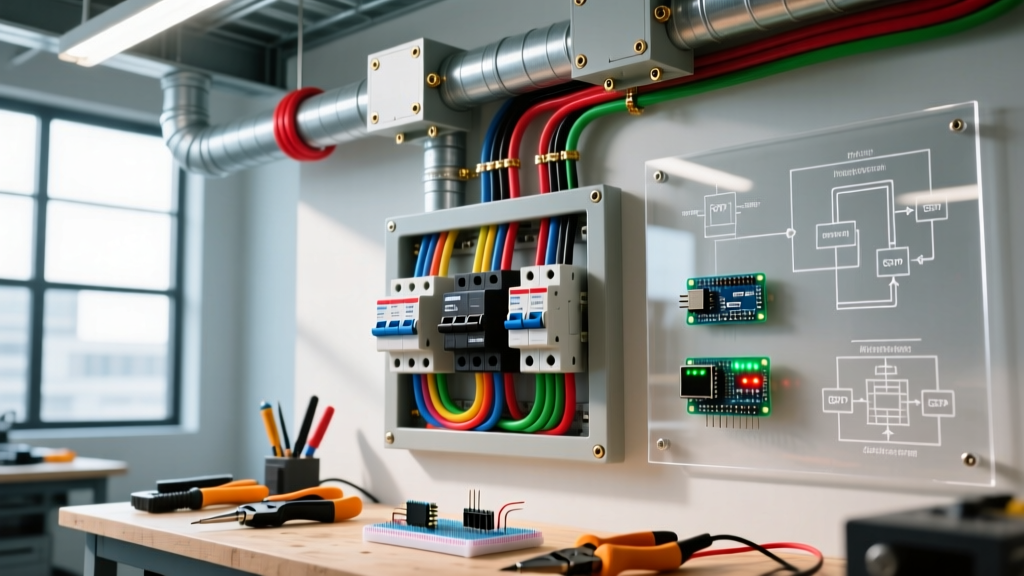
When transitioning from residential DIY projects to commercial construction, the concept of basic electrical wiring changes dramatically. In a home, basic wiring typically involves running non-metallic (NM-B) sheathed cable, wiring 120/240V split-phase panels, and securing Romex to wooden studs. In a commercial environment, 'basic' means routing individual THHN/THWN-2 conductors through steel conduit, terminating 120/208V 3-phase Wye systems, and adhering to rigorous National Electrical Code (NEC) torque specifications.
As of the 2026 construction cycle, commercial electricians must navigate higher material costs—copper THHN averages $0.45 to $0.70 per foot depending on gauge—and stricter energy codes. This guide strips away the fluff and provides a professional, actionable framework for executing fundamental commercial wiring rough-ins, panel terminations, and branch circuit routing.
Residential vs. Commercial: A Structural Comparison
Understanding the physical and electrical differences is the first step in mastering commercial installations. The table below outlines the core deviations in standard wiring methodologies.
| Feature | Residential Wiring | Commercial Wiring |
|---|---|---|
| Wiring Method | NM-B (Romex) Cable | THHN/THWN-2 in EMT or Rigid Conduit |
| Standard Voltage | 120/240V (1-Phase, 3-Wire) | 120/208V or 277/480V (3-Phase, 4-Wire Wye) |
| Overcurrent Protection | Standard Thermal-Magnetic Breakers | Thermal-Magnetic, Electronic Trip, or Bolted Pressure |
| Support/Mounting | Wood/Metal Studs (Staples) | Unistrut, Threaded Rod, Beam Clamps, Trapeze Hangers |
| Grounding | Bare Copper in NM-B / Ground Screw | Insulated Green THHN / Isolated Ground Receptacles |
Essential Tools and Materials for the Commercial Rough-In
You cannot execute commercial wiring with a standard residential toolkit. Precision and physical leverage are paramount. Ensure your inventory includes the following commercial-grade essentials:
- Conduit Benders: Klein Tools 56207 (3/4-inch EMT bender) and 56210 (1-inch EMT bender). Aluminum shoes are preferred for reducing fatigue during repetitive offsets.
- Wire Stripping & Termination: Ideal Industries 45-091 Reflex wire strippers. For terminations, a calibrated torque screwdriver (like the CDI 401SM) is legally required by NEC 110.14(D) for terminals rated 100A or less.
- Pulling Lubricant: Ideal 74-0781 Yellow 77 premium pulling compound. Never dry-pull THHN through EMT; friction can micro-tear the nylon jacket, leading to ground faults.
- Fish Tapes & Vacuum: A 200-foot steel fish tape (Klein 56332) paired with a rigid PVC conduit vacuum setup for long runs exceeding 75 feet.
Step-by-Step Commercial Circuit Routing
1. Layout and Conduit Mounting
Unlike residential wiring where cables are snaked through drilled studs, commercial conduit must be surface-mounted or hung from the structural deck. Use a laser level to mark a uniform height (typically 96 to 108 inches above the finished floor for exposed retail spaces). Mount 3/4-inch EMT using 1-hole steel straps or Unistrut channels (P1000) anchored with 3/8-inch wedge anchors into concrete or #12 self-drilling tek screws into steel joists. Maintain a strict 10-foot support interval and secure within 3 feet of every junction box, as mandated by NEC Article 358.
2. Bending Offsets and Saddles
Commercial spaces are dense with HVAC ductwork, fire sprinkler mains, and plumbing. You will frequently need to bend offsets to navigate these obstacles. For a standard 45-degree offset using 3/4-inch EMT, the shrink constant is 3/8 inch per inch of offset depth. If you need to bypass a 4-inch pipe, your total shrink will be 1.5 inches. Measure precisely, mark the conduit with a pencil, and use the dedicated offset marks on your bender shoe to maintain a smooth, code-compliant sweep that won't snag wire during the pull.
3. Pulling Conductors and Managing Fill Capacity
Before pulling, verify your conduit fill. According to NEC Chapter 9, Table 1, when pulling three or more conductors into a single conduit, the maximum allowable fill is 40%. For 3/4-inch EMT, this means you can comfortably pull four #12 AWG THHN wires (three phases/neutral plus ground) or up to sixteen #12 AWG wires. Always leave a dedicated pull string (mule tape) in the conduit for future low-voltage or circuit expansions.
Navigating NEC Code Requirements
Commercial electrical inspectors are notoriously strict regarding code compliance. Two critical areas frequently flagged during 2026 rough-in inspections include:
Inspector Alert: Torque Verification. Under NEC 110.14(D), electricians must use a calibrated torque tool to tighten panelboard lugs and breaker terminals to the manufacturer's specified inch-pound rating. Failing to provide torque cards or using 'feel' instead of a calibrated tool is an automatic inspection failure in most commercial jurisdictions.
Additionally, NFPA 70 (National Electrical Code) Article 210.8 now heavily mandates Ground-Fault Circuit Interrupter (GFCI) protection for commercial receptacles rated 150V to ground or less, 50A or less. This includes single-phase and 3-phase receptacles in areas like retail floors, breakrooms, and maintenance closets. Ensure your panel schedule accounts for 2-pole GFCI breakers where necessary, as they require significantly more physical space in the panelboard gutter.
Advanced Troubleshooting: The Triplen Harmonic Threat
One of the most dangerous failure modes in modern commercial basic electrical wiring is neutral overloading due to non-linear loads. In a 120/208V 3-phase Wye system, traditional linear loads (like incandescent lighting or resistive heaters) cancel out neutral current. However, modern commercial spaces are packed with LED drivers, variable frequency drives (VFDs), and server power supplies.
These solid-state devices draw current in short, high-amplitude pulses, creating 'triplen harmonics' (3rd, 9th, 15th harmonics). Instead of canceling out on the neutral bus, these harmonic currents add up arithmetically. It is entirely possible to have 20 amps of balanced current on Phases A, B, and C, but 60 amps of harmonic current on a shared #12 AWG neutral wire, leading to melted insulation and catastrophic fires.
The Pro Solution: When designing or wiring commercial office spaces or data centers, always specify a '200% Neutral' panelboard (which features a physically oversized neutral busbar) and consider running a dedicated, oversized neutral conductor back to the panel for heavily loaded lighting circuits. For deeper commercial safety standards regarding electrical infrastructure, refer to the guidelines published by OSHA's Electrical Safety division.
Commercial Wiring FAQ
Can I use residential NM-B Romex in a commercial drop ceiling?
No. NEC Article 334.12 strictly prohibits the use of NM-B cable in commercial spaces where the building is constructed of non-combustible materials, or above drop ceilings used for environmental air handling (plenum spaces). You must use THHN in metal conduit or, in specific plenum-rated scenarios, MC (Metal Clad) cable with a rated plenum jacket.
Why do commercial panels use white and gray tape on phase wires?
Commercial 3-phase panels require phase identification. While residential uses black, red, and blue for hot legs, commercial 120/208V systems typically mandate Black, Red, and Blue for phases A, B, and C respectively. For 277/480V systems, the standard phase colors are Brown, Orange, and Yellow. Electricians use high-quality vinyl phase tape (like 3M Super 33+) to identify conductors at both the panel and the termination point to ensure consistent phasing across the entire facility.
What is the voltage drop limit for commercial branch circuits?
While the NEC recommends a maximum 3% voltage drop for branch circuits and 5% total for feeder and branch combined (Informational Note to NEC 210.19), commercial engineers often design to stricter 1.5% limits for sensitive IT and medical equipment. For a 200-foot run on a 20A, 120V circuit, you must upsize from #12 AWG to #8 AWG copper to maintain a voltage drop under 2%.
Final Thoughts on Commercial Execution
Mastering basic electrical wiring in a commercial setting is less about memorizing color codes and more about understanding the physical infrastructure, thermal dynamics, and strict code frameworks that keep large-scale buildings safe. By investing in commercial-grade conduit tools, adhering strictly to torque specifications, and anticipating harmonic loads, you transition from a residential wire-puller to a true commercial electrical professional.